Index
Index
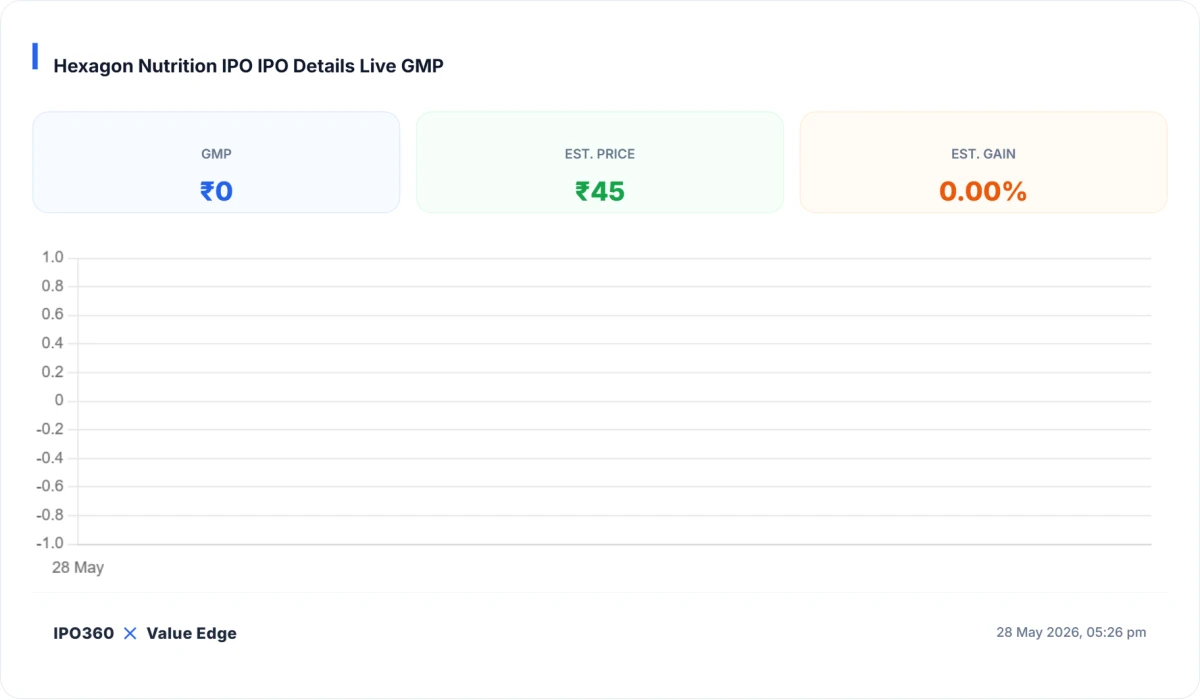
Before an IPO officially lists on NSE or BSE, there is an unofficial market where investors quietly trade its shares at a price nobody regulates — and that price often tells you more about market sentiment than anything else. That price is called the Grey Market Premium, or GMP. If you have been tracking IPOs and kept seeing "GMP: ₹45" on platforms and wondered what it means, this guide breaks it all down.
What Exactly is IPO GMP?
GMP stands for Grey Market Premium. It is the difference between an IPO's official issue price and the informal price at which its shares (or applications) are being bought and sold before listing.
This trading happens in what is called the grey market — an unregulated, over-the-counter market where buyers and sellers transact IPO applications and shares privately, completely outside the stock exchanges. It is not illegal in India, but it operates beyond SEBI's oversight, which means zero investor protection if something goes wrong.
| Term | What it means | Example |
|---|---|---|
| Issue Price | Official price set by the company | ₹139 |
| GMP | Extra amount being traded in grey market | ₹45 |
| Est. Listing Price | Issue Price + GMP | ₹184 |
| Est. Gain % | (GMP ÷ Issue Price) × 100 | ~32% |
When you see "GMP: ₹45" on IPO360 or any tracking platform, it means grey market participants believe the stock will list approximately ₹45 above its official issue price.
How is GMP Formed? Step-by-Step
GMP is not officially calculated by anyone. It emerges organically from demand and supply in the grey market, similar to how any informal price gets discovered.
Step 1 — IPO is announced. A company files its Red Herring Prospectus (RHP) with the exchange and announces its price band.
Step 2 — Grey market dealers start collecting orders. Even before the IPO opens for subscription, informal dealers begin gauging buying interest from investors who expect the stock to list higher.
Step 3 — A going rate emerges. Based on the volume of orders, a consensus informal price develops. This premium above the issue price is the GMP.
Step 4 — GMP fluctuates daily. As the subscription period progresses and data on actual subscription levels comes in, the GMP moves up or down based on:
- Subscription levels (more demand = higher GMP)
- Broader market conditions (Nifty up or down)
- Fresh news about the company
- Competing IPOs open in the same week
Kostak Rate and Subject-to-Sauda — What Are They?
Two related terms you will frequently see alongside GMP on IPO tracking platforms:
Kostak Rate
Kostak is the premium a grey market buyer pays to purchase your entire IPO application before allotment is decided. If the Kostak rate is ₹800, a dealer will pay you ₹800 for your application regardless of whether you get allotment or not. It is a risk-free way to profit from a highly demanded IPO without waiting for listing day. The buyer takes the allotment risk.
Subject-to-Sauda (S2S)
Subject-to-Sauda is a conditional trade. The buyer pays you a premium only if you actually receive shares in the allotment. No allotment = no payment. A high S2S rate signals strong confidence in both getting allotment and a good listing. For HNI-category applications, S2S is more commonly discussed than Kostak.
Positive, Negative, and Zero GMP — What Each Signals
| GMP Type | What It Signals | What to Do |
|---|---|---|
| Positive (+₹X) | Market bullish, listing gain expected | Cross-check with fundamentals before applying |
| Zero (₹0) | Neutral sentiment, par or slight discount listing | Focus on company fundamentals — market is indifferent |
| Negative (−₹X) | Market bearish, below-issue listing likely | Be cautious — strong signal to avoid unless fundamentals are compelling |
| Seller Only | No buyers willing to pay any premium | Extremely bearish — very high chance of listing below issue price |
Is GMP Reliable? When to Trust It and When to Ignore It
This is the most important question — and most investors get it wrong. GMP is not a crystal ball. Here is a clear breakdown:
When GMP is a useful signal
- Large Mainboard IPOs — IPOs like Hyundai India (2024) or Bajaj Housing Finance have deep grey markets with thousands of participants. GMP from these tends to reflect genuine institutional and HNI sentiment and is reasonably predictive.
- Consistently high GMP over 5+ days — A sustained trend is far more meaningful than a single-day number. A GMP that steadily rises from ₹10 to ₹50 over five days is a much stronger signal than one that jumps from ₹0 to ₹60 overnight.
- GMP aligns with analyst reviews — When fundamentals are strong AND GMP is positive, both signals reinforce each other. That is when GMP becomes genuinely useful.
When GMP is misleading
- SME IPOs — The grey market for SME IPOs is very thin (few participants). A high GMP on an SME IPO can be created by just a handful of operators and means very little about actual listing potential.
- Day 2–3 subscription spikes — If GMP suddenly jumps sharply mid-subscription, it often reflects promoter or operator activity, not organic investor demand.
- Market downturn during IPO period — A strong GMP set during positive market conditions can become irrelevant if Nifty corrects 2–3% during the subscription window.
The rule to remember: GMP tells you what speculators think today. It does not tell you what the company is worth. Always check the RHP, financials, and independent analyst reviews before applying for any IPO.
How to Track IPO GMP Accurately
GMP data is available on IPO tracking platforms and updates throughout the day. When reading GMP, focus on:
- The trend, not just the number — Is GMP rising or falling over the last 3–5 days?
- GMP relative to issue price — A ₹20 GMP on a ₹50 IPO (40% gain) is very different from ₹20 on a ₹500 IPO (4% gain)
- Whether subscription data confirms it — High GMP but low subscription is a red flag
- Kostak and S2S alongside GMP — Together they paint a more complete picture of grey market sentiment