Index
Index
Demat · Part 4 of 6
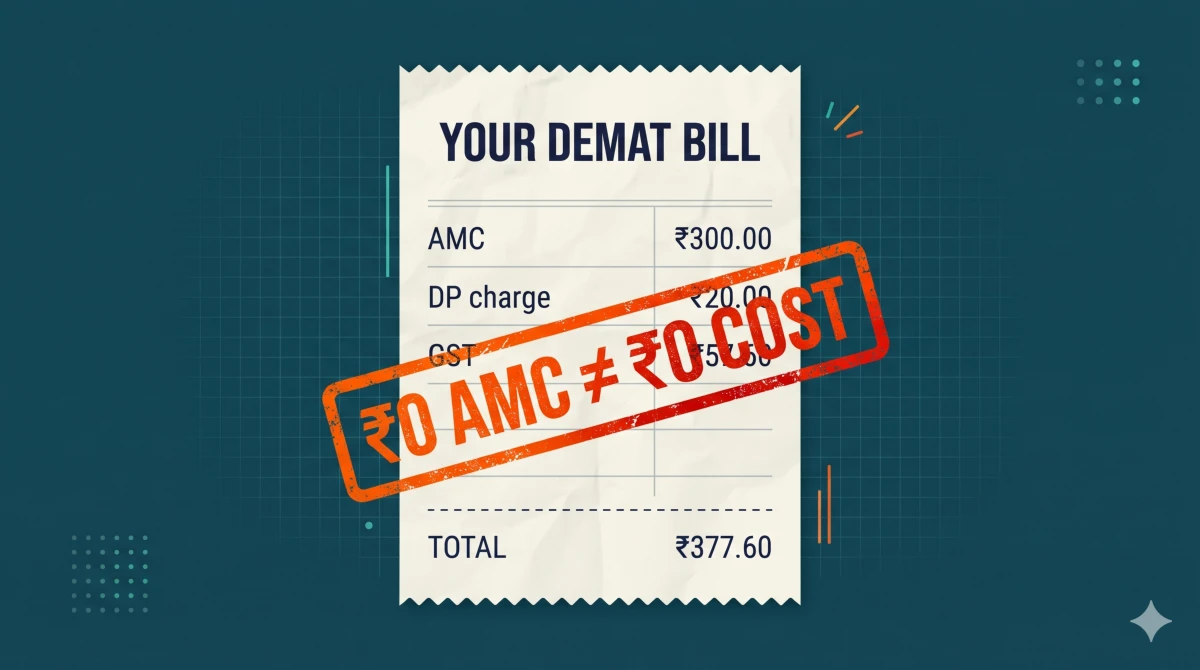
Neha received her first IPO allotment last year, sold on listing day, and booked a neat profit. Then she opened her ledger and found three deductions she had never heard of: a quarterly maintenance fee, a "DP charge" on the sale, and GST on both. None of them was large. Together, and repeated across a year of IPO flipping, they added up to more than she had expected to pay for an account she had been told was "free."
Most demat accounts in India now cost nothing to open. Keeping one, and selling from it, still costs money. This guide explains each charge, compares four widely used brokers, and shows how a small investor can legally pay close to zero.
Practical Tips
The Four Charges on Every Demat Bill
Every depository participant (DP), which is usually your broker, bills under the same four heads. Only two of them recur for a typical retail investor.
| Charge | When it applies | Typical range (Nov 2026) |
|---|---|---|
| Account opening | Once, at signup | ₹0 for resident individuals at most discount brokers |
| AMC | Yearly, often billed quarterly | ₹0 to ₹300 + GST; nil under BSDA up to ₹4 lakh |
| DP (debit) charge | Each time shares leave your demat, mainly on a delivery sale | ₹13 to ₹20 + GST per scrip |
| Pledge / off-market transfer | When you pledge for margin or move shares out | ₹20 to ₹30 + GST per ISIN |
The DP charge is the one that catches IPO investors. It is a flat fee per scrip per day, regardless of quantity. Selling one share or one full lot costs the same. Part of it goes to the depository (CDSL charges ₹3.50) and the rest is the broker's markup. Buying, receiving an IPO allotment, and intraday or F&O trades do not attract it.
Broker-by-Broker Comparison, November 2026
The table below covers four large brokers for a resident individual on a regular (non-BSDA) account. All figures exclude 18% GST unless stated.
| Charge | Zerodha | Groww | Upstox | Angel One |
|---|---|---|---|---|
| Account opening | Free | Free | Free | Free |
| AMC, year 1 | Free (accounts opened from 1 June 2026) | ₹0 | Free | Free |
| AMC, year 2 onwards | ₹300/year, billed quarterly | ₹0 | ₹300/year | ₹60/quarter, only in quarters you trade |
| DP charge per sell | ₹13 (₹15.34 with GST) | ₹20 | ₹20 | ₹20 |
| Margin pledge per ISIN | ₹30 | ₹20 plus GST | ₹20 | ₹20 |
| Off-market transfer | ₹25 | ₹20 plus GST | ₹20 per ISIN | ₹20 + GST per ISIN. |
Two details matter. Groww waives its own share of the DP fee on sales below ₹100, so only the ₹3.50 CDSL portion applies. Female first holders get a ₹0.25 discount on the CDSL fee at most brokers. Brokerage on the sale is separate from these demat charges: Zerodha charges ₹0 on delivery, while the other three charge up to ₹20 per order.
Practical Tips
What an IPO Investor Actually Pays in a Year
Take a realistic pattern: four IPO allotments a year, each sold on listing day as a single-scrip sale. Here is the year-two cost, GST included.
| Broker | AMC (regular account) | DP charges (4 sells) | Annual total | Total under BSDA (holdings below ₹4 lakh) |
|---|---|---|---|---|
| Zerodha | ₹354 | ₹61 | ₹415 | ₹61 |
| Groww | ₹0 | ₹94 | ₹94 | ₹94 |
| Upstox | ₹354 | ₹94 | ₹448 | ₹94 |
| Angel One | Up to ₹283 | ₹94 | Up to ₹378 | ₹94 |
Against a listing gain, these amounts are small. On Bajaj Housing Finance's September 2024 listing, one retail lot of 214 shares sold at ₹150 was worth ₹32,100; a ₹23.60 DP charge is under 0.1% of that. The cost becomes noticeable when allotments are rare, holdings are small, and a fixed AMC runs year after year regardless.
This is exactly where Neha stood. She held about ₹3 lakh in shares on a regular account, plus a second demat she had opened only to "improve" her IPO odds. Both accounts were paying AMC.
BSDA: The Cheapest Upgrade Most Investors Miss
The Basic Services Demat Account is a SEBI-mandated low-cost variant. Since SEBI's June 2024 circular, the maximum AMC any DP can charge is fixed by holding value:
| Value of holdings | Maximum BSDA AMC |
|---|---|
| Up to ₹4 lakh | Nil |
| Above ₹4 lakh to ₹10 lakh | ₹100 per year + GST |
| Above ₹10 lakh | Not eligible; regular AMC applies |
The eligibility condition most people overlook is that you must have only one demat account in which you are the sole or first holder. A second account, even an idle one, disqualifies you.
SEBI's December 2025 circular, effective 31 March 2026, made the facility more robust. Delisted securities and zero-coupon zero-principal bonds no longer count towards the ₹10 lakh limit, DPs must review eligibility every quarter, and an eligible account cannot be moved to a costlier regular plan without your informed consent. If your holdings later cross ₹10 lakh, regular AMC applies; if they fall back, the account can return to BSDA.
Five Ways to Cut Your Demat Bill
First, check whether you qualify for BSDA. Your Client Master Report (CMR) shows the BSDA flag; if it is missing and you meet the conditions, ask your DP to convert the account.
Second, close idle demat accounts. Because only one application per PAN is valid in any IPO category, a second demat in your own name does not raise your allotment odds. It does add AMC and may cost you BSDA eligibility.
Third, sell an allotment in a single day. DP charges apply per scrip per day, so splitting the same stock's exit across two days doubles the fee.
Fourth, match your broker to your behaviour. Frequent sellers should weigh the DP fee more heavily; buy-and-hold investors with small portfolios should weigh AMC more heavily.
Fifth, read the ledger, not the brochure. Pledge charges, off-market transfers and call-and-trade fees appear in the account statement, not on the contract note.
Neha took the first two steps. She closed her idle second account and had her primary account converted to BSDA. Her projected yearly cost fell from roughly ₹770 across two accounts to under ₹100, with her IPO allotment chances unchanged. Open your CMR tonight and check for the BSDA flag; it takes about two minutes.
KEY TAKEAWAYS
- Opening a demat account is free at major brokers, but maintaining one and selling from it is not.
- DP charges of ₹13 to ₹20 plus GST apply per scrip on every delivery sale, including listing-day exits from IPOs; allotment credits are free.
- Zero AMC removes the holding fee only. Frequent sellers pay most of their demat costs through DP charges.
- Under BSDA, AMC is nil up to ₹4 lakh and capped at ₹100 a year up to ₹10 lakh, but only if you hold a single demat account.
- Since 31 March 2026, DPs review BSDA eligibility quarterly and cannot shift eligible investors to costlier plans without consent.
- Broker tariffs change often, so verify the current pricing page and your own ledger before choosing or switching.