Index
Index
Demat · Part 1 of 6
Meera got her first salary in October and decided she would apply for the next big IPO. She had a savings account, a UPI app and a PAN card. On the morning the issue opened, she searched for the "apply" button in her banking app and found that it needed something she did not have: a DP ID and client ID.
Meera's situation is common. India has over 23 crore demat accounts, yet every IPO season brings a wave of first-time investors who discover this requirement on day one of the issue. The short answer to the question in the title is yes. The longer answer covers what a demat account actually does in an IPO, what else you need, what it costs, and which small details get applications rejected.
Practical Tips
Why IPOs Need a Demat Account
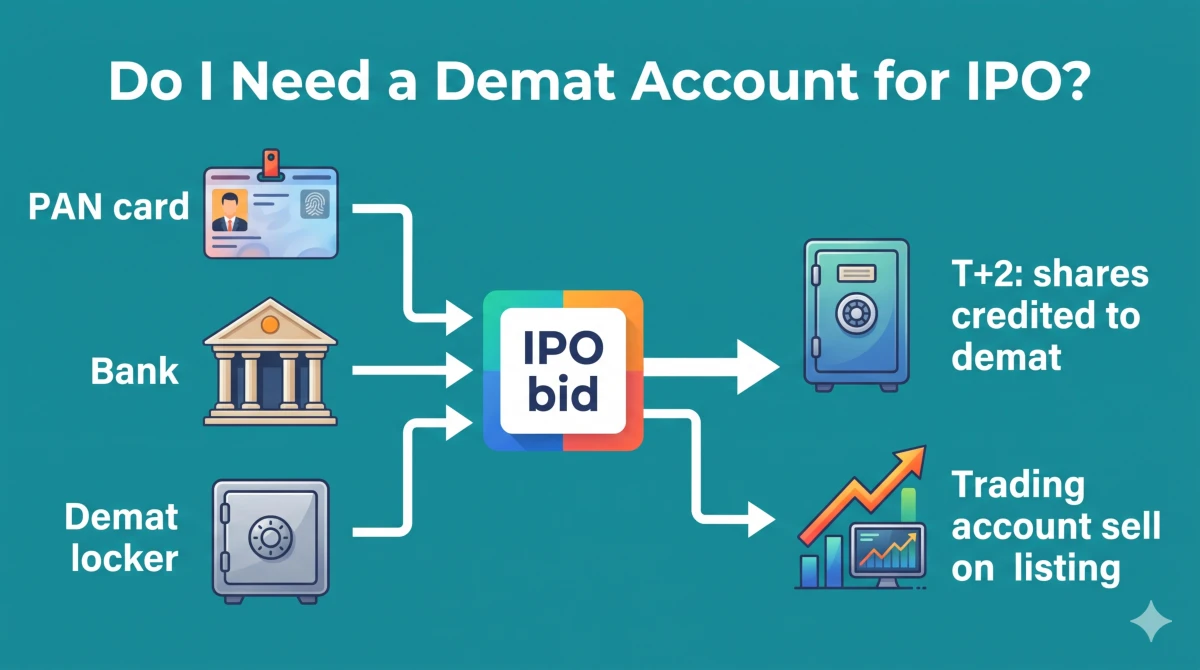
Physical share certificates are a thing of the past for new issues. When an IPO allots you shares, the registrar does not post you a certificate. It credits the shares electronically to the demat account you named in your application, held with one of India's two depositories, NSDL or CDSL, through a depository participant (DP) such as your broker or bank.
Your demat account is therefore the delivery address for the shares. Without it, there is nowhere for the allotment to go, which is why the IPO application form cannot be submitted without valid demat details. Your PAN is also mandatory and must match the PAN registered on that demat account.
Here is where the demat account fits in the standard T+3 IPO timeline.
| Day | What happens | Role of your demat account |
|---|---|---|
| T (issue closes) | Bidding ends | Demat details already captured in your bid |
| T+1 | Basis of allotment finalised | Registrar checks PAN and demat details are valid |
| T+2 | Shares credited, unallotted money released | Allotted shares land in your demat account |
| T+3 | Listing | Shares can be sold through a linked trading account |
What a Demat Account Costs
Account opening is free with most brokers today. The recurring cost is the annual maintenance charge (AMC), and here SEBI's Basic Services Demat Account (BSDA) framework helps small investors considerably.
| Value of your holdings | BSDA AMC | Typical regular demat AMC |
|---|---|---|
| Up to ₹4 lakh | Nil | ₹300–800 a year |
| ₹4 lakh to ₹10 lakh | ₹25 per quarter plus GST | ₹300–800 a year |
| Above ₹10 lakh | Not eligible | ₹300–800 a year |
To qualify, you can have only one demat account under your PAN as sole or first holder. Since March 31, 2026, brokers must review accounts every quarter and move eligible ones to BSDA automatically.
For someone like Meera, starting with an IPO or two and a small portfolio, the demat account can cost nothing to hold.
Practical Tips
Myth vs Reality
| Myth | Reality |
|---|---|
| I can apply with just a bank account and PAN | No. Every IPO application needs demat details |
| I need a trading account to apply | Not if you apply through bank ASBA. You need one to sell |
| More demat accounts means better allotment odds | One PAN, one valid application, regardless of accounts |
| Demat accounts are expensive to maintain | Under BSDA, AMC is nil up to ₹4 lakh in holdings |
| A demat account in my parent's name works for me | Bank, demat and PAN must all belong to the applicant |