Index
Index
General IPO · Part 11 of 12
Rohan, a salaried investor in Pune, opens the RHP of an upcoming health insurer and reaches page 40 without finding a single number he recognises. There is no EBITDA margin and no inventory cycle. Instead he finds a solvency ratio, a combined ratio, IBNR reserves, and a line stating that the issue required the approval of IRDAI under Section 6A(4) of the Insurance Act. He starts to wonder whether this is a normal IPO at all.
In some ways it is, and in others it is not. An insurer goes through the same SEBI process as any mainboard issuer, but a second regulator sits beside SEBI. The business is also measured in a language most retail investors were never taught. This guide covers both: the filing rules insurers face, and the few numbers that tell you whether the IPO deserves your bid.
Practical Tips
Two Regulators, One Offer Document
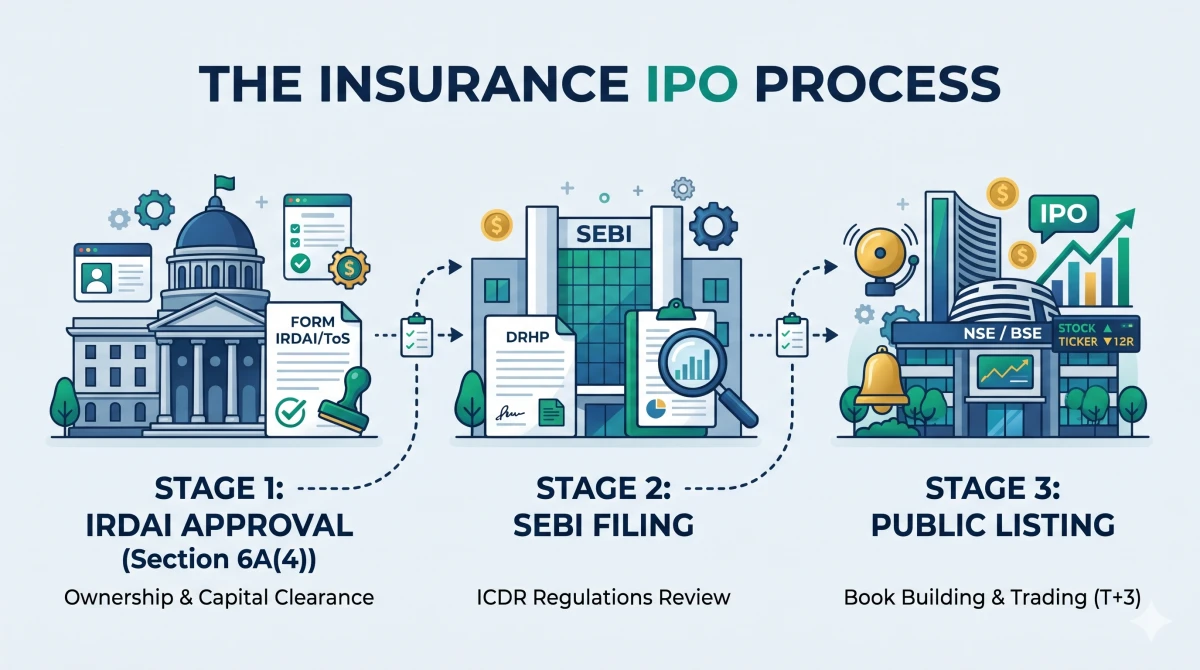
SEBI reviews the offer document. IRDAI reviews who will own the insurer after the IPO. This split exists because an insurer holds policyholders' money for decades, so the identity and fitness of its shareholders matter to the insurance regulator in a way they do not for a cement or software company.
| Stage | Regulator | What happens |
|---|---|---|
| 1. Ownership clearance | IRDAI | Insurer applies in Form IRDAI/ToS for approval of the share issue or transfer; this must come before any filing with SEBI |
| 2. DRHP filing | SEBI | Standard ICDR review; SEBI issues observations |
| 3. RHP and book building | SEBI and exchanges | Price band, anchor round, three-day bidding |
| 4. Listing | NSE / BSE | Same T+3 timeline as any mainboard IPO |
| After listing | IRDAI | Any transfer or issue above 5% of paid-up capital needs prior IRDAI approval |
Everything from Stage 2 onwards will feel familiar. Stage 1 is the step that delays insurer IPOs. A promoter group that IRDAI considers unsuitable, or a capital structure it questions, can hold up the issue before SEBI ever sees the draft.
What Changed in 2024 and 2025
Two reforms simplified the route to listing.
| Rule | Earlier position | Current position |
|---|---|---|
| IRDAI listing approval | Separate prior written approval required (2015 regulations) | Removed by the IRDAI Registration and Capital Regulations, notified 20 March 2024; only Section 6A(4) approval remains |
| Lock-in on IPO allottees | IPO shares could technically be caught by the lock-in that applies to an unlisted insurer | 2024 Master Circular exempts shares allotted or transferred under the SEBI offer document |
| Share transfer approval threshold | Above 1% of paid-up capital | Above 5% (Sabka Bima Sabki Raksha Act, 2025, notified December 2025) |
| Foreign investment cap | 74% | 100% |
For a retail investor, the lock-in fix matters most. The shares you receive in an insurer IPO are freely tradable on listing day, as they are in any other IPO. The 5% threshold affects large buyers rather than you, but it reduces friction when promoters or private equity funds sell blocks after listing. That means more supply overhang becomes possible once their lock-in periods end.
Practical Tips
Why Many Insurer IPOs Put QIBs First
Young insurers often spend years building their policy book before they report steady profits. Many therefore cannot meet the operating-profit track record that SEBI requires under Regulation 6(1) of the ICDR Regulations, and they list under Regulation 6(2) instead. Under that route, at least 75% of the issue must go to qualified institutional buyers (QIBs), and the retail portion is capped at 10%.
Star Health, Go Digit and Niva Bupa all used this 75 / 15 / 10 allocation split. This changes Rohan's arithmetic. With only 10% of the issue reserved for retail investors, a retail subscription of 5 times on a 6(2) issue can leave his odds of allotment worse than the same subscription figure would on a standard issue, where retail receives 35%. Check the reservation table in the RHP before you assume that a "moderately subscribed" IPO gives you a good chance of allotment.
The Numbers That Replace P/E
Insurers earn from two sources: underwriting (premiums collected minus claims and expenses) and investment income on the float. Standard ratios built for manufacturers miss both. Here is what to read instead.
| Metric | Applies to | What it tells you | Warning sign |
|---|---|---|---|
| Solvency ratio | All insurers | Capital buffer against policy obligations; IRDAI's control level is 150% | Ratio hovering near 150%, or IPO proceeds earmarked mainly to top it up |
| Embedded value (EV) and VNB margin | Life insurers | Value of the existing policy book; profitability of new policies | High price-to-EV multiple alongside a falling VNB margin |
| Combined ratio | General and health insurers | Claims plus expenses as a percentage of premium; above 100% means an underwriting loss | Persistently above 100% with only investment income keeping profits positive |
| Persistency (13th and 61st month) | Life insurers | Share of policies customers keep renewing | Sharp drop in later-year persistency |
| Incurred claims ratio | Health insurers | Share of premium paid out as claims | Very low ratio (possible over-pricing or claim rejections) or rising sharply |
Valuation conventions differ by type of insurer. Life insurers are usually priced on P/EV, while general and health insurers are priced on price-to-book or P/E. A life insurer at 3 times EV and a general insurer at 40 times earnings can both be "cheap" or "expensive" only relative to their own peer group.
How Insurer IPOs Have Actually Listed
| Company | Type | Listed | Issue price | NSE listing open | Change |
|---|---|---|---|---|---|
| Star Health | Standalone health | Dec 2021 | ₹900 | ₹848.80 | −5.7% |
| LIC | Life (PSU) | May 2022 | ₹949 | ₹867.20 | −8.6% |
| Go Digit | General | May 2024 | ₹272 | ₹286 | +5.1% |
| Niva Bupa | Standalone health | Nov 2024 | ₹74 | ₹78.14 | +5.6% |
| Canara HSBC Life | Life | Oct 2025 | ₹106 | ₹106 | 0% |
Myth: a large, well-known insurer will list at a big premium. Reality: none of the five insurers above opened more than 6% higher, and two listed at a discount. The pattern has an explanation. Insurer IPOs are often large offers for sale by promoters, they are priced by bankers who know institutions will value them on EV or book, and their earnings compound slowly. Insurance is a compounding business sold to a market that wants overnight gains, and the result is usually a quiet debut.
LIC added a retail twist: policyholders received a separate reservation and a ₹60-per-share discount. These quotas reappear in group-company IPOs, so it is worth knowing how they work.
Reading the Next Insurer IPO
The 100% FDI ceiling and the easier share-transfer rules are expected to bring more insurers to market. Be careful with labels, though. InsuranceDekho, which media reports in July 2026 said was targeting a DRHP filing by end-September 2026, is an insurance marketplace, not an underwriter. Its RHP will read like a platform company's, with commissions and take rates, rather than like an insurer's, with solvency ratios and claims.
Rohan applies his new checklist to the health insurer's RHP. He finds a solvency ratio comfortably above 150%, a combined ratio that has stayed just over 100%, and a 75 / 15 / 10 allocation. His conclusion is that this is a long-term holding at best and a weak bet for listing gains. He applies for one lot, sized to an amount he is willing to hold for three years, and skips the leverage he had been considering. That is the right posture for most insurer IPOs: bid as an owner, not as a flipper.
KEY TAKEAWAYS
Insurers need IRDAI approval under Section 6A(4) before filing with SEBI, and the old separate IRDAI listing approval was removed in March 2024. Shares allotted in the IPO carry no insurer lock-in for retail investors and are tradable on listing day. Since December 2025, IRDAI approval is needed only for share transfers above 5%, and foreign ownership of up to 100% is allowed. Many insurers list under Regulation 6(2), which caps retail at 10%, so the RHP's reservation table matters more than the headline subscription figure. Judge insurers on solvency, EV and VNB margin, or combined ratio rather than P/E. Recent insurer listings, from LIC to Canara HSBC Life, have been flat to modest, so treat these as long-term holdings rather than listing-gain plays.