Index
Index
General IPO · Part 2 of 12
Priya was allotted one lot of Ola Electric in August 2024: 195 shares at ₹76, an investment of ₹14,820. Within eleven days the stock touched ₹157.53. By late October it had slipped below ₹76, and it later closed as low as ₹36.12. Now Priya wonders whether buying more at a lower price would bring her average down.
Mutual fund investors know this idea as cost averaging. It transfers to IPOs, but not in the way most people assume, because an IPO sells everyone the same share at the same price, once.
Practical Tips
Three Ways IPO Investors "Average"
| Method | What you do | What it fixes | What it does not fix |
|---|---|---|---|
| Across IPOs | Apply to several researched IPOs over months, one lot each | Concentration in one issue, allotment luck | A weak IPO still loses money |
| Post-listing tranches | Buy more of a stock you hold in stages after listing | Entry-price timing | Company-specific risk |
| Averaging down | Buy more as the price falls | Lowers your break-even | Doubles your exposure to a weakening business |
The first method is the most useful for retail investors. Retail allotment is largely a lottery, so a single bid is a thin sample. Bidding for one lot in each of several IPOs gives you several chances at allotment and keeps any one failure small. Our guide on improving your odds covers the allotment side.
The Maths Behind Priya's Decision
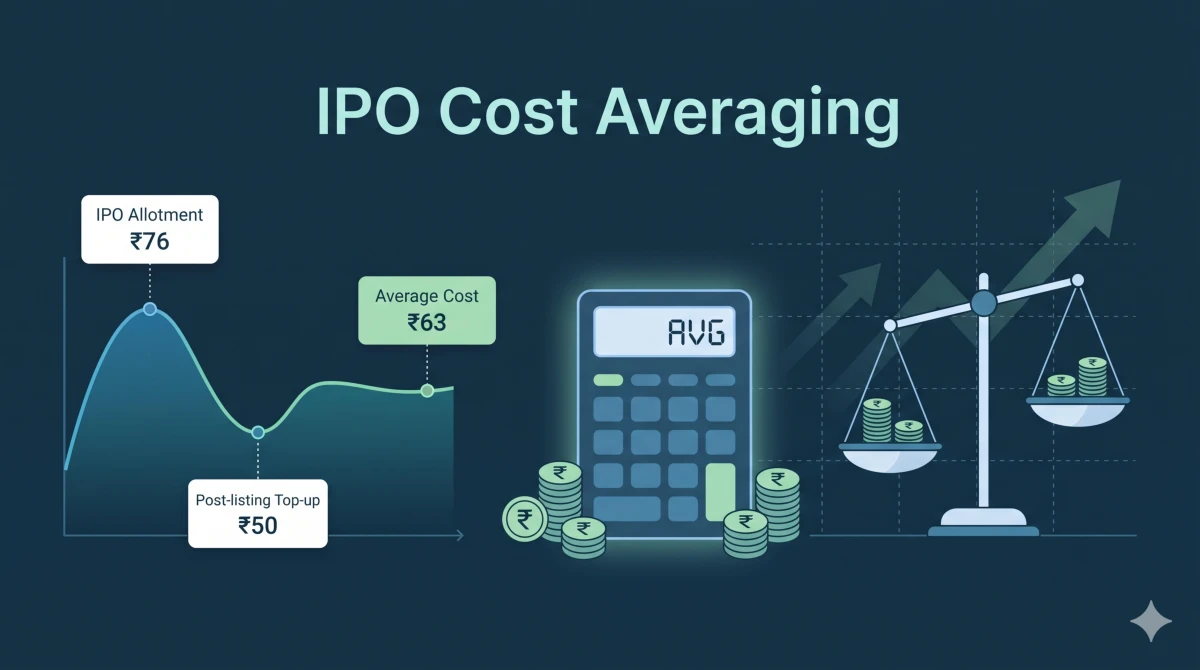
Suppose Priya buys another 195 shares on the exchange at ₹50 (a hypothetical price for illustration).
| Purchase | Shares | Price | Cost |
|---|---|---|---|
| IPO allotment | 195 | ₹76 | ₹14,820 |
| Top-up (illustrative) | 195 | ₹50 | ₹9,750 |
| Total | 390 | ₹63 average | ₹24,570 |
Her break-even falls from ₹76 to ₹63. But she now has ₹24,570 riding on one company instead of ₹14,820. Averaging lowers the price the stock must reach for you to break even. It never lowers how much you can lose.
Average cost = total money invested ÷ total shares held. Priya: ₹24,570 ÷ 390 = ₹63 per share.
Myth vs Reality
The myth is that buying more as the price drops is always smart. The reality is that a lower price is a discount only if the business is still worth the original price.
Listing-day results also tell you little about what follows. Ola Electric listed flat on the NSE at ₹76 and closed day one at ₹91.20, yet it later fell more than 50% below the issue price. Spreading across issues is the safer habit:
| IPO | Issue price | Listing outcome |
|---|---|---|
| Bajaj Housing Finance (Sep 2024) | Upper band | 114% listing gain |
| Hyundai Motor India (Oct 2024) | ₹1,960 | Listed at ₹1,934 on NSE, 1.3% below |
| Ola Electric (Aug 2024) | ₹76 | Flat listing, weak afterwards |
An investor holding one lot of each would have seen a big winner, a small loss and a long-term disappointment. Hyundai's minimum lot was 7 shares (₹13,720), so even the weaker outcomes stayed small.
Practical Tips
Tax: Every Lot Has Its Own Clock
You do not pay tax on an "average" price. Each purchase keeps its own cost and its own holding period, and brokers generally report sales on a first-in-first-out basis. For FY 2026-27, the listed-equity rates remain as set in July 2024:
| Holding period | Tax rate | Relief |
|---|---|---|
| 12 months or less (short-term) | 20% | None |
| More than 12 months (long-term) | 12.5% | First ₹1.25 lakh of gains per year exempt |
A 4% cess applies on top. So if Priya tops up months after her allotment, the new shares may still be short-term when the original lot has turned long-term. Selling the newer lot early costs 20% on any profit.
A Simple Rulebook
Fix your bid size before the IPO season starts, for example one lot per issue, so excitement does not decide it for you. Apply only to IPOs you have actually read about, and use IPO360's Fund Allocator to see how much capital each live issue needs. Decide your top-up rule in advance: add only after reading the next quarterly results, and never take a position beyond twice its original size. Write your exit rule down as well.
Here is how it ended for Priya. She skipped the ₹50 top-up and kept the ₹9,750 for the next IPO she had researched. A top-up at ₹50 would have been under water too, because Ola later closed as low as ₹36.12. Her lesson was to spread the money and size positions sm
KEY TAKEAWAYS
An IPO has one issue price, so there is no averaging inside a single issue. The useful form of averaging for retail investors is spreading small, equal bids across several researched IPOs. Buying more after listing lowers your break-even, but it raises the money you have at risk in one company. Average down only when the original investment case is intact, never just because the price is lower. Each purchase lot has its own cost and holding period, with 20% tax on gains within 12 months and 12.5% above ₹1.25 lakh after that. Set your bid size, top-up limit and exit rule before you apply.