Index
Index
General IPO · Part 12 of 12
Rohan, a retail investor in Pune, gets a full allotment in a ₹1,000 crore IPO priced at ₹500. On listing day the stock opens at ₹505 and then slides. By noon it is at ₹488. Then something odd happens. Every time it dips toward ₹485, a steady buyer appears and the price holds.
That buyer is not a coincidence. It is the stabilising agent, running the IPO's green shoe option. It is one of the few tools in Indian capital markets designed to cushion a weak listing, and also one of the least used.
This article explains how the mechanism works, what SEBI allows, why most Indian issuers skip it, and what it does and does not mean for an investor like Rohan.
Practical Tips
How a Green Shoe Option Works
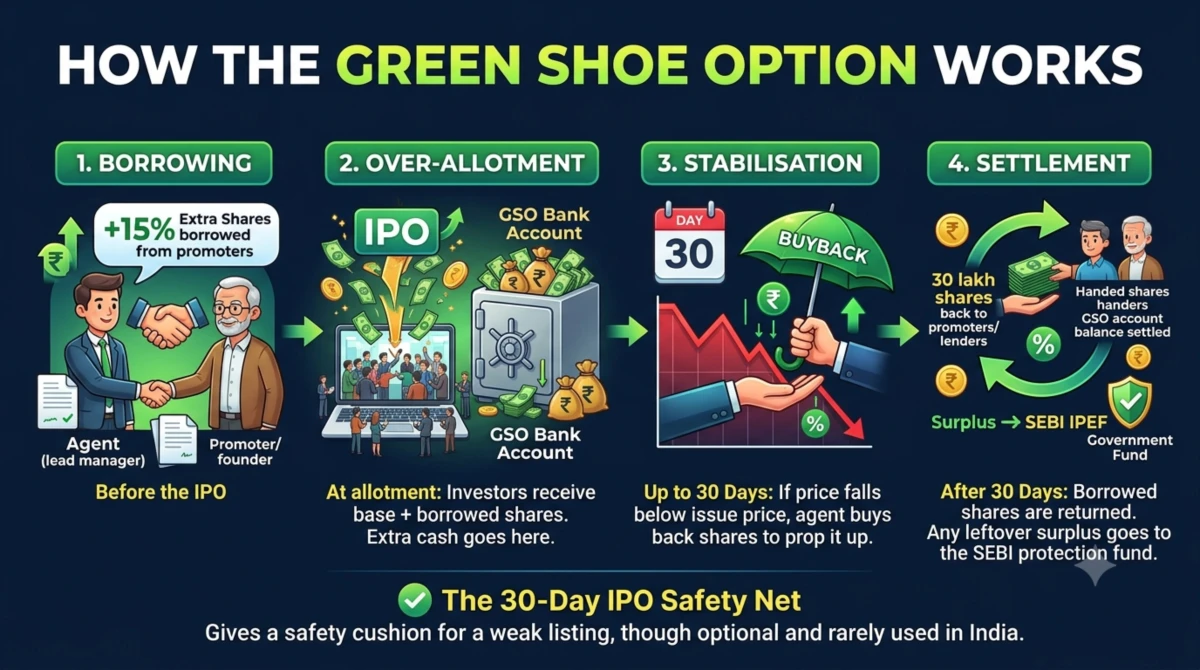
The mechanism runs in four stages, starting before the IPO opens and ending about a month after listing.
| Stage | When | What happens |
|---|---|---|
| 1. Borrowing | Before the issue | One of the lead managers is appointed stabilising agent and borrows shares from promoters or pre-issue shareholders, up to 15% of issue size |
| 2. Over-allotment | At allotment | Investors receive the base issue plus the borrowed shares. The money for the extra shares goes into a separate GSO bank account |
| 3. Stabilisation | Up to 30 days from listing | If the price trades below the issue price, the stabilising agent may buy shares from the market using the GSO account money |
| 4. Settlement | After the 30-day window | The borrowed shares are returned to the lenders, using shares bought in the market, fresh shares issued by the company, or a mix of both |
The key idea is that the stabilising agent starts with a short position. It has sold shares it does not own, because they were borrowed. That obligation is what gives it both the cash and the reason to buy in the market if the price weakens.
The Three Ways It Can End
Take Rohan's IPO. Base issue of ₹1,000 crore at ₹500 per share means 2 crore shares. A full 15% green shoe adds 30 lakh borrowed shares, and ₹150 crore lands in the GSO bank account.
| Scenario | What the stabilising agent does | How the 30 lakh borrowed shares are returned | Final issue size |
|---|---|---|---|
| Price stays above ₹500 for 30 days | Buys nothing, since buying above issue price makes no sense | Company issues 30 lakh fresh shares at ₹500 | 2.30 crore shares (₹1,150 crore raised) |
| Price stays below ₹500 | Buys 30 lakh shares in the market, say at ₹480 (₹144 crore) | All 30 lakh come from market purchases | 2 crore shares (₹1,000 crore raised) |
| Price dips, then recovers | Buys 20 lakh shares at ₹480, then stops once the price recovers | 20 lakh from the market, 10 lakh fresh from the company | 2.10 crore shares |
In the second scenario, ₹6 crore is left over in the GSO account (₹150 crore minus ₹144 crore, before expenses). Under Regulation 57, that surplus does not go to the bank, the company or the promoters. It goes to SEBI's Investor Protection and Education Fund. That single rule explains a lot about why the tool is rarely used, which we cover below.
Practical Tips
SEBI Rules at a Glance
The green shoe has been available in India since August 2003. It now sits in the SEBI ICDR Regulations, 2018, under Regulation 57 for IPOs, Regulation 153 for further public offers and Regulation 279 for SME issues.
| Rule | Requirement |
|---|---|
| Mandatory? | No. The issuer "may" provide it |
| Maximum over-allotment | 15% of issue size |
| Who runs it | A lead manager appointed as stabilising agent |
| Who lends shares | Promoters and/or pre-issue shareholders |
| Shareholder approval | Required in the resolution approving the issue |
| Agreement | Issuer and stabilising agent must sign before filing the draft offer document |
| Stabilisation window | Up to 30 days from the start of trading |
| Accounts | Separate GSO bank account and GSO demat account |
| Disclosure | Must be described in the offer document |
| Profit from stabilisation | Not allowed. Surplus goes to SEBI's Investor Protection and Education Fund |
If an IPO you are evaluating has a green shoe, the RHP will say so clearly, usually in the offer structure and a dedicated section on price stabilisation.
Why Most Indian IPOs Skip It
The green shoe had a strong start. ICICI Bank's 2004 public issue carried a ₹450 crore green shoe with DSP Merrill Lynch as stabilising agent, and TCS's 2004 IPO included one of over 83 lakh shares. ICICI Bank used it again in its 2007 follow-on offer.
Since then, adoption has faded, even in issues where a weak listing hurt retail investors. LIC (May 2022) and Hyundai Motor India (October 2024), two of the largest IPOs in Indian history, both listed below their issue price with no stabilisation mechanism in place.
The reasons are commercial rather than regulatory.
| Friction | Why it matters |
|---|---|
| No profit for the stabilising agent | In the US, underwriters keep the spread when they buy back below the issue price. In India, every rupee of surplus goes to SEBI's investor fund. The banker earns only a fixed fee |
| No incentive for lenders | Promoters lend shares and take on paperwork, with no clear borrowing fee |
| Limited firepower | 15% of the issue and 30 days may not be enough in a sharp sell-off, and a visible failure is worse than no attempt |
| Compliance load | Two separate accounts, daily exchange reporting, SEBI reporting and strict return timelines |
Put simply, India designed the green shoe as a pure investor-protection tool. That is admirable, but it also removed the reason most bankers would want to run one.
Myth vs Reality, and What It Means for You
| Myth | Reality |
|---|---|
| A green shoe guarantees the issue price | It only supports the price for up to 30 days, and only up to 15% of the issue |
| It means the company is raising more money | Only if the price holds. If the agent buys in the market, the issue size stays the same |
| The bankers profit from it | Not in India. Any surplus goes to SEBI's investor fund |
| Most big Indian IPOs have one | Most do not, including recent mega-issues |
Back to Rohan. His stock hovered between ₹485 and ₹495 for most of the first month as the stabilising agent absorbed selling. On day 31 the support ended, and within a week the stock settled at ₹462, closer to what the market actually thought it was worth. Rohan, who had read the RHP and marked the stabilisation end date in his calendar, had already decided to exit near ₹490 during the ;window. His loss was about 2%, not 7.6%.
A green shoe does not change what a stock is worth. It changes how fast the market gets there.
Your action list is short. Search the RHP for "green shoe" or "price stabilisation." If it exists, note the stabilisation end date and the size of the pool. Treat any calm in the first 30 days as supported, not proven. Re-check the price after the window closes before deciding to hold.
KEY TAKEAWAYS
1. A green shoe option lets an IPO over-allot up to 15% extra shares, borrowed from promoters or pre-issue shareholders. 2. The money from those shares funds market purchases if the price falls below the issue price, for up to 30 days after listing. 3. If the price holds, the company issues fresh shares to repay the lenders and raises more money. If it falls, market purchases repay them. 4. It is optional under Regulation 57 of the SEBI ICDR Regulations, and any surplus goes to SEBI's Investor Protection and Education Fund. 5. Because stabilising agents cannot profit, very few recent Indian IPOs, including LIC and Hyundai, have used it. 6. If an IPO you hold has one, track the 30-day window and judge the stock on its price after support ends.