Index
Index
General IPO · Part 1 of 12
Priya gets a one-lot allotment, watches the stock list at more than double the issue price, and sells within minutes. Her broker app shows a tidy profit. What it does not show is the tax she will owe by March, or the form she needs to report it on.
Most first-time IPO investors treat tax as something for later, or for bigger players. The rules are simple, but a few quiet triggers catch people out. This guide maps every stage of an IPO against tax, using the rates for FY 2026-27. Union Budget 2026 left capital gains rates unchanged, so the structure below is the one in force.
Practical Tips
Where Tax Enters an IPO: Stage by Stage
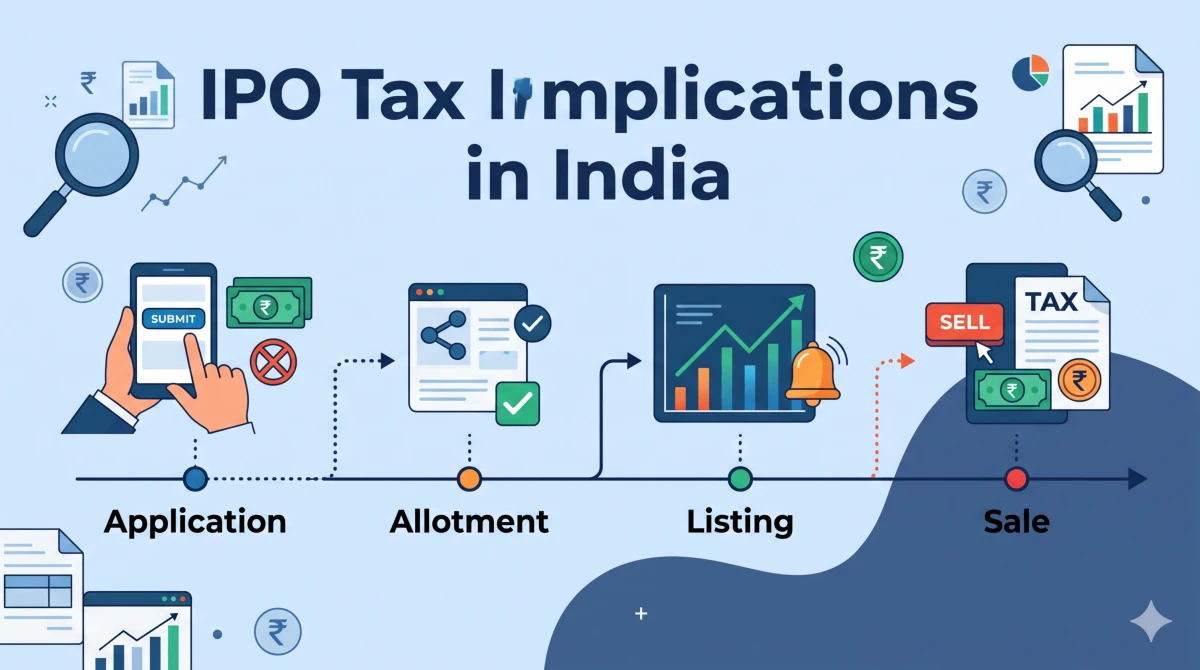
An IPO has five stages an investor touches, and only one of them creates a tax bill. The table below shows where tax applies.
| Stage | Taxable? | What to know |
|---|---|---|
| Applying (ASBA or UPI block) | No | Your money is blocked, not spent |
| Refund for unallotted shares | No | Return of your own capital, not income |
| Allotment | No | Your cost of acquisition is fixed at the issue price you paid |
| Listing | No | A gain on paper is not taxed |
| Sale of shares | Yes | STCG or LTCG, depending on how long you held |
| Dividends while holding | Yes | Added to your income and taxed at your slab rate |
The tax clock starts at allotment, not at listing. Your holding period is counted from the allotment date, and your purchase cost is the issue price, not the listing price. That is why a sale on listing day is always a short-term sale.
STCG vs LTCG on IPO Shares
The only decision that changes your rate is how long you hold after allotment.
| Short-term | Long-term | |
|---|---|---|
| Holding period | Up to 12 months | More than 12 months |
| Tax rate | 20% | 12.5% on gains above ₹1.25 lakh per financial year |
| Indexation | Not available | Not available |
| Cess | 4% | 4% |
A listing-day sale is generally a delivery sale of shares credited to your demat through allotment, so the gain is short-term capital gains. It is not intraday trading income, because you did not buy and sell the same day. At higher total incomes, surcharge also applies, but it is capped at 15% on these gains.
Priya's sale shows what this looks like in rupees.
Practical Tips
Three IPO Tax Myths
Myth: no tax if I sell on listing day. Reality: a listing-day sale is taxed as STCG at 20%. Speed does not change the rate.
Myth: the refund for unallotted shares is taxable. Reality: it is your own money coming back. Nothing is reported.
Myth: a small gain does not need reporting. Reality: capital gains count towards the total income that decides whether you must file a return. They must also be disclosed in the return when you do file.
Reality Check: a 114% listing gain sounds like free money, but about a fifth of it, plus cess, belongs to the taxman. Treat roughly 21% of any short-term gain as already spent.
Practical Tips
Losses, Costs and Filing Your Return
Not every IPO works out, and the tax rules treat losses sensibly. A short-term loss can be set off against both short-term and long-term gains. A long-term loss can be set off only against long-term gains. Unabsorbed losses can be carried forward for up to eight years, but only if you file your return by the due date.
On costs, brokerage and expenses wholly connected with the sale can be deducted from your gain. STT cannot. Your broker's tax P&L statement is the easiest source for scrip-wise figures.
What Priya Does Next
Priya sold on listing day, so her gain is short-term. She sets aside about 21% of the ₹17,120 profit, downloads her broker's tax P&L after March, and reports the gain in ITR-2 before the due date. Had she wanted the ₹1.25 lakh exemption to apply, she would have needed to hold past 12 months, a trade-off between a certain gain now and an uncertain price later.
Your next step is the same. Before your next listing, decide whether you are selling on day one or holding. Then note the allotment date and keep the contract notes. Your holding period and your cost both depend on them.
KEY TAKEAWAYS
Applying, receiving a refund, getting allotted and seeing the stock list are all tax-free events. Tax arises only on sale. Your holding period starts at allotment, and your cost is the issue price. Sales within 12 months attract 20% STCG, and sales after 12 months attract 12.5% LTCG on gains above ₹1.25 lakh a year, with 4% cess on both. A listing-day sale is short-term, not intraday income. Losses can be set off and carried forward for eight years if you file on time. Grey market deals sit outside the system and need professional advice.