Index
Index
Is IPO GMP Reliable? When to Trust It and When to Ignore It
Ask any retail investor how an upcoming IPO is likely to perform, and the first number they quote is usually the Grey Market Premium. GMP has become the unofficial scoreboard of the Indian IPO market, tracked obsessively across websites and Telegram groups in the days before an issue opens. Yet for every IPO where the grey market called the listing correctly, there is another where it missed badly, leaving investors who bet purely on GMP disappointed. The honest answer to whether GMP is reliable is neither a clean yes nor a firm no. It is a directional signal that works reasonably well on average and fails at the individual level often enough to demand caution. Understanding exactly where that line falls is what separates informed applicants from those chasing hype.
Practical Tips
What GMP Actually Measures
Before judging reliability, it helps to be clear about what GMP represents. The Grey Market Premium is the extra amount, over and above the IPO issue price, that buyers in an informal off-market are willing to pay for shares or applications before the stock officially lists. If an IPO is priced at Rs. 500 and the grey market premium is Rs. 150, the implied listing price is around Rs. 650. This trading happens through a small network of dealers and is entirely unrecognised by SEBI, the NSE, and the BSE. Because it reflects real money changing hands based on demand expectations, GMP does carry genuine information about sentiment. But it is important to remember that GMP is a forecast of the listing price made by a handful of operators, not an official quote and not a settled fact. It shifts daily, sometimes hourly, and can reverse sharply as the listing approaches.
The Case for Trusting GMP
There is real statistical support for GMP as a broad indicator, which is why it refuses to disappear despite years of scepticism. Large-scale analyses of Indian IPOs point to a meaningful relationship between grey market premiums and eventual listing performance. One study covering roughly 300 IPOs from 2019 onward found the correlation between GMP and listing-day returns to be close to 0.8, which in statistical terms is a strong relationship. The general rule that a higher GMP tends to accompany a stronger listing, and a negative GMP tends to precede a weak or discounted debut, holds up across large data sets. Market commentary consistently notes that most IPOs end up listing within about 15 to 20 percent of their grey-market implied price.
The key phrase here is "on average." When you pool hundreds of IPOs together, the errors in individual predictions tend to cancel out, and the overall directional accuracy looks impressive. Analysis of the full set of mainboard IPOs listed in 2024 found that the gap between listing prices implied by average GMP and by last-day GMP was not substantial across the large sample, with individual distortions washing out in aggregate. For an investor trying to gauge whether an IPO is broadly hot, lukewarm, or cold, GMP is a legitimately useful first read.
Where GMP Breaks Down
The problem is that you do not apply to hundreds of IPOs at once. You apply to one at a time, and at the level of a single issue, GMP can be badly wrong. The averages that make GMP look reliable across a data set offer little comfort when your specific application lands on an outlier.
Consider the range of real outcomes. Vibhor Steel Tubes in early 2024 listed with a variance of nearly 59 percent above what its latest GMP implied, delivering a listing gain far beyond grey market expectations and rewarding applicants who never saw it coming. Tata Technologies in November 2023 was priced at 500 rupees with a GMP of around 475 rupees, yet it listed near 1,200 rupees, a gain of roughly 140 percent that the grey market meaningfully underpredicted. IREDA and Premier Energies are further cases where the actual debut comfortably outran the signal.
The failures cut both ways. Hyundai Motor India in October 2024 carried grey market optimism that did not survive contact with the market, delivering a weak, near-flat to negative debut. Ola Electric similarly saw grey market enthusiasm fade into a muted listing. And Paytm in November 2021 remains the cautionary tale, listing around 27 percent below its issue price. In each of these cases, an investor who treated GMP as a guarantee walked away with a very different result from the one they were promised.
Practical Tips
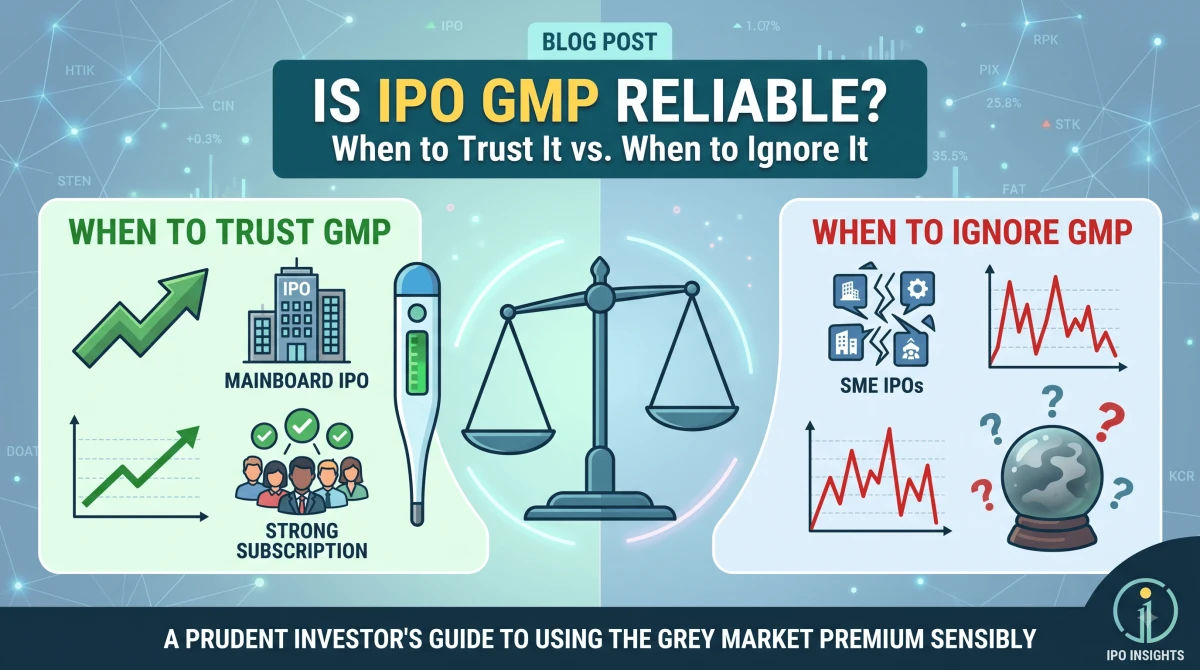
When to Trust GMP and When to Ignore It
GMP deserves the most weight when several conditions line up. It is more trustworthy for large mainboard IPOs with wide grey market participation, where the premium has been stable and consistent over several days rather than swinging wildly, and where it broadly agrees with other signals such as subscription demand and the quality of the business. A steady, positive GMP on a well-known mainboard company, confirmed by heavy institutional and retail subscription, is a reasonably dependable directional read.
GMP deserves to be ignored, or at least heavily discounted, in the opposite situations. Be sceptical when the premium is on a small SME issue, when it has spiked suddenly just before listing, when it contradicts weak subscription numbers, or when it seems disconnected from the fundamentals of the company. A last-minute surge in GMP is often the least reliable version of the signal, because the grey market has lately shown a habit of starting high and then selling off as listing nears. Above all, ignore GMP entirely as a basis for deciding whether a company is a good long-term investment. GMP predicts a single day. It says nothing about the business you would own afterward.
How to Use GMP Sensibly
The healthiest way to treat GMP is as a thermometer, not a crystal ball. It tells you roughly how warm or cold sentiment is around an issue, and that is genuinely worth knowing. It does not tell you the exact temperature at listing, and it certainly does not tell you whether the stock deserves a place in your portfolio a year from now.
A sound approach is to read GMP alongside the subscription data across retail, HNI, and QIB categories, the reputation and history of the book-running lead managers, the company's financials and valuation, and the objects of the issue. When these signals agree, your confidence can be reasonably high. When they disagree, that disagreement is itself valuable information, and GMP alone should not break the tie. Applying to an IPO purely because the grey market premium looks attractive, with no attention to the underlying business, is speculation dressed up as analysis. The grey market is a useful crowd of opinion, but it is still just opinion, and an unregulated one at that.
Practical Tips
• GMP is moderately reliable as a directional signal and unreliable as an exact predictor of listing price. • Across large samples of Indian IPOs, correlation with listing-day returns is strong, but individual IPOs frequently deviate. • Most issues list within roughly 15 to 20 percent of their grey-market implied price, yet outliers like Tata Technologies and Vibhor Steel Tubes broke that range sharply upward, while Paytm and Hyundai disappointed. • GMP is most trustworthy for large, liquid mainboard IPOs with stable premiums and is least trustworthy for thinly traded, easily manipulated SME issues. • A sudden last-minute GMP spike is often the least reliable version of the signal. • Never use GMP to judge long-term investment quality; it predicts one day, not the value of the business.