Index
Index
IPO Analysis · Part 9 of 13
Priya, a fictional first-time investor, is scrolling headlines the evening before an IPO opens. One says brokerages have given the issue a "Subscribe" rating. Another recalls that agencies once graded IPOs out of five. She wonders whether "Subscribe" is the official grade, and whether a 5/5 would make the shares safe to buy.
Neither assumption holds, and the confusion is common. "Rating" now covers four different things: an IPO grade, a credit rating on debt, a brokerage recommendation and grey market sentiment. This article separates them, explains what the old 1-to-5 grade measured, and shows what to rely on instead.
Practical Tips
What an IPO grade measured
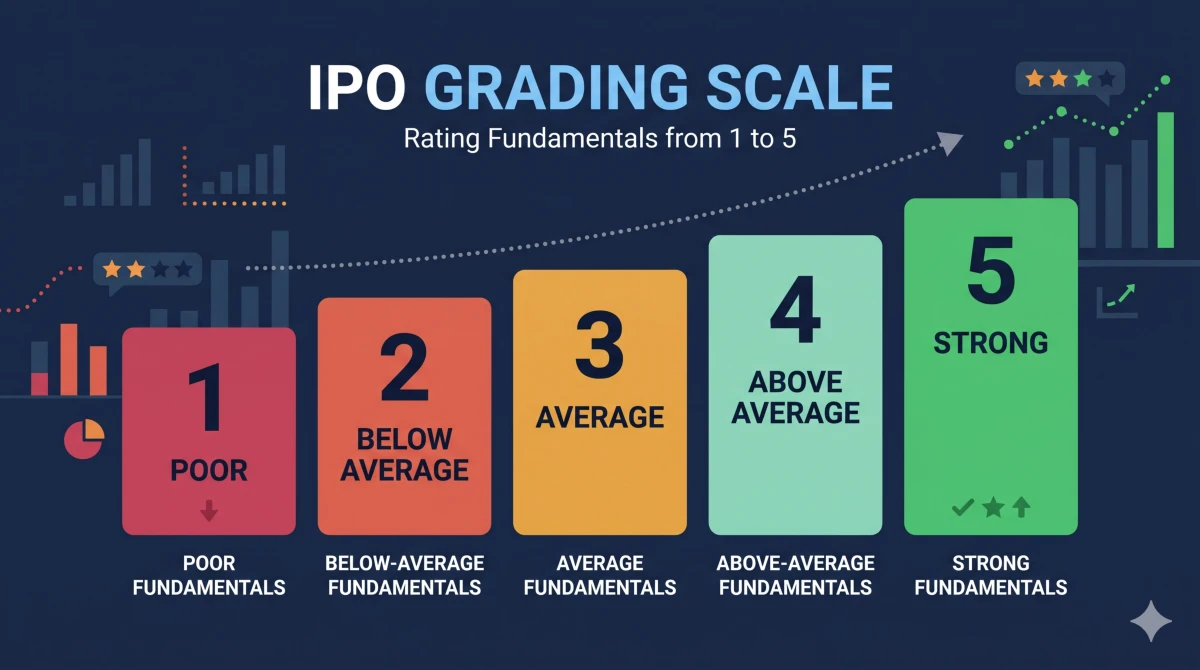
SEBI described the grade as a relative assessment of an issue's fundamentals against other listed equities in India, on a five-point scale. Agencies such as CRISIL, ICRA and CARE looked at business prospects, financial position, management quality and governance. The issuer appointed the agency and paid for the grading, and had to disclose every grade obtained, with the agency's rationale, in its offer documents.
| Grade | Meaning |
|---|---|
| 5 | Strong fundamentals |
| 4 | Above-average fundamentals |
| 3 | Average fundamentals |
| 2 | Below-average fundamentals |
| 1 | Poor fundamentals |
Two limits mattered from day one. CRISIL described its grading as a one-time assessment, neither an audit nor a credit rating. And grades did not consider the issue price, so a strong business could still be offered at a poor price.
Why SEBI made grading optional
The clearest case is Coal India in 2010. CRISIL, ICRA and CARE each gave the issue a 5/5, and it raised about ₹15,199 crore with 15.14x subscription. Three months later, Moneylife questioned whether the grade had weighed supply risks that ICRA's own research was already flagging. At the other end, Tarapur Transformers received CRISIL's IPO Grade 1, indicating poor fundamentals. In the early years, most graded issues landed on 2 or 3.
The research was mixed. An IIM-Ahmedabad study found that low-grade issues drew weaker demand than ungraded IPOs, but there was no evidence that grading improved IPO pricing. A Value Research comparison found that lower-graded IPOs had given lower returns. So grades carried some information about business quality and almost none about whether the price was fair. Issuers also complained that mandatory grading raised costs and delayed issues, while SEBI already vets offer documents.
| Myth | Reality |
|---|---|
| A 5/5 grade means the IPO is safe | It rated fundamentals, not price or risk of loss |
| No grade means something is wrong | Grading is optional, so absence says little |
| A grade is a "Subscribe" call | An IPO grade is not a suggestion or recommendation to subscribe |
Practical Tips
What replaced the grade: four things people call a "rating"
| Label | Issued by | What it tells you | What it misses |
|---|---|---|---|
| IPO grade | Credit rating agency, paid by issuer | Fundamentals vs listed peers | Price; now optional |
| Debt credit rating | Credit rating agency | Ability to repay borrowings | Equity upside |
| Brokerage "Subscribe/Avoid" | Brokerage research desks | Analyst view, usually including valuation | No fixed format; views differ; possible business ties |
| GMP | Unofficial dealers | Short-term sentiment | Unregulated; can be wrong |
Today's "ratings" mostly come from brokerages. For the Milky Mist IPO in August 2026, brokerages recommended "Subscribe". The GMP was ₹24 on 12 August, the issue closed at 56.12x, and the shares listed at ₹165, a 17.86% premium to the ₹140 upper band. Everything pointed the same way that time. That is not guaranteed, and a brokerage tag is an opinion that can change from one analyst to the next.
Where to find a grade, and how to read one
Priya opens the red herring prospectus. If an issuer obtained a grade, it appears in the offer document, and the agency's detailed rationale sits among the documents available for inspection. Her issue carries none, which is normal now that grading is optional, so she moves on rather than treating it as a warning.
If you do find a grade, read three things:
- The rationale text, not just the number, because the stated strengths and risks are the useful part.
- The date, since a grade is a snapshot from a particular time.
- Whether more than one agency graded the issue, and whether they agree.
A three-step routine that replaces the grade
First, read the risk factors, because that is where the issuer itself lists what could go wrong. Second, test the price against listed peers, which is the part grades skipped. Third, treat GMP and brokerage views as inputs to weigh, not instructions to follow.
Priya spends twenty minutes on this instead of hunting for a score. She finds one risk she had not noticed, sees that the valuation sits close to peers, and decides to bid for a single lot. Her decision rests on the company's own disclosures, not on a label. Her case is illustrative, not a recommendation.
KEY TAKEAWAYS
An IPO grade was a one-time opinion on fundamentals, scored 1 to 5 by a SEBI-registered agency, and it never covered price. Grading was mandatory from May 2007 and has been optional since February 2014, so many IPOs carry none and that alone is not a red flag. Coal India's triple 5/5 and Tarapur Transformers' Grade 1 show the scale could separate strong businesses from weak ones without telling you whether the price was right. Brokerage "Subscribe" ratings and GMP are opinions and sentiment, not regulated grades. Use the risk factors and a peer valuation check as your core routine. Before your next application, open the RHP and search for "grading", which takes two minutes.