Index
Index
IPO Analysis · Part 6 of 13
KFin Technologies is one of India's largest registrars. Yet for its own ₹1,500 crore IPO it did not appoint itself. It appointed Bigshare Services, a rival. The choice makes sense once you see what a registrar is: a record-keeper that should not be marking its own homework.
Meera, a first-time applicant (an illustrative investor), learns this the hard way. She bids for a mainboard IPO through her broker's app and waits. On allotment day the app shows nothing, and the support chat tells her to "contact the registrar". Meera has never heard of one.
Practical Tips
What an RTA Does From Bid to Demat
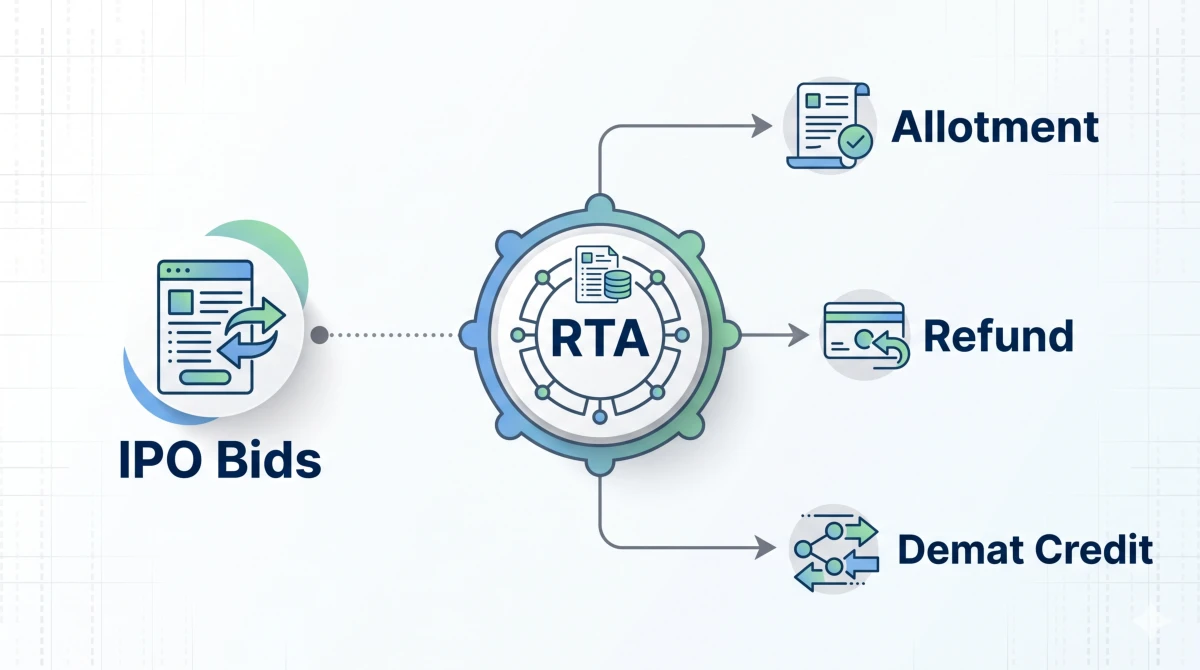
SEBI's 1993 registrar regulations describe the job plainly: finalise the list of persons entitled to allotment, and process and dispatch allotment letters, refund orders and related documents. Registration comes in two categories. Category I covers both issue-registrar and share-transfer work, while Category II covers either one. In an IPO the work runs in five stages.
| Stage | What the RTA does |
|---|---|
| Bidding window | Collates bid data and reconciles it with exchange, bank and depository records |
| After close | Prepares the basis of allotment, which the exchange must approve |
| Allotment day | Finalises the allottee list and sends banks the file to debit allotted amounts and release the rest |
| Before listing | Coordinates with CDSL and NSDL to credit shares to demat accounts |
| After listing | Answers investor queries and often continues as the company's share transfer agent |
At no stage does the RTA hold your money. Under UPI and ASBA your funds stay blocked in your own bank account, and the RTA's file only tells the bank what to debit and what to release.
RTA, Broker, Exchange and BRLM: Who Does What
Most allotment confusion comes from calling the wrong party. The table separates the four.
| Party | Who picks it | Role | Ask it about |
|---|---|---|---|
| Broker or UPI app | You | Places your bid and blocks funds | Bid status, mandate errors |
| Exchange (NSE/BSE) | Issuer lists on it | Collates bids, approves basis of allotment | Subscription data, listing |
| BRLM | Issuer | Manages the offer: documents, pricing, marketing | Offer structure |
| RTA | Issuer | Allotment data, refunds, share-credit instructions | Allotment outcome, credit, refund |
You choose your broker. You never choose the registrar, and a new IPO can use a different one from the last IPO you applied to.
The Registrars You Will Actually Meet
Meera finds her answer on the exchange's IPO page: MUFG Intime India, formerly Link Intime. She is in good company. A tracker of 209 IPOs with a registrar on record shows three names doing most of the work.
| Registrar | Mainboard IPOs | SME IPOs | Total |
|---|---|---|---|
| KFin Technologies | 42 | 27 | 69 |
| MUFG Intime (formerly Link Intime) | 33 | 15 | 48 |
| Bigshare Services | 14 | 29 | 43 |
Source: ipomarket.in registrar tracker, accessed October 2026. These are one tracker's counts, not an official SEBI ranking.
KFin and MUFG Intime together handled 75 of the 90 mainboard issues in that set, about 83%. Bigshare leads in SME issues with 29. Skyline Financial Services and Cameo Corporate Services also act as registrars.
Practical Tips
Myth vs Reality
| Myth | Reality |
|---|---|
| The RTA chooses who gets shares | The RTA runs the exchange-approved basis. In an oversubscribed retail category, lots are drawn by computer, not picked by a person |
| My broker can explain why I was not allotted | Your broker holds only your bid. The allotment file sits with the RTA |
| The registrar sends my refund | Under UPI and ASBA nothing was taken, so the bank simply releases the block after the RTA's file arrives |
How to Find Your IPO's Registrar and What to Ask It
IPO360's allotment status tracker at ipo360.in/allotment-status is the quickest starting point. The registrar is also named on the cover of the RHP and on the IPO's page on NSE or BSE. Once allotment is finalised, open the registrar's own portal, select the IPO and enter your PAN, application number or DP ID. The IPO usually appears in the dropdown only after allotment is final.
If the result puzzles you, SEBI's May 2025 investor charter for RTAs gives you the right to seek clarification on allotment and to see the RTA's escalation matrix.
Meera enters her PAN on MUFG Intime's portal and sees "not allotted". The issue was oversubscribed and her single lot did not come up in the draw. Her blocked amount is released, she has lost nothing, and she now knows which party answers allotment questions.
KEY TAKEAWAYS
An RTA is a SEBI-registered registrar appointed by the issuer, not by you, your broker or the exchange. It reconciles bids, runs allotment on the exchange-approved basis and sends the files that debit or release your funds. Your broker knows your bid, but only the RTA holds the allotment record. KFin Technologies, MUFG Intime and Bigshare handle most issues, with Bigshare strongest in SME. The registrar changes from IPO to IPO, so check it each time. Before your next application, note the registrar's name from the RHP so allotment day holds no surprises.