Index
Index
IPO Timeline- Introduction
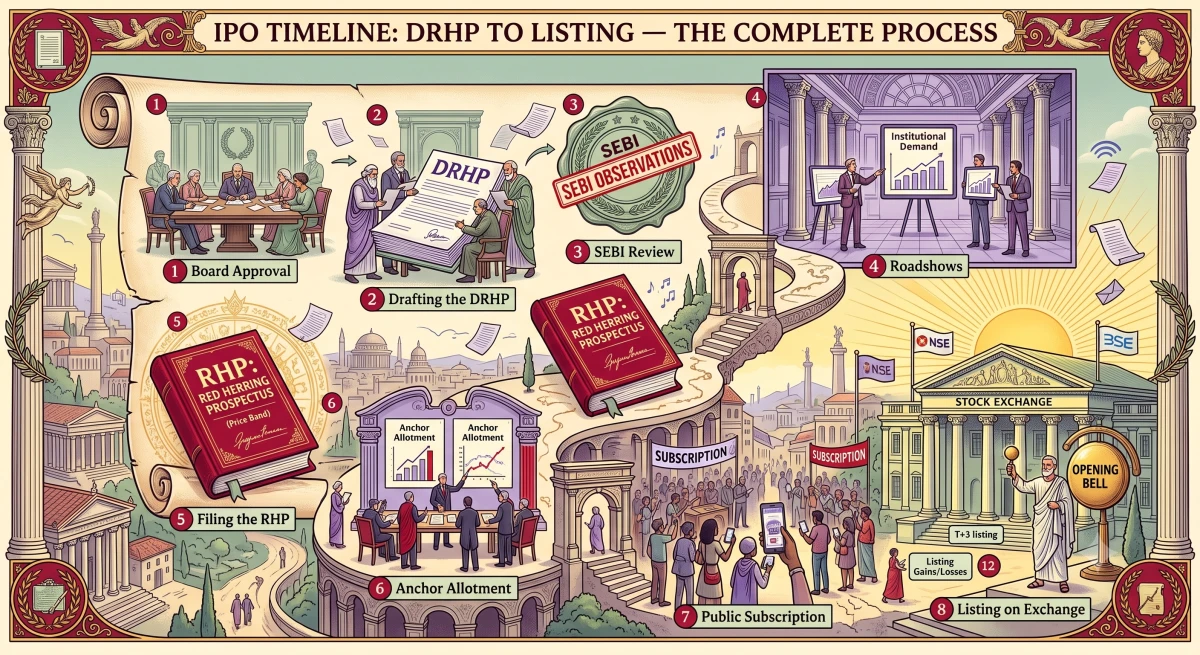
By the time you see an IPO open for subscription on your broker app, the company has already spent a year or more preparing for that three- days window. Going public is one of the most demanding exercises a company undertakes. A long chain of due diligence, regulatory filings, valuation debates, and investor roadshows, all under SEBI's supervision. Understanding this behind-the-scenes journey isn't just trivia it tells you how seriously a company has been vetted, what the key documents mean, and why timelines matter. This guide walks through the entire IPO process in India, stage by stage, from the boardroom decision all the way to the opening bell on listing day.
An Easy Way to Think About It: A Cricketer's Debut
An IPO is like a cricketer's debut for the national team. In domestic cricket, only selectors and scouts know how good he is. That's a private company. His India debut is the IPO so suddenly millions can watch him and "buy in." Years of trials and selector scrutiny come first, just as a company faces due diligence, the DRHP, and SEBI's review before listing. And remember a dazzling debut doesn't guarantee a great career, just as a big listing gain doesn't guarantee a good long-term investment.
Stage 1: The Internal Decision and Board Approval
Before anything public happens, the company's board of directors and shareholders must formally approve the plan to go public. At this stage, management decides why it needs the money, roughly how much to raise, and what the split between fresh issue and Offer for Sale (OFS) will be. Promoters and early investors decide how much of their own stake they're willing to sell.
This is also the clean-up phase. The company regularises its corporate structure, resolves related-party transactions, sorts out Employee Stock Ownership Plan [ESOP] schemes, and ensures its financials can withstand intense public scrutiny. Companies with messy books or unresolved legal issues often spend months here before they're IPO-ready.
Stage 2: Appointing the Merchant Bankers (BRLMs)
The company then hires one or more Book Running Lead Managers, the investment banks that run the entire IPO. For large issues, there are often several working together (names like Kotak Mahindra Capital, Axis Capital, and ICICI Securities appear frequently on Indian mainboard IPOs).
The BRLMs' responsibilities are vast they conduct due diligence, drafting the offer documents, valuing the company, marketing the issue to institutions, and managing the pricing. Alongside them, the company appoints legal counsel, independent auditors, and a Registrar and Transfer Agent (RTA) such as Link Intime(now MUFG Intime) or KFin Technologies, who later handles allotment and refunds.
Stage 3: Due Diligence and Drafting the DRHP
This is the heavy-lifting phase. The bankers and lawyers pore over the company's financials, contracts, litigation history, and business risks in exhaustive detail. The output of all this work is the Draft Red Herring Prospectus (DRHP) — the single most important document in the entire process.
The DRHP covers the business model, audited financials, detailed risk factors, promoter and shareholder details, and the "objects of the issue" with a precise breakdown of how the money raised will be used. One important thing to note: the DRHP does not contain the final price band or issue size. Those come later
Stage 4: Filing with SEBI and the Exchanges
The company files the DRHP with SEBI and simultaneously with the stock exchanges (NSE and BSE), paying the applicable fees. SEBI makes the DRHP publicly available so that investors, analysts, and the media can examine it. At the same time, the company applies to the exchanges for in-principle approval to list its shares.
This public availability is a genuine advantage for retail investors as the DRHP is a free, comprehensive source of information straight from the company, far more reliable than social media speculation.
Practical Tips
Stage 5: SEBI Review and Observations
SEBI scrutinises the DRHP, raises queries, and asks the company for clarifications or additional disclosures. This review can take anywhere from a few weeks to a few months, depending on the complexity of the company and how complete its filing was.
Once satisfied, SEBI issues its "observations" and gives a green light to proceed. A crucial point for investors: SEBI's observation is not an endorsement of the company or its valuation. It only confirms that the disclosures meet regulatory standards. The investment judgement remains entirely yours. The approval is also time-bound and the company typically must launch its IPO within one year of receiving SEBI's observations.
Practical Tips
Stage 6: Marketing and the Roadshow
With SEBI's observations in hand, the bankers take the company's management on roadshows — a series of presentations to institutional investors such as mutual funds, insurance companies, and foreign funds, held across major financial hubs.
The purpose is twofold: to generate interest and to gauge appetite. The feedback from these meetings directly influences how the IPO is priced. Strong institutional demand allows a company to price at the higher end of its intended range; lukewarm interest may force a more conservative price. This is also where the anchor book begins to take shape.
For a recent example you may consider ZEPTO where their valuation expectations did not match in these roadshows with the investors
Stage 7: Filing the RHP and Setting the Price Band
Based on the demand gauged during roadshows, the company finalises its price band (for example, ₹100–₹105 per share) and the lot size, then files the Red Herring Prospectus (RHP) with the Registrar of Companies. The RHP is the near-final offer document, now complete with the price band. The public subscription dates are announced at this stage.
Here's a quick summary of the key documents in the process:
| Document | When filed | Contains price band? |
|---|---|---|
| DRHP | Filed with SEBI for review | No |
| RHP | Filed after SEBI observations, before opening | Yes |
| Prospectus | Filed after issue price is finalised | Yes (final price) |
Stage 8: Anchor Investor Allotment
One business day before the IPO opens to the public, a portion of shares is allotted to anchor investors — large, credible institutional investors who commit early. A strong anchor book sends a powerful signal to the wider market: if respected institutions are backing the issue, retail and other investors gain confidence.
To prevent these big investors from dumping shares immediately after listing, SEBI enforces a lock-in on anchor allotments. Under current rules, 50% of an anchor investor's shares are locked in for 30 days from allotment, and the remaining 50% for 90 days. This phased lock-in reduces the sharp post-listing sell-offs that used to hurt retail investors.
Stage 9: The Public Subscription Window
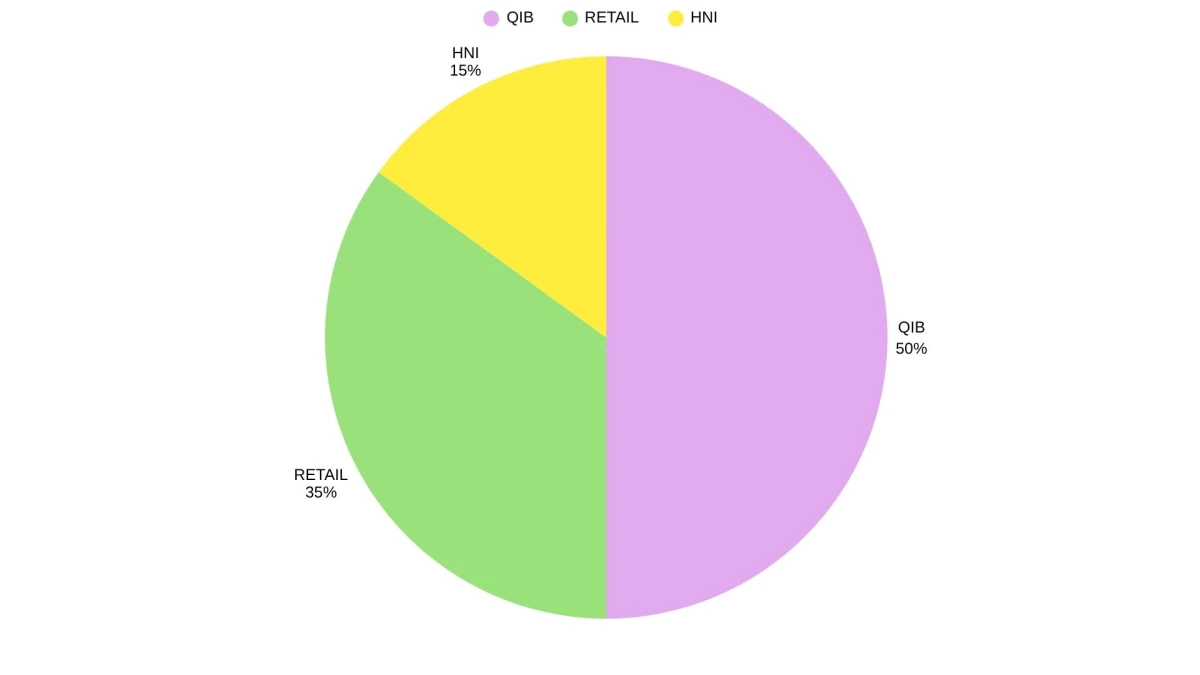
This is the stage retail investors actually see. The IPO opens for three business days, during which retail investors, HNIs (High Net-worth Individuals), and QIBs (Qualified Institutional Buyers) place their bids within the price band using UPI or ASBA.
Each category has a reserved quota. For a standard book-built mainboard IPO, the typical split is 50% for QIBs, 15% for non-institutional investors (HNIs), and 35% for retail investors. The exchanges display live subscription figures throughout, showing how many times each category has been subscribed — a figure you'll see quoted as "22 times subscribed" or similar.
Stage 10: Price Discovery and Allotment
After the subscription window closes, the final issue price is fixed based on the bids received (in a book-built issue, this is the cut-off price). The RTA then processes the allotment.
If the issue is oversubscribed — which most successful IPOs are — retail shares are allotted through a computerised lottery, so getting shares is partly down to luck. Successful applicants have their blocked funds debited; unsuccessful applicants have their funds released. Thanks to the ASBA and UPI systems, your application money is only blocked in your bank account during this period, not actually debited, until shares are allotted to you.
Stage 11: Listing on the Exchange
Under current SEBI rules — mandatory for all IPOs since December 1, 2023 — shares must list on a T+3 basis, meaning three business days after the issue closes. This was reduced from the earlier T+6 timeline to free up investor capital faster and enable quicker refunds.
On listing day, trading doesn't begin immediately at the regular market open. There's a special pre-open session (typically 9:00 to 9:45 AM) where buy and sell orders are collected to discover the opening price based on demand and supply. After this session, the stock begins trading freely, and its price moves with the market. This is the moment the "listing gain" or "listing loss" becomes real.
Stage 12: Post-Listing Obligations
The journey doesn't end at listing. Once public, the company takes on a permanent set of responsibilities. It must publish quarterly financial results, make continuous disclosures of material events, and comply with SEBI's LODR (Listing Obligations and Disclosure Requirements) framework and corporate governance norms.
Promoter shareholdings are subject to lock-in periods, and the company must maintain a minimum level of public shareholding over time. In short, going public trades the privacy of a private company for the capital, visibility, and accountability of a listed one — a trade-off that reshapes how the company operates for good.