Index
Index
Types of IPOs in India: Mainboard, SME & FPO
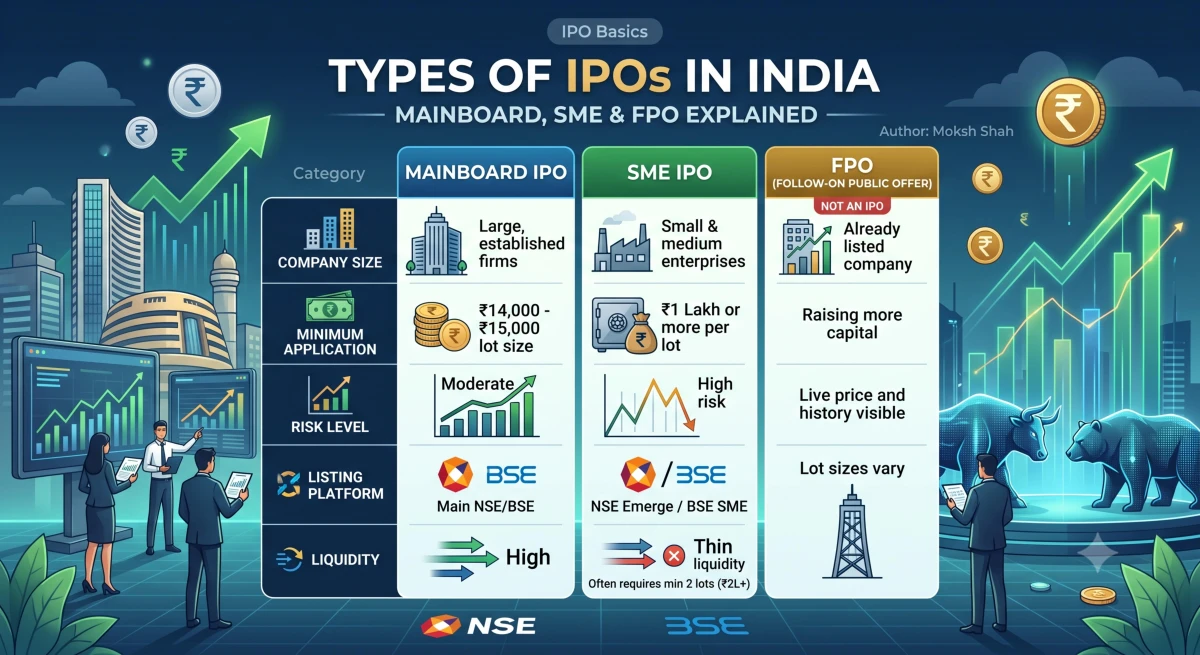
When most people say "IPO," they picture one thing: a big, well-known company selling shares to the public for the first time. But that is only one flavour. In India, public offerings come in a few distinct forms, and the differences are not cosmetic. They change how much money you need to apply, how much risk you are taking on, how liquid the stock will be after listing, and even who is allowed to vet the company before it reaches you.
Get the type wrong and you can end up locking ₹2 lakh into a thinly traded SME stock when you thought you were applying to a regular ₹15,000-lot mainboard issue. This guide walks through the three types you will actually encounter, which are the Mainboard IPO, the SME IPO, and the FPO, along with a few related terms worth knowing
Practical Tips
Mainboard IPO: The One Everyone Knows
A Mainboard IPO is the standard, full-size public offering, and it is what you think of when a company "goes public." These are larger, more established firms that list directly on the main platforms of the NSE and BSE.
To qualify, a company generally needs a post-issue paid-up capital of at least ₹10 crore, and it must clear SEBI's ICDR (Issue of Capital and Disclosure Requirements) eligibility tests. There are broadly two routes to qualification. The first is the profitability route, which requires an average operating profit of at least ₹15 crore across the last three years, among other conditions. The second is the book-building route under Regulation 6(2), where a company that does not meet the profit test can still list if it allots at least 75% of the issue to Qualified Institutional Buyers (QIBs).
The key protection for retail investors is that the DRHP of a mainboard IPO is reviewed directly by SEBI, which can raise observations, seek clarifications, or delay the offer until its concerns are addressed. That regulatory scrutiny is a big reason mainboard listings carry lower governance risk than SME issues.
For you as an investor, two things matter most. First, the application size is affordable, usually around ₹14,000 to ₹15,000 for one lot. Second, once the shares are listed, they trade freely in any quantity, including a single share, with strong liquidity from both retail and institutional participation.
SME IPO: Smaller Companies, Bigger Swings
SME IPOs exist because small and medium enterprises often cannot clear the mainboard bar, since they lack the track record, scale, or profitability. To give them a route to public capital, the NSE and BSE created dedicated platforms called NSE Emerge and BSE SME.
The eligibility rules are lighter. A company must have a post-issue paid-up capital between roughly ₹1 crore and ₹25 crore. If it crosses the ₹25 crore ceiling, it no longer qualifies for the SME platform and must go to the mainboard instead. Under SEBI's March 2025 ICDR amendments, the framework tightened further: an issuer with post-issue paid-up capital up to ₹10 crore is eligible directly, while those above ₹10 crore and up to ₹25 crore face additional conditions. Companies typically must also have been operational for three years with positive EBITDA in at least two of the last three years.
Crucially, on the SME platform the stock exchange reviews the offer documents, with SEBI playing a supervisory role rather than the direct, line-by-line vetting a mainboard DRHP receives. Less scrutiny means more responsibility falls on you to do your own homework.
Two features tend to catch retail investors off guard. The first is the large minimum application, which is usually ₹1,00,000 or more per lot, compared with about ₹14,000 for a mainboard issue, so you cannot apply for a small amount. The second is thin post-listing liquidity, because SME stocks can trade in very low volumes with wide bid-ask spreads. Exiting is not always easy, and prices can move sharply on small trades.
Practical Tips
Mainboard vs SME IPO: Side by Side
Here is how the two stack up on the factors that actually affect your decision:
| Factor | Mainboard IPO | SME IPO |
|---|---|---|
| Company size | Large, established | Small or medium |
| Listing platform | Main NSE / BSE | NSE Emerge / BSE SME |
| Post-issue paid-up capital | ₹10 crore or more | ₹1 to ₹25 crore |
| Document vetting | SEBI (direct) | Exchange (SEBI supervisory) |
| Minimum application | ₹14,000 to ₹15,000 | ₹,00,000 or more |
| Profitability required | Yes, or the QIB book-building route | EBITDA track record; lighter |
| Post-listing liquidity | High | Often thin |
| Risk level | Moderate | High |
Practical Tips
FPO: Not Actually an IPO
Here is where terminology trips people up. An FPO (Follow-on Public Offer) is often lumped in with IPOs, but it is a different event. In an IPO, a company offers shares to the public for the first time. In an FPO, a company that is already listed comes back to the market to raise more capital.
Because the company is already trading, you can see its live market price, its history as a public company, and its post-listing track record before you decide, which is information you simply do not have in a genuine IPO. FPOs use the same mechanics you will recognise, such as price bands, anchor investors, the QIB, NII, and retail categories, and lot sizes.
The clearest recent example is Vodafone Idea's ₹18,000 crore FPO in April 2024, one of the largest follow-on offers in Indian history. It was priced at ₹11 per share, raised ₹5,400 crore from 74 anchor investors ahead of the offer, and was subscribed 7 times overall. Notably, the retail portion was fully subscribed, while QIBs came in at over 17 to 19 times.
It is also worth remembering that FPOs can be pulled. Adani Enterprises' ₹20,000 crore FPO in early 2023 was fully subscribed but was called off and refunded after the stock crashed on the back of the Hindenburg report, which proves that even a subscribed offer is not guaranteed to complete.
A Few Related Terms You Will See
Beyond the three main types, a handful of terms describe how an offer is structured rather than the size of the company. These are not separate types of IPO so much as features that can apply to a mainboard or an SME issue.
A Fresh Issue is one where the company creates and sells new shares, and the money raised goes into the company for expansion, debt repayment, or working capital. An Offer for Sale (OFS) is one where existing shareholders, such as promoters or early investors, sell their shares, and the money goes to them rather than to the company. Many IPOs are a mix of both. Finally, the distinction between book-built and fixed-price offerings describes how the price is set: a book-built IPO uses a price band and lets demand determine the final price, whereas a fixed-price IPO sets a single price upfront. Most large IPOs today are book-built.
Knowing these terms helps you read a prospectus properly. An IPO that is entirely an OFS, for instance, raises nothing for the company itself, which is worth knowing before you assume your money is funding growth.
Which Type Suits You?
There is no universally "best" type, because the right choice depends on your risk appetite and how much work you are willing to do.
Mainboard IPOs suit most retail investors. They offer a lower ticket size, higher liquidity, direct SEBI oversight, and a broader base of research and analysis to lean on. If you are newer to IPO investing, this is where to start.
SME IPOs are for investors who can afford a commitment of ₹2 lakh or more, who understand that they may struggle to exit quickly, and who are willing to dig into offer documents themselves. The upside can be significant, but so can the downside, and the lighter regulatory review means the safety net is thinner.
FPOs involve a different decision entirely. Since the company is already listed, treat it more like buying an existing stock at a possibly discounted price than a bet on an unknown debutant. Look closely at why the company needs the money, because network expansion is a very different story from plugging debt.