Index
Index
What is an IPO Price Band?
When a company launches a book-built IPO, it doesn't sell shares at a single fixed price. Instead, it announces a price band — a range with a lower limit (the floor price) and an upper limit (the cap price) — and asks investors to bid anywhere within that range. When Bajaj Housing Finance came to market in September 2024, its price band was ₹66–70 per share. You could bid at ₹66, ₹70, or any rupee value in between. The price band is one of the first numbers you'll check about any IPO, because it decides how much you'll pay per share and, combined with the lot size, how much money you need to apply. This guide breaks down exactly what the band is, who sets it, and how to bid within it.
Practical Tips
Floor Price vs Cap Price: The Two Ends of the Band
Every price band has two boundaries, and understanding both matters.
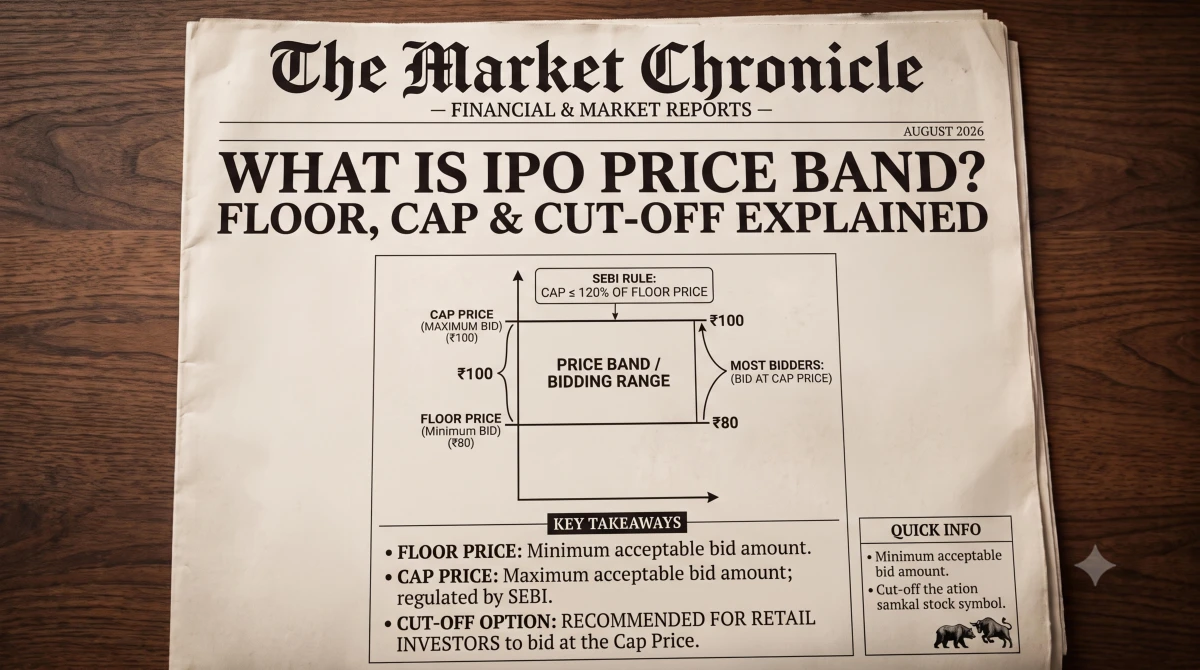
The floor price is the minimum you're allowed to bid. It's the price below which no bid is accepted. The cap price (also called the ceiling) is the maximum. The company will not price the issue above this number, no matter how strong demand is.
The gap between them is deliberately narrow because of a SEBI rule under the ICDR Regulations: for a book-built issue, the cap price cannot exceed 120% of the floor price. So if the floor is ₹100, the cap can be at most ₹120. This stops companies from advertising a low, attractive floor and then pricing far higher.
Here's how that looked across some well-known IPOs:
| IPO | Price Band | Spread (Floor → Cap) |
|---|---|---|
| Ola Electric (Aug 2024) | ₹72 – ₹76 | ~5.6% |
| Bajaj Housing Finance (Sep 2024) | ₹66 – ₹70 | ~6.1% |
| Hyundai Motor India (Oct 2024) | ₹1,865 – ₹1,960 | ~5.1% |
| Tata Technologies (Nov 2023) | ₹475 – ₹500 | ~5.3% |
| LIC (May 2022) | ₹902 – ₹949 | ~5.2% |
Notice most bands are a tight 5–6% spread even though SEBI allows up to 20%. Companies keep it narrow to signal confidence and simplify the bidding decision.
Practical Tips
Who Decides the IPO Price Band?
The price band isn't picked randomly. It's set by the company's management together with the Book Running Lead Managers (BRLMs) — the investment banks managing the issue — usually just a few days before the IPO opens.
They arrive at the range through a mix of inputs: the company's financials and profit history, valuation multiples (like P/E ratio) of already-listed peers, the total amount the company wants to raise, overall market sentiment, and — importantly — feedback from large institutional investors gathered during pre-IPO roadshows. Anchor investors, who are allotted shares one day before the IPO opens, also give a strong real-money signal about what serious buyers think the shares are worth.
The band is then filed in the Red Herring Prospectus (RHP) and announced publicly. Because it reflects negotiation and demand-testing rather than a fixed formula, two analysts can reasonably disagree on whether a given band is cheap or expensive — which is exactly why reading the fundamentals yourself matters.
What is the Cut-Off Price? (The Retail Shortcut)
Most retail investors don't agonise over which rupee value to bid. They tick a box called "cut-off price."
Bidding at cut-off means you agree to accept whatever final price the company sets within the band — effectively bidding at the cap. If the shares are eventually priced below the cap, you get a refund for the difference. This is why cut-off bidding is popular: you maximise your chance of allotment (since you're bidding at the highest price) without having to guess the final number.
For example, in the Bajaj Housing Finance IPO (band ₹66–70), a retail investor bidding at cut-off was effectively bidding ₹70. The issue was priced at ₹70, so no refund was needed. Only retail investors and eligible employees/shareholders can use the cut-off option — QIBs and NHIs must bid at a specific price.
Practical Tips
Price Band Discounts: When You Pay Less Than the Floor
Sometimes a company offers a discount to specific investor categories, letting them buy below the floor price. This is most common in large government-backed issues.
The clearest example is the LIC IPO of May 2022. The band was ₹902–949, but LIC policyholders got a ₹60 discount and retail investors plus employees got a ₹45 discount. So a retail investor bidding at cut-off paid ₹904 (₹949 − ₹45), and an eligible policyholder paid even less. These discounts are disclosed upfront in the RHP and applied automatically at allotment — you don't do anything extra beyond applying in the correct category.
Discounts are a way to reward loyal stakeholders and boost subscription in the retail and policyholder buckets. They don't appear in every IPO, so always check the "price" section of the RHP or the IPO detail page before assuming one exists
Can the Price Band Be Revised?
Yes — but within limits. A company can revise its price band during the bidding window, though this is uncommon. If it does, SEBI requires that the IPO bidding period be extended by at least three working days, and the revision must be advertised so existing bidders can reconsider.
More often, what changes is not the band itself but the final issue price set within it. After bidding closes, the company and BRLMs look at demand at each price level and fix the cut-off/issue price. In strong IPOs, this is almost always the cap: Hyundai Motor India priced at ₹1,960 (the top of its ₹1,865–1,960 band), and Tata Technologies priced at ₹500 (the top of ₹475–500). A price set at the floor, or a downward band revision, is usually a sign of weak demand — a caution flag worth noting.
Price Band vs Fixed Price IPO
A price band only exists in a book-built IPO. In a fixed price IPO — more common among smaller SME issues — the company names a single price and you either apply at that exact number or you don't. There's no range, no bidding, and no cut-off option because there's nothing to discover; the price is set in advance.
The book-building band exists precisely to discover the right price through investor demand, which is why larger mainboard IPOs almost always use it. If you see a single price with no floor and cap, you're looking at a fixed price issue.
How the Price Band Affects Your Investment Amount
The price band, together with the lot size, tells you the cheque you need to write. Exchanges require every retail application to be worth roughly ₹14,000–₹15,000 at minimum, and the lot size is calibrated to the cap price so that one lot at the cap stays within the retail limit.
Take Bajaj Housing Finance: cap price ₹70, lot size 214 shares. One lot at cut-off cost 214 × ₹70 = ₹14,980. You must block this full amount at the cap (via UPI or ASBA) even if the shares are eventually priced lower — the excess is refunded. So when you check a price band, immediately multiply the cap by the lot size to know what will actually be blocked in your bank account.