Index
Index
Pre-IPO · Part 1 of 6
Priya, an illustrative retail investor, has applied for four IPOs this year and been allotted shares in none. This week a colleague offers her stock in a well-known company that has not yet listed. It is available today at what he calls a pre-IPO discount, with no allotment lottery involved. Her ₹1.5 lakh is ready to transfer.
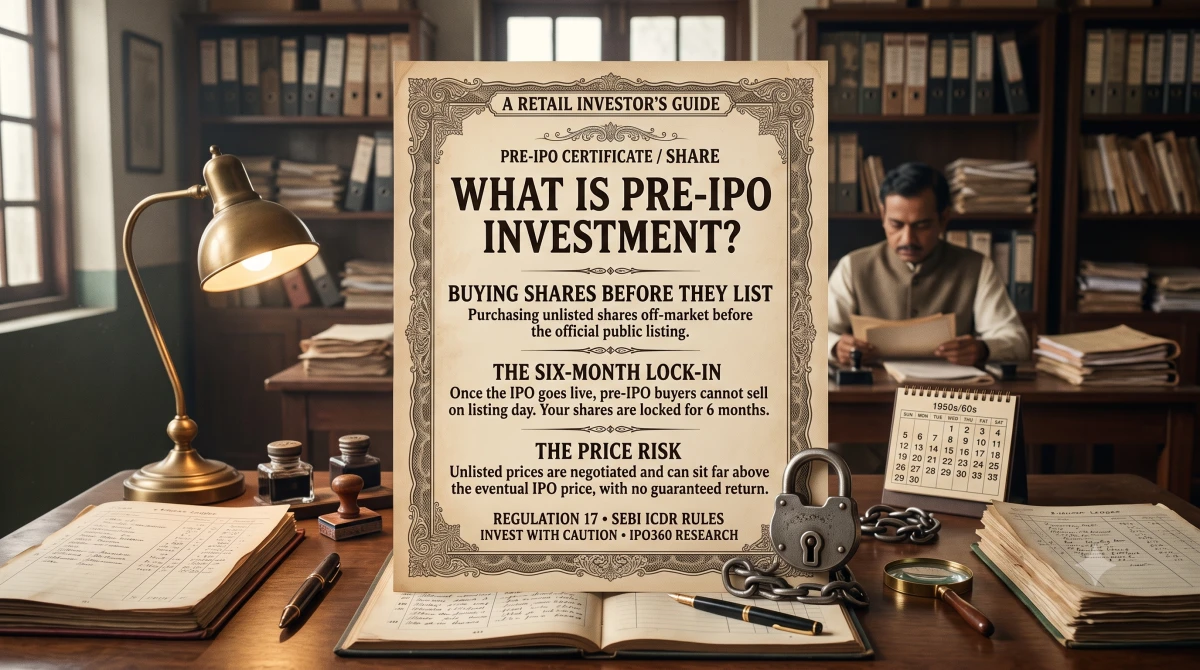
What she is being offered is a pre-IPO investment, meaning the purchase of a company's shares before they are listed on an exchange. In a market where IPO allotments are scarce, the appeal is obvious. The difficulty lies in what the offer leaves out. The price has been set by a dealer rather than by the market, and selling may not be possible for months after listing.
Practical Tips
How Pre-IPO Shares Reach Retail Investors
A company's shares are called unlisted when they do not trade on NSE or BSE. Those held by founders, early investors and employees can still change hands privately, and a pre-IPO investment is a purchase of such shares in the period before an IPO is expected. The transfer is completed off-market through the depositories, NSDL or CDSL, and the shares can be credited to an ordinary demat account. No separate account is needed.
| Route | Who sells | What it means for you |
|---|---|---|
| Secondary purchase via broker or dealer | Existing shareholders and early investors | The most common retail route; the dealer negotiates the price |
| ESOP sale | Employees holding vested options | Supply depends on the company's ESOP policy |
| Pre-IPO placement | The company itself, shortly before the IPO | Tends to go to institutions and large investors |
| Alternative Investment Fund (AIF) | A pooled fund holding unlisted shares | Indirect exposure, usually with higher minimum tickets |
For most retail investors, the secondary route is the only practical one. It is also the route where price discovery is weakest, which matters for everything that follows.
Pre-IPO Versus IPO: What You Actually Get
The two routes are often described as alternatives, but they differ on almost every feature that affects your money.
| Feature | Pre-IPO (unlisted) purchase | Applying in the IPO |
|---|---|---|
| Price | Negotiated with a dealer or seller | Fixed within the declared price band |
| Allotment | Assured, once you pay and shares are transferred | Subject to subscription and the allotment draw |
| Where it trades | Off-market; no exchange price | Listed on NSE or BSE after the IPO |
| Oversight | Platforms may sit outside SEBI's direct supervision | Regulated issue process, with an RHP |
| Liquidity | Low; buyers can be hard to find | High after listing, subject to lock-in |
| Certainty | The IPO may be delayed or cancelled | The issue is already open and dated |
Certainty of ownership is the real benefit of the pre-IPO route. Everything else in the table is a cost you are choosing to carry in exchange for it.
The Lock-In Rule Most Buyers Discover Late
Under Regulation 17 of the SEBI ICDR Regulations, pre-issue capital held by persons other than promoters is locked in for six months from the date of allotment in the IPO. Certain categories of holders are exempt, so the offer document is the final authority on any given shareholder. The lock-in runs from the allotment date, which falls a few days before listing, so the effective wait after you first see the stock on screen is slightly shorter.
| Holder | Lock-in |
|---|---|
| Promoters (minimum 20% contribution) | 18 months from IPO allotment |
| Promoter holding above 20% | 6 months from IPO allotment |
| Non-promoter pre-IPO holders | 6 months from IPO allotment |
| Anchor investors | 50% for 30 days, the rest for 90 days |
| Retail IPO allottees | None |
The last row is the one that matters. An investor who wins an IPO allotment can sell on listing day. An investor who bought the same company pre-IPO generally cannot.
Practical Tips
Myth vs Reality: The Unlisted Price Is Not a Floor
Myth: Unlisted shares are always cheaper than the eventual IPO price. Reality: Unlisted prices are driven by dealer quotes and enthusiasm, and a company's IPO is priced through institutional book-building, which can pull the price well below what unlisted buyers paid. Outlook Business reported two clear cases from 2025.
| Company | IPO price | Reported unlisted high | Unlisted high vs IPO price |
|---|---|---|---|
| NSDL | ₹800 | About ₹1,250 | About 56% higher |
| HDB Financial Services | ₹740 | About ₹1,525 | About 106% higher |
Buyers at those highs were sitting on paper losses before the stock had even listed. The IPO may also not arrive on schedule, since a delayed or cancelled issue leaves the buyer holding illiquid shares with no exit date.
Who Should Consider It, and Who Should Not
An unlisted price is an opinion, while an IPO price band is a negotiation. A pre-IPO purchase suits an investor who can hold for a year or longer, who can afford to lose the amount invested, and who treats it as a small, deliberate allocation rather than a shortcut around IPO rejections. It suits a buyer who has confirmed the company's filing status and read its draft prospectus. It does not suit anyone who needs the money back soon, anyone borrowing to fund the purchase, or anyone persuaded by a tip on a messaging group.
Tax is a further cost to plan for. Unlisted shares held for under 24 months are taxed at your slab rate when sold, so a quick exit after the lock-in does not enjoy the treatment listed equity does.
Priya's illustrative outcome is a modest one. She declines the full ₹1.5 lakh, confirms where the company stands in the IPO process, and commits ₹30,000 that she can leave untouched for a year. Her next step, and yours, is to check that filing status and the lock-in terms in the offer document before sending any money to a dealer.
KEY TAKEAWAYS
A pre-IPO investment is a purchase of unlisted shares, usually through an off-market secondary deal arranged by a broker or dealer. It guarantees ownership but not a profit, and it does not guarantee that the IPO will happen on schedule. Non-promoter pre-IPO holders face a six-month lock-in from the IPO allotment date, while IPO allottees can sell on listing day. Unlisted prices are negotiated and can sit far above the eventual IPO price, as NSDL and HDB Financial showed in 2025. Holding such shares for under 24 months attracts tax at slab rates. Size the position as money you can leave untouched, and verify the filing status before you pay.