Index
Index
SEBI Regulations · Part 4 of 4
Priya bids ₹1.5 lakh in a mainboard IPO on Monday. By Thursday the issue has closed, and the company announces that it will not go ahead. Her first question is the one every applicant asks: is my money safe, and can they do this?
They can, and it is safe. Indian rules let an issuer walk away at several points, and they are strict about what must happen to your money when it does. The stage at which a company withdraws decides how much notice it must give and how quickly your funds must come back.
Practical Tips
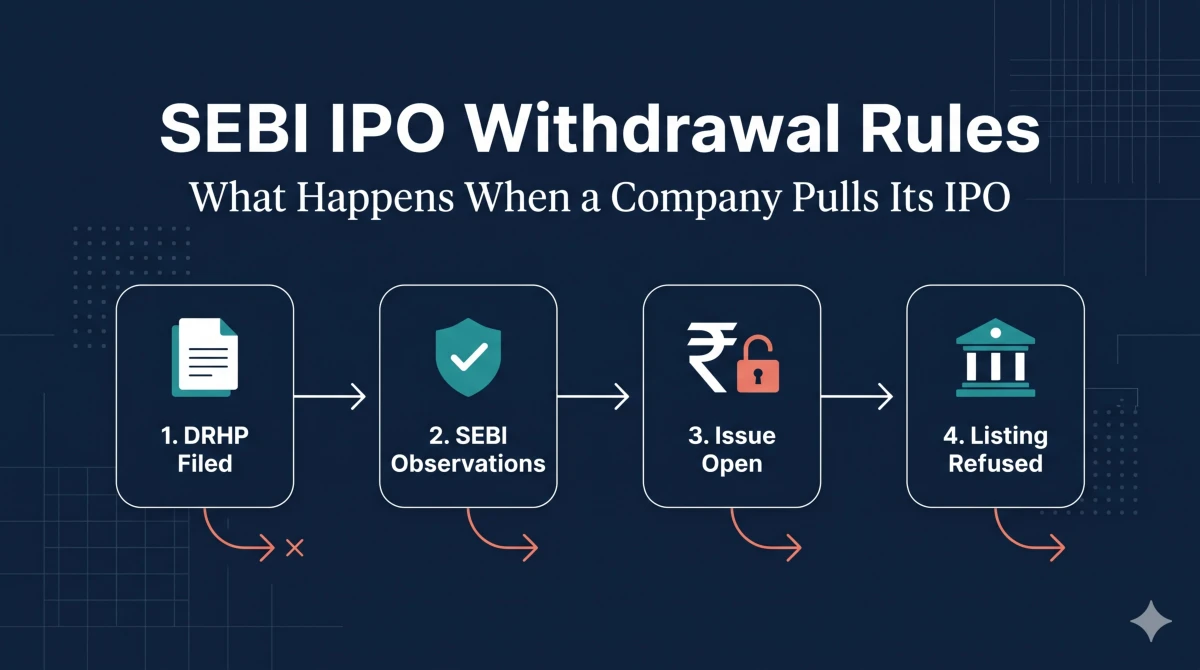
Four Stages, Four Different Rules
Withdrawal is not a single event. It looks different depending on how far the IPO has travelled.
| Stage | What the company does | What investors see |
|---|---|---|
| 1. DRHP filed, awaiting SEBI | Withdraws its draft papers from SEBI | A "withdrawn" status on SEBI's processing list. No money is involved. |
| 2. SEBI observations issued, RHP not filed | Lets the approval lapse or withdraws | Silence. The IPO simply never opens. |
| 3. Issue open, before allotment | Decides not to proceed | A public notice, then unblocking of all bids |
| 4. Allotted, listing permission refused | Cannot list | Full refund, even though shares were allotted |
Stage 1 is the most common. Indira IVF filed its preliminary papers with SEBI on February 13 and withdrew its draft offer document on March 19, 2025, without giving a reason. Stage 3 is the one that affects retail money, so it gets most of this article.
What Must Happen After the Issue Opens
Once bidding has started, the issuer cannot quietly retreat. Offer documents commit the company to a public notice within two working days of the issue closing date, giving reasons for not proceeding. The notice goes out in newspapers and to the stock exchanges.
For investors, the refund clock matters more than the notice. The issuer refunds all subscription amounts within four working days of the issue's closure. Because ASBA and UPI bids only block money rather than debit it, no manual action is needed; the bank releases the blocked amount once the registrar confirms. Offer documents also say that delayed unblocking beyond two working days from the closing date attracts compensation of ₹100 per day or 15% per annum of the bid amount, whichever is higher.
Priya's ₹1.5 lakh stays in her own account throughout. It is unavailable for a few days, not at risk.
Practical Tips
The 90% Rule: When Withdrawal Is Not a Choice
Myth: companies withdraw only when they want to. Reality: sometimes the rulebook decides for them.
Under ICDR Regulation 45, the minimum subscription must be at least ninety per cent of the offer, except in an offer for sale. If an issue falls short, the money goes back. This is the rule behind the recent SME failures.
Wagons Learning's issue opened on 2 May 2025 and was pulled days later; a company must receive applications for at least 90 per cent of the issue size. Phytochem Remedies' ₹38.22 crore issue is a cleaner example: it drew only 0.57x subscription and was withdrawn on December 22, 2025. The company blamed volatile markets, but the 90% rule was the hard stop.
GIFT City's first IPO showed the same pattern at a smaller scale. XED Executive Development pulled its issue after receiving subscriptions for only 5% of the shares on offer.
If a company misses the 90% floor but still wants to list, there is no workaround in the standard mainboard process. The money goes back. For what happens when demand is weak but the floor is met, see our guide on undersubscribed IPOs.
Withdrawn, Lapsed or Returned: Three Different Endings
A DRHP that goes nowhere can end in three ways, and they carry different consequences.
A withdrawal is the issuer's own decision. A lapse happens when time runs out: a public issue must open within twelve months of SEBI's observations, or eighteen months on the pre-filed route. SEBI gave a one-time extension for observations expiring between April and September 2026, but that window has now closed, so lapsed approvals need fresh filings.
A return is SEBI sending the draft back because it is deficient. Returned DRHPs carry a minimum six-month cooling-off before resubmission, and no filing fee is refunded. A voluntary withdrawal has no single fixed cooling-off that applies to every case. What the company must file next depends on the stage it withdrew at.
The confidential route changes the picture too. Under the confidential filing route, an issuer that decides not to proceed can withdraw without any substantive offer document staying in the public record. Captain Fresh used this route: it withdrew its confidential DRHP on December 24, 2025 and planned to refile after regulatory approvals for its acquisition.
How to Read a Withdrawal
Not every withdrawal is a warning. A company that withdraws because markets turned, or because it is reorganising around an acquisition, is behaving differently from one that withdraws after SEBI queries on revenue or promoter background.
Check three things when a withdrawal hits the news. First, the stage: a withdrawal before SEBI observations says little, while one after your money was blocked says more. Second, the stated reason: "market conditions" and "subscription below 90%" are different stories. Third, what happens at relaunch: if the company returns with a lower price band or changed financials, the earlier withdrawal was a price discussion.
Priya's ₹1.5 lakh was unblocked within the four-working-day window. She did not need to claim anything. She checked her bank statement, saw the amount free again, and moved on to the next IPO.
KEY TAKEAWAYS
- A company can withdraw at four stages, from pulling its DRHP to being refused listing after allotment.
- After the issue opens, the issuer must publish a notice with reasons within two working days of closing.
- Application money is refunded or unblocked within four working days of closure. No claim is needed.
- The 90% minimum subscription rule (Regulation 45) forces a refund on weak issues, except pure offers for sale.
- SEBI observations stay valid for 12 months (18 on the pre-filed route), after which a fresh filing is needed.
- A withdrawal is a signal to read, not an automatic red flag. Check the stage and the stated reason.