Rajnandini Fashion India Limited
1. Overview
Rajnandini Fashion India Limited (RFIL) is a Jaipur-registered, Surat-headquartered women's apparel company incorporated on October 11, 2010 (originally as Vyoum Trade Link Private Limited). The Company designs, manufactures and sells ethnic and casual wear through a dual-channel model — online (B2C) and wholesale/institutional (B2B). Its product portfolio spans unstitched dress materials, sarees, kurtis, kurta sets, co-ord sets, dresses, tops, tunics and maternity gowns, with key raw materials including poly-cotton, rayon, silk and cotton fabrics.
RFIL operates 2 in-house manufacturing facilities at Surat, Gujarat (Unit-I, commissioned August 2023, 90 sewing machines) and Jaipur, Rajasthan (Unit-II, commissioned December 2024, 50 sewing machines). Prior to 2023, the Company relied entirely on third-party manufacturing. The transition to in-house production has been a defining inflection point, enabling RFIL to scale revenue from Rs. 23.02 crore in FY23 to Rs. 30.69 crore in FY25, a ~33% rise over two years, while simultaneously expanding EBITDA margins from 3.67% to 24.38%.
RFIL's B2C channel operates through seven major e-commerce platforms (Amazon, Flipkart, Myntra, Ajio, LimeRoad, Nykaa, Shopsy) and its own website (www.rajnandinifashion.com). The Company has delivered over 2.78 lakh net B2C orders in FY25 and 2.91 lakh in the nine months ended December 2025. Platform recognition includes Flipkart "Gold Seller" status in Women's Ethnic Wear (March 2025) and Shopsy "Star Seller" designation (May 2024). The Company also holds ISO 9001:2015 certification for its Surat unit.
2. Business Model and Revenue Streams
Revenue Segmentation — B2C vs. B2B
RFIL's revenue mix has undergone a structural shift toward B2B in recent years, driven by active outreach to bulk buyers and garment processors:
| Segment | Dec26 | FY25 | FY24 | FY23 |
|---|---|---|---|---|
| B2B Revenue (₹ Cr) | 15.23 | 11.70 | 4.08 | 1.13 |
| B2B % of Total | 50.35% | 38.13% | 17.51% | 4.04% |
| B2C Revenue (₹ Cr) | 15.02 | 18.99 | 19.24 | 26.88 |
| B2C % of Total | 49.65% | 61.87% | 82.49% | 95.96% |
| Total Revenue (₹ Cr) | 30.25 | 30.69 | 23.32 | 28.01 |
The B2B ramp-up is notable — from just ₹1.13 crore in FY23 to ₹11.70 crore in FY25, a ~10x expansion in two years. B2B margin accretion is a key driver of the overall EBITDA improvement.
Revenue by Product Category (₹ in Cr)
| Category | FY25 | % |
|---|---|---|
| Manufactured — Casual & Ethnic Wear | 19.69 | 64.16% |
| Manufactured — Fabric | 0.40 | 1.30% |
| Trading — Casual & Ethnic Wear | 3.43 | 11.17% |
| Trading — Fabric | 7.17 | 23.37% |
| Total | 30.69 | 100% |
Pricing Strategy and Channel Economics
- B2C pricing: Primarily in the ₹250–₹2,000 range for online retail; positioned for mass-market and aspirational consumers
- B2B pricing: Bulk fabric and apparel supplied to wholesalers and garment processors; driven by volume contracts
- Return management: B2C gross orders far exceed net orders due to platform-level returns (~32–34% return rate); net B2C revenue is post-return
- Platform mix: Multi-platform strategy de-risks dependency on any single channel; Shopify-powered proprietary website adds direct-to-consumer capability
Operational Technology
The Company uses Uniware for inventory and order management and Shopify for its proprietary e-commerce platform, supporting stock monitoring, channel integration, order processing and return management.
3. Products and Service Portfolio
Ethnic Wear (Primary Segment)
- Unstitched Dress Materials: Entry price point (₹250–₹600); high-volume SKU
- Sarees: Mid-range (₹450–₹700); catering to traditional wear occasions
- Kurtis & Kurta Sets: Core SKU (₹400–₹2,000 range); covers budget to premium
- Patiala Suits: ₹450–₹2,000; strong northern and pan-India demand
Casual Wear (Growth Segment)
- Cotton Tops & Tunics: ₹400–₹699; everyday wear for the working-class consumer
- Dresses & Co-Ord Sets: ₹500–₹899; contemporary fashion for young urban buyers
- Maternity Gowns: ₹600–₹799; niche but premium-positioned
B2B Fabric Trading
- Printed Design Fabrics: Supplied to garment processors; high volumes
- Dyed Plain Fabrics: Bulk commodity trade; pricing driven by yarn input costs
B2B fabric revenue grew from Nil in FY23 to ₹7.17 crore in FY25, making it the single largest revenue sub-segment by FY25
Manufacturing Capacity Utilisation (9M FY26)
| Unit | Location | Installed Capacity | Actual Production | Utilisation |
|---|---|---|---|---|
| Unit-I | Surat, Gujarat | 4,60,460 pieces | 4,01,573 pieces | 87.21% |
| Unit-II | Jaipur, Rajasthan | 2,45,700 pieces | 1,67,155 pieces | 68.03% |
Unit-I is operating at near-optimal utilisation, validating the IPO's capex object of setting up a new 6,000 sq. ft. Surat facility. Unit-II, being newer (commissioned December 2024), is still ramping up toward optimal utilisation.
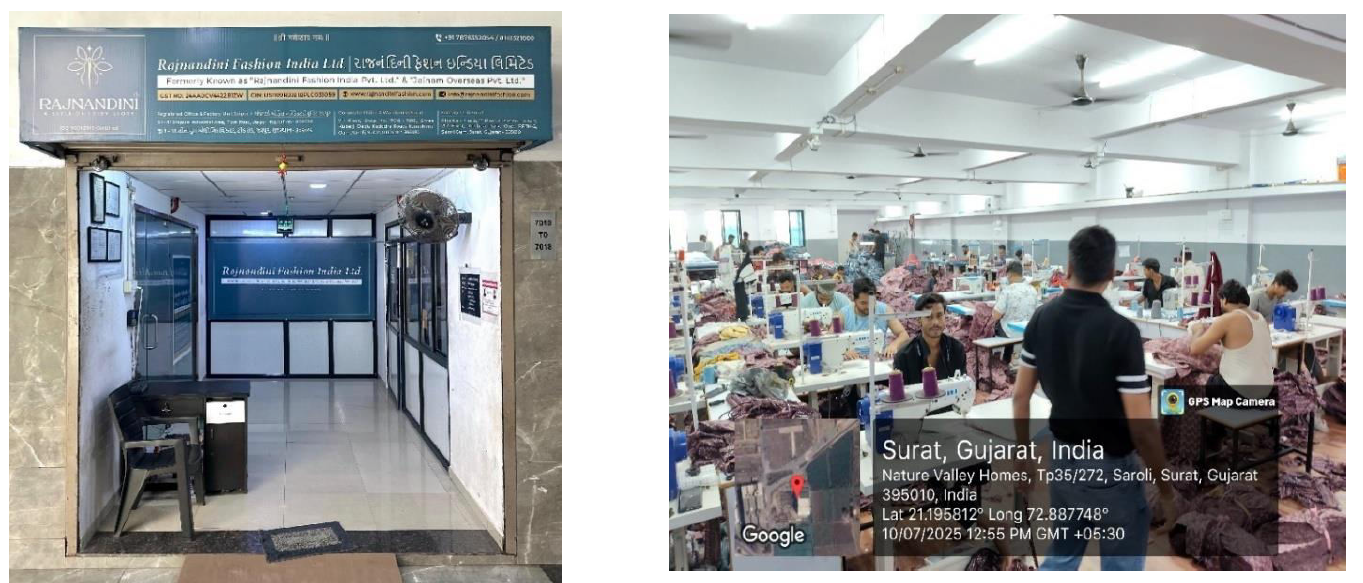
Four Brands under the Portfolio
- Merira — ethnic wear, premium positioning
- Monira — ethnic wear, mid-tier positioning
- Roly Poly — children's adjacent/casual
- Rajnandini — anchor house brand
4. Key Business Strengths
- Multi-platform B2C presence drives wide geographic reach — RFIL sells in 35+ states and UTs, with international exports to 4+ countries and expansion plans in South India
- In-house manufacturing (operational since August 2023) has been the primary driver of margin expansion from 3.67% EBITDA (FY23) to 24.38% (FY25), replacing costlier outsourced production
- High B2C capacity utilisation at Unit-I (87.21% in 9M FY26) demonstrates strong product-market fit and operational discipline at the core facility
- Validated platform credibility — Flipkart "Gold Seller" in Women's Ethnic Wear, ISO 9001:2015 certified, Shopsy "Star Seller" designation, underpinning brand trust
- B2B revenue ramp-up from ₹1.13 Cr (FY23) to ₹11.70 Cr (FY25) reflects a structural diversification away from solely retail-dependent income, improving revenue quality
- Broad product price architecture (₹250–₹2,000) enables RFIL to serve consumers across income strata, insulating the business from single segment slowdowns
- Technology-enabled operations via Uniware and Shopify enabling inventory optimisation, channel integration and return management at scale
5. Future Growth Strategy
- New Surat manufacturing facility — Proposed 6,000 sq. ft. expansion at Surat (total project cost ₹1.42 Cr, ₹1.35 Cr funded from IPO proceeds) to address Unit-I's near-full utilisation and unlock capacity for growing B2B and B2C order volumes
- Product portfolio diversification — Plans to enter kids' wear and men's wear segments in addition to existing women's wear, significantly expanding the total addressable market and broadening brand relevance
- B2B channel deepening — Engagement with new bulk buyers, garment processors and apparel retailers across new geographies; strategy to reduce dependence on any limited set of institutional buyers
- B2C amplification — Scaled presence on third-party e-commerce platforms supported by targeted digital campaigns, seasonal marketing and improved direct-to-consumer (D2C) channels to drive repeat purchases and brand recall
- Geographic expansion — Dedicated push into South India (currently underpenetrated), while maintaining domestic coverage across 35+ states; continued international exports into existing and new markets
- Working capital strengthening — IPO proceeds of ₹7.00 Cr allocated to working capital will support larger order volumes, faster inventory turns and improved credit terms with raw material suppliers
- Debt reduction — ₹5.50 Cr of IPO proceeds earmarked for partial repayment of borrowings; expected to reduce finance costs (FY25 finance cost: ₹1.05 Cr) and improve net margin trajectory





























Delete Comment?
Are you sure you want to delete this comment? This action cannot be undone.
Discussion
Join the discussion!
Log In to CommentNo comments yet. Be the first to share your thoughts!