Index
Index
Demat · Part 5 of 6
Meet Priya, an illustrative investor. She applied for a mainboard IPO through her old broker's app and got an allotment. Since then she has moved to a cheaper broker with a better portfolio view, and her allotted shares are stuck in the wrong account. Selling and rebuying would cost her brokerage and tax. Leaving them means paying charges on two demat accounts. The fix is an off-market transfer: shares move directly from one demat account to another, with no stock exchange involved. It takes minutes to submit, but it fails if you get three things wrong: the lock-in status, the beneficiary and the reason code.
Practical Tips
Three Checks Before You Start
First, the shares must be visible in your holdings. IPO shares are credited before listing, but the credit can reflect only on or just before listing day, so trust your demat statement rather than the allotment message. Second, check for a lock-in. Retail allottees, such as those in Bajaj Housing Finance's September 2024 IPO, face none. Anchor investors, however, have 50% of their shares locked for 30 days and the rest for 90 days from allotment, and pre-IPO shareholders for six months. Third, keep the receiving account's name, PAN, DP ID and client ID ready, even when it is your own account.
| Situation | Can it move off-market? |
|---|---|
| Retail allotment, credit visible in holdings | Yes, no lock-in applies |
| Credit not yet visible | Wait for it to reflect |
| Anchor or pre-IPO shares inside lock-in | No, locked shares cannot be transferred |
| Shares pledged for margin | Release the pledge first |
How to Transfer: Step by Step
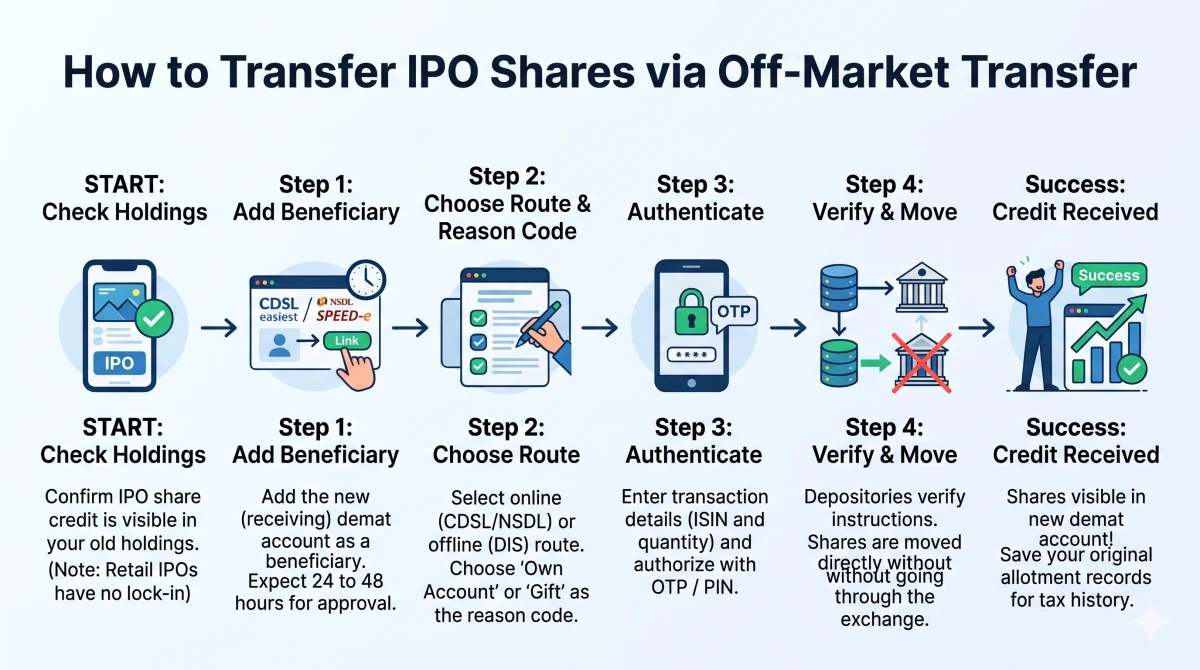
Since the end of 2023, every off-market transfer needs the receiving account added as a beneficiary first. That includes transfers between your own accounts and transfers between depositories. Without it, the system rejects the instruction. Choose the route that matches where your shares sit.
| Route | Who uses it | Notes |
|---|---|---|
| CDSL Easiest | CDSL account holders, online | Covers CDSL-to-CDSL and CDSL-to-NSDL transfers |
| NSDL SPEED-e | NSDL account holders, online | Register on the NSDL portal first |
| DIS (paper slip) | Anyone, through the broker | Up to 5 ISINs per slip; broker verifies by call or email |
The online sequence is the same on both portals. Log in and register, add the beneficiary account and confirm it with the OTP, then enter the ISIN, quantity and reason code, and authenticate the final instruction. Beneficiary approval is the slow step: on CDSL Easiest, a newly linked account can take about 24 working hours to become trusted, and some brokers quote 24 to 48 working hours.
Priya registered on CDSL Easiest, added her new NSDL account as a beneficiary and then waited a day before the link turned active. Only then could she enter the transfer.
Practical Tips
What the Transfer Costs
Costs depend on why you are moving the shares. Broker fees vary: some charge a flat amount per transaction, others a percentage with a minimum, and a few charge nothing extra. Check your DP's tariff sheet before you submit.
| Cost | Own account or family gift | Off-market sale |
|---|---|---|
| Stamp duty | Not payable | 0.015% of consideration, paid before the transfer |
| DP transfer fee | As per your broker's tariff | As per your broker's tariff |
| Tax at transfer | None | Capital gains for the seller |
Tax: A Transfer Moves Your Shares, Not Your Tax History
Myth: moving shares to a new account resets your purchase date and cost. Reality: for a transfer to your own account, there is no change of ownership, so no tax arises, and your original cost and holding period carry forward. The same applies to a gift to a relative: no tax at the time of gifting, and when the recipient later sells, the donor's cost and holding period are used.
On that later sale, the usual equity rates apply. Listed shares held for more than 12 months attract 12.5% long-term capital gains tax above the annual ₹1.25 lakh exemption, and shorter holdings attract 20%. Budget 2026 left both rates unchanged for FY 2026-27. Two cautions: a gift from a non-relative can be taxable for the recipient, and gifts to a spouse or minor child can lead to clubbing of the income they generate, so confirm with your CA.
When a Transfer Fails, and How Priya's Ended
Most rejections come from four causes: the beneficiary was never added (CDSL shows the error "Active link between seller and buyer does not exist"), the wrong reason code was chosen, the shares are locked in or pledged, or the receiving account's details do not match. Fix the cause and resubmit rather than repeating the same instruction.
Priya's transfer went through once her broker processed it. Her new broker may not show her original purchase price, so she saved her allotment statement and contract note for tax records.
KEY TAKEAWAYS
1. An off-market transfer moves shares directly between demat accounts, with no exchange involved. 2. Add the receiving account as a beneficiary first; allow 24 to 48 working hours for approval. 3. Retail IPO shares have no lock-in, but anchor and pre-IPO shares do and cannot move until it ends. 4. Pick the right reason code: own account and gift attract no stamp duty, while a sale attracts 0.015%. 5. A transfer to yourself or a relative triggers no tax, and your cost and holding period carry forward. 6. Keep your allotment statement and purchase records, because your new broker may not show your original cost.