Index
Index
Investor Categories · Part 5 of 9
₹170 off a ₹1,785 share. That was the discount NSE offered its own eligible staff in its September 2026 IPO, and it is the clearest reason employee quotas exist. Meera, a fictional employee at a company preparing its own listing, is looking at a price band topping out at ₹400 and a line in the prospectus she almost skipped: "Employee Reservation Portion". This guide follows her decision step by step, and uses NSE's IPO as the real-world check on the numbers.
Practical Tips
Who Counts as an Eligible Employee
Eligibility is defined in each company's Red Herring Prospectus (RHP), not by one universal rule. In practice, permanent employees and working directors of the issuer qualify, and the RHP may extend this to employees of Indian subsidiaries or the holding company. Contract workers, freelancers and consultants are generally excluded, as are promoters and their close relatives even when they are on the payroll.
Two conditions catch people out. You must qualify on a cut-off date stated in the RHP, so a recent joiner may miss out. And the benefit is personal: you cannot bid on behalf of a spouse, parent or friend.
How the Quota Works, Side by Side
| Feature | Employee category | Retail category |
|---|---|---|
| Size of quota | Up to 5% of post-issue capital (optional) | Minimum 35% of net offer (standard issue) |
| Bid limit | Up to ₹2 lakh, up to ₹5 lakh if the quota is undersubscribed | Up to ₹2 lakh |
| Price | Discount to issue price possible | Issue price |
| Cut-off price bidding | Allowed | Allowed |
| Who can apply | Eligible employees only | Any individual |
| If oversubscribed | Proportionate allotment, as per RHP | Computerised lottery |
The discount is the company's choice, and in practice it stays under roughly 10%. NSE gave ₹170 per share (about 9.5%), Indiqube Spaces gave up to 9.28% (₹22) in July 2025, and Canara HSBC Life gave ₹10 in October 2025. Some issues offer no employee discount at all, so check the RHP.
Practical Tips
Case Study: What the Discount Did in NSE's IPO
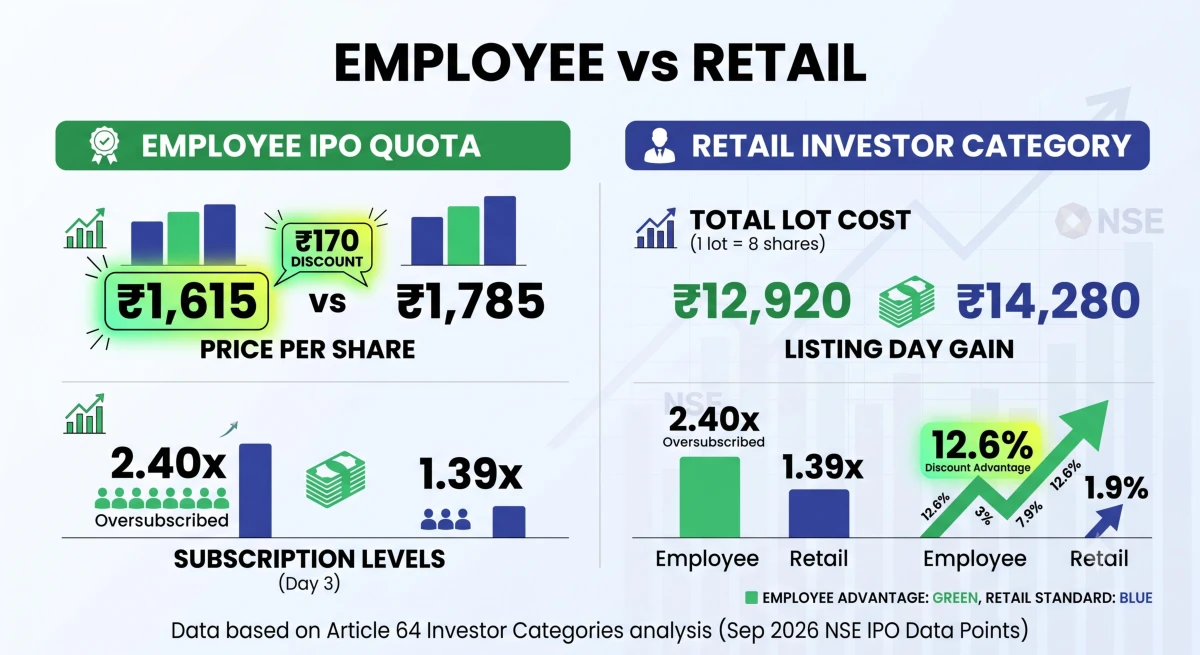
NSE's IPO priced at ₹1,785, opened on BSE at ₹1,800 on 24 September 2026, and last traded at ₹1,818 in the listing-day data. That is a modest gain of about 1.9% for a retail applicant. The discount changed the picture for employees:
| Item (NSE IPO, Sep 2026) | Employee | Retail |
|---|---|---|
| Price paid per share | ₹1,615 | ₹1,785 |
| Cost of one lot (8 shares) | ₹12,920 | ₹14,280 |
| Subscription (Day 3 snapshot) | 2.40x | 1.39x |
| Gain at ₹1,818 | ₹203 (12.6%) | ₹33 (1.9%) |
The same listing price produced very different returns because the employee's break-even sits about 9.5% below the issue price. The discount also cushions a weak listing: the shares could list well below the issue price before an employee is in the red.
A discount is a head start, not a strategy.
Employee, Retail, or Both? A Decision Guide
| Your situation | What to do |
|---|---|
| Eligible and comfortable with the company | Bid in the employee category to get the discount |
| Want more chances of getting shares | Bid in the employee category and separately in retail, which is generally permitted because they are different pools (confirm in the RHP) |
| Want to bid above ₹2 lakh as an employee | You can bid up to ₹5 lakh, but the amount above ₹2 lakh is allotted only if the quota is undersubscribed |
| Not eligible (contract staff, promoter group) | Use the retail category |
| Unsure about the business | Skip it. Loyalty is not a valuation |
Meera decides to bid 15 lots (525 shares) at the employee price of ₹380, which is ₹400 less a ₹20 discount. That comes to ₹1,99,500, just under the ₹2 lakh limit. She also places a separate retail bid for 1 lot of 35 shares at ₹400, which is ₹14,000.
Meera's Result
All figures here are illustrative. The employee quota closes at 1.5 times subscribed, so allotment is proportionate and Meera receives two-thirds of her bid: 350 shares, costing ₹1,33,000. The rest of her blocked amount is released. Her retail bid loses the lottery and gets nothing. If the stock lists at ₹420, her gain is ₹14,000, or 10.5% on what she paid, compared with 5% for a retail buyer at ₹400.
The second bid barely mattered, and the discount did most of the work. She also concentrated more of her money in her employer's stock, which brings up a risk the discount does nothing to reduce.
Practical Tips
KEY TAKEAWAYS
The employee quota is optional and capped at 5% of post-issue capital. Only eligible employees on the RHP's cut-off date qualify, and the benefit cannot be transferred. The bid limit is ₹2 lakh, stretching to ₹5 lakh only if the quota is undersubscribed. The discount is set by the company and stays under roughly 10% in practice. Oversubscription means proportionate allotment, and NSE's employee portion was about 2.4 times subscribed. Before your employer's next IPO, read the "Employee Reservation Portion" section of the RHP and note the cut-off date, discount and limit before the issue opens.