Index
Index
NRI IPO Investment: Rules, Restrictions, and How to Apply
Here's the thing most guides get slightly wrong: there's no such thing as an "NRI category" in an Indian IPO. SEBI's reservation buckets — retail, NII, QIB — don't care about residency. For IPO purposes, being an NRI isn't a category at all; it's a residency status your bank account has to prove before SEBI even asks which category you're in. Get the account infrastructure wrong, and it doesn't matter whether your bid would have qualified as retail or HNI — the application simply won't go through, or worse, gets flagged after the fact. This guide walks through exactly what an NRI needs in place, gate by gate, before bidding on an Indian IPO.
Practical Tips
NRI Is a Status, Not a SEBI Category
It helps to separate two questions that guides often blur together: "Am I eligible to apply at all?" and "Which reservation bucket does my bid fall into?" The first question is about residency and account infrastructure — FEMA territory. The second is exactly the same retail-vs-NII math covered for resident investors: bid up to ₹2 lakh and you're retail, with lottery-based allotment and the cut-off price option; bid above that and you're NII, with proportionate allotment and no cut-off pricing.
An NRI bidding ₹1.5 lakh competes in the same retail pool, against the same lottery odds, as a resident retail investor bidding the same amount. There's no separate NRI quota, no separate NRI lottery, and no NRI-specific reservation percentage. The residency status only changes how the money gets there — not where it lands once it arrives.
The Account Infrastructure: NRE vs NRO
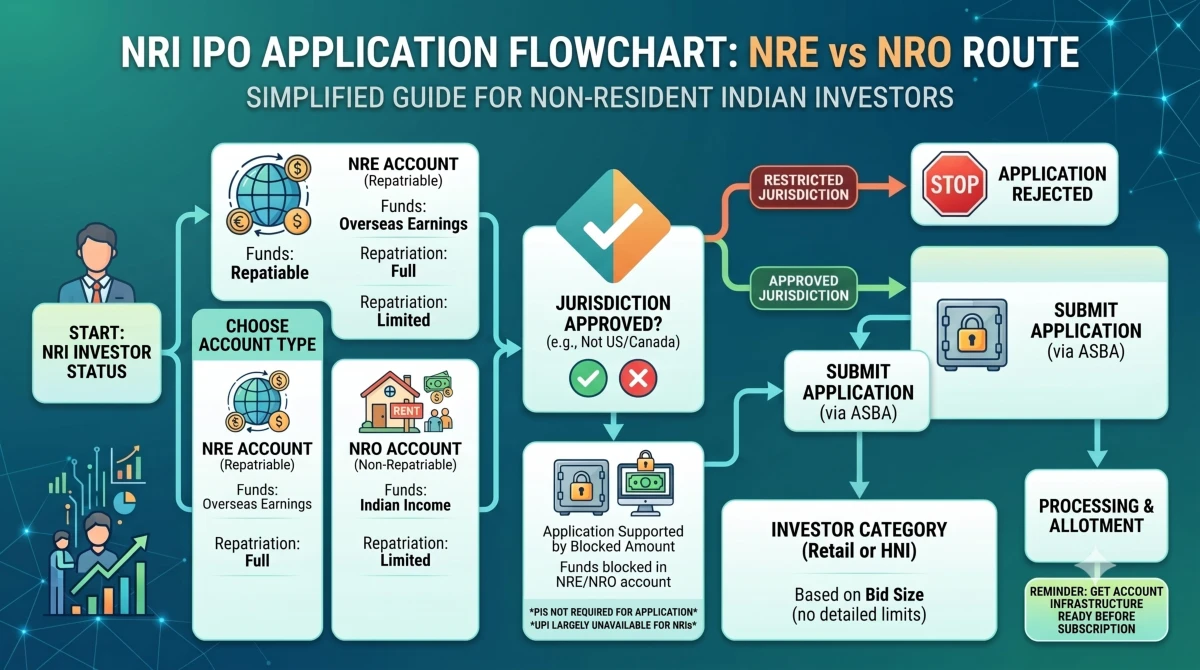
Before applying for any IPO, an NRI needs an NRE or NRO bank account with an authorised dealer bank, plus a demat account opened specifically in non-resident status and matched to the same account type.
| Feature | NRE Account | NRO Account |
|---|---|---|
| Source of funds | Overseas earnings, remitted to India | Income earned within India (rent, dividends, pension) |
| Repatriation | Fully repatriable, no cap | Repatriable up to USD 1 million per year, after tax compliance |
| Matching demat | Repatriable NRI demat account | Non-repatriable NRI demat account |
| Best suited for | Money you may want to move abroad later | Indian-sourced rupee income already in India |
Getting this choice wrong has a real cost. Fund your application through an NRO account when your money originated overseas, and you don't just add paperwork — you permanently lose the ability to freely repatriate that specific investment later. The account type isn't a formality; it's a one-way decision about where your money is allowed to go afterward.
Practical Tips
How the Application Actually Gets Submitted
ASBA (Application Supported by Blocked Amount) is the standard, and in practice the only reliable, route for NRI IPO applications — your bank blocks the bid amount in your NRE or NRO account until allotment is finalised, exactly as it does for resident retail investors. UPI-based applications, now common for resident retail investors, are largely unavailable to NRIs; a handful of banks support it, but it isn't something to assume or plan around.
Documentation typically includes PAN, passport copy, proof of overseas address, and proof of the linked NRE/NRO account — most banks now offer video KYC for NRIs, which has meaningfully cut down the older paperwork-by-courier process.
The Jurisdiction Gate: Not Every IPO Is Open to Every NRI
This is the restriction that catches the most people off guard, and it has nothing to do with SEBI. Individual companies routinely exclude NRIs based in the United States and Canada from their IPO altogether, issue by issue, because opening the offer to those jurisdictions pulls in US securities-law and FATCA-related compliance obligations most Indian issuers would rather avoid. This isn't a blanket rule written into SEBI regulations — it's a company-by-company decision, stated explicitly in the Red Herring Prospectus.
Check the RHP before assuming eligibility. An NRI based in the UAE or Singapore applying for the same IPO faces none of this friction; the restriction is genuinely jurisdiction-specific, not a general NRI exclusion.
Investment Ceilings Most Applicants Will Never Hit
FEMA also caps how much NRI money, in total, can sit in any single listed Indian company: an individual NRI investment limit of roughly 5% of the company's paid-up capital, and an aggregate NRI ceiling of 10% across all NRI investors combined, extendable up to the sectoral foreign investment cap if the company's board and shareholders approve it. For the vast majority of retail and even HNI-sized IPO bids, this ceiling is irrelevant — it only becomes a live constraint for very large NRI allocations in smaller-cap companies, and the company's registrar would flag it well before your application became the problem.
The repatriation limit is more likely to matter in practice: money routed through an NRO account can only be moved abroad up to USD 1 million per financial year, after tax compliance, even if the listing gain itself is far larger.
Practical Tips
Putting the Gates Together
Strip away the acronyms and the process is really four sequential checks: confirm your residency status and open the right account (NRE if you want full repatriation flexibility, NRO if the funds already originated in India); check the specific IPO's RHP for jurisdiction eligibility, especially if you're based in the US or Canada; apply through ASBA rather than assuming UPI will work; and let your bid size determine your category exactly as it would for a resident investor. Miss any one gate, and the application either doesn't go through or lands somewhere you didn't plan for.
If you're an NRI planning your first Indian IPO application, the single highest-leverage thing to do this week isn't researching which IPO to apply for — it's opening the correctly-matched NRE/NRO and demat pair with an authorised dealer bank before a subscription window you actually want to catch opens. That infrastructure step, done in advance, is what determines whether you can apply at all when the moment come
KEY TAKEAWAYS
NRI is a residency status, not a separate SEBI reservation category — retail and HNI classification still applies based on bid size alone. Applications route through an NRE (repatriable) or NRO (non-repatriable) account matched to an NRI demat account, using ASBA rather than the PIS route, which doesn't apply to primary-market IPOs. UPI is generally unavailable to NRI applicants. Individual companies can exclude NRIs from the US and Canada issue by issue — always check the RHP. FEMA also sets individual (5%) and aggregate (10%, extendable) investment ceilings per company, though these rarely affect ordinary retail or HNI-sized bids. The single most important step is getting the account infrastructure set up before a subscription window opens, not during it.