Index
Index
INTRODUCTION
On 14 October 2024, one day before Hyundai Motor India's ₹27,870 crore IPO opened to the public, 225 investors had already been allotted shares worth ₹8,315 crore. Retail applicants had not yet seen the bidding screen, but the anchor list was already on the exchange websites. That list is the earliest hard evidence of institutional demand an IPO offers, and also one of the most over-interpreted.
Practical Tips
How the Anchor Round Works
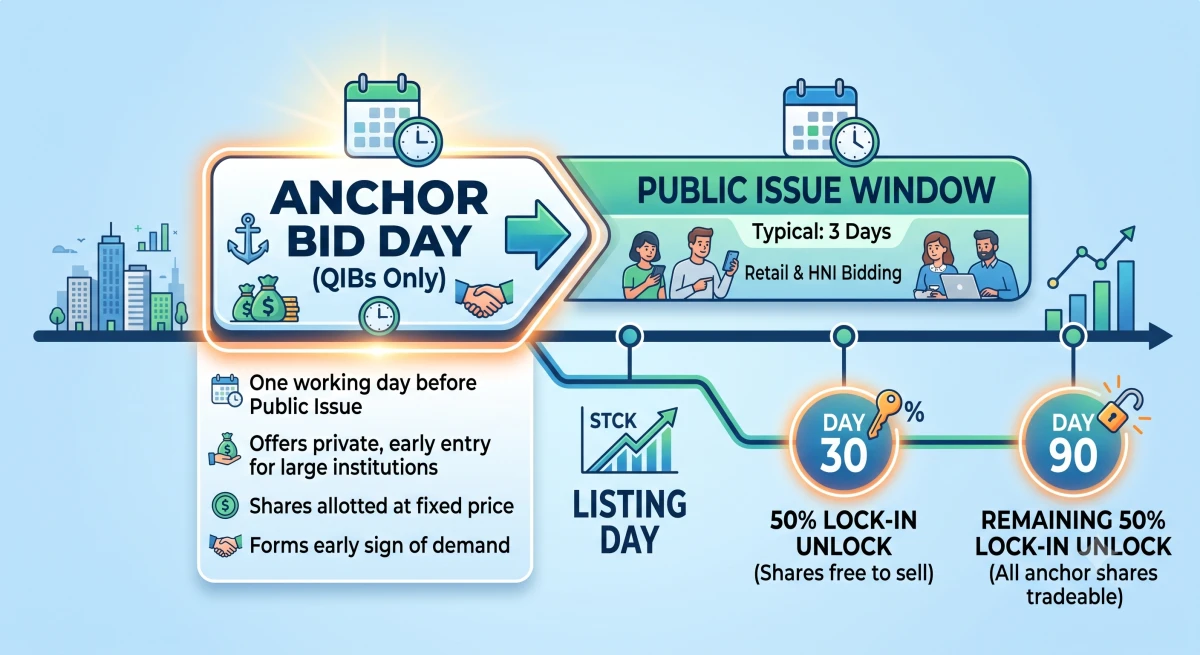
An anchor round is a one-day, private book run by the company and its book running lead managers (BRLMs). Bidding opens and closes on the working day before the public issue, and allotment happens the same day. The allocation is discretionary. The BRLMs choose who gets how much, unlike the retail category, where oversubscribed issues are settled by lottery.
The anchor price is fixed before the issue opens. For both Hyundai Motor India (₹1,960) and Ola Electric (₹76), it was the upper end of the price band, which is also the price retail applicants finally paid. The anchor portion is carved out of the QIB quota, so it does not shrink the retail or HNI quotas. Companies value the round because it locks in a large block of demand before the public window and puts recognisable institutional names on record.
| Stage | What happens | Hyundai Motor India (2024) |
|---|---|---|
| Day before opening | Anchor bidding and allotment | 14 Oct: 4.24 crore shares at ₹1,960 |
| Issue days | Public bidding window | 15–17 Oct |
| Allotment | Basis of allotment finalised | 18 Oct |
| Listing | Shares begin trading | 22 Oct |
Who Can Be an Anchor, and How Many
Only QIBs qualify, which means mutual funds, insurers, banks, SEBI-registered foreign portfolio investors and pension funds meeting the corpus threshold. A retail investor cannot bid in this category, whatever the amount. SEBI's amendment effective 30 November 2025 reshaped the framework, and the table shows the current position.
| Rule | Current position |
|---|---|
| Minimum bid | ₹10 crore (mainboard), ₹2 crore (SME) |
| Minimum allotment | ₹5 crore per anchor |
| Number of anchors | Allocation up to ₹250 crore: 2 to 15. Above ₹250 crore: at least 5 and at most 15 for the first ₹250 crore, plus 15 for every additional ₹250 crore or part thereof |
| Size cap | Up to 60% of the QIB portion |
| Reserved slice | 40% of the anchor portion: 33.33% for domestic mutual funds, 6.67% for life insurers and pension funds. Any unfilled insurer/pension slice goes to mutual funds |
Before the amendment, only one-third of the anchor portion was reserved, and it was for mutual funds alone. The change is aimed at drawing in more long-horizon domestic money.
A Real Anchor Book: Hyundai Motor India
Hyundai's anchor book is a clean specimen because every number is public. Foreign names included GIC, New World Fund, JP Morgan Funds, Fidelity and BlackRock, while domestic funds such as SBI MF, HDFC MF, ICICI Prudential MF and Nippon India MF, along with insurers like SBI Life, filled the rest.
| Item | Hyundai Motor India (Oct 2024) |
|---|---|
| Amount raised | ₹8,315.28 crore |
| Shares allotted | 4,24,24,890 |
| Price | ₹1,960 (upper end of band) |
| Investors | 225 |
| Share of QIB portion | 60% (29.84% of total issue) |
| Domestic mutual funds' share | 34.4% of anchor portion |
Ola Electric offers a contrast in shape. Its anchor book raised ₹2,763 crore from 84 investors at ₹76, with ten domestic mutual funds taking ₹1,117 crore, about 40.43% of the book.
Practical Tips
Myth vs Reality
Anchor rounds attract folklore, and three claims come up more than any others.
| Myth | Reality |
|---|---|
| Anchors buy at a discount that retail never gets | In both Hyundai and Ola, anchors paid the upper end of the band, the same price as the final issue price |
| Anchors are locked in for months | Only half is locked for 90 days; the other half can be sold after 30 days |
| A big anchor book guarantees listing gains | Hyundai had 225 anchors and still listed below issue price |
The Lock-in: When Anchors Can Sell
Since April 2022, 50% of each anchor's shares are locked in for 30 days and the remaining 50% for 90 days. Both periods run from the date of allotment, not the listing date. Before that, the whole allocation came free after a single 30-day lock-in. When a date falls on a weekend, the first chance to sell is the next trading day.
| IPO | Anchor allotment | 50% free | Remaining 50% free |
|---|---|---|---|
| Hyundai Motor India | 14 Oct 2024 | 17 Nov 2024 | 16 Jan 2025 |
| Urban Company | 9 Sep 2025 | 16 Oct 2025 | 14 Dec 2025 |
These dates are known from day one. Urban Company, which raised ₹853.87 crore from anchors, saw its shares fall nearly 4% when the first lock-in ended in October 2025. An unlock date does not force selling, but it adds supply to the market.
How to Read an Anchor Book Before You Apply
The anchor allotment is published on the exchange websites on the bid date, usually the evening before your application window opens. Four checks take a few minutes. First, look at the mix. Long-only mutual funds, insurers and sovereign funds signal patient demand, while a book dominated by a few unfamiliar names deserves more caution. Second, see whether the anchors took the full 60% of the QIB portion, which suggests demand exceeded what the company could give. Third, compare the anchor price with the upper end of the band. Fourth, mark the 30-day and 90-day unlock dates in your calendar.
Then pair this with the grey market reading on IPO360's Live GMP Tracker (ipo360.in/gmp), remembering that both signals can miss. An anchor book tells you who was willing to be early, not who is willing to stay.
KEY TAKEAWAYS
- An anchor investor is a QIB that bids at least ₹10 crore (mainboard) and is allotted shares one working day before the IPO opens.
- Anchors can take up to 60% of the QIB portion, and this does not reduce the retail or HNI quotas.
- Since 30 November 2025, 40% of the anchor portion is reserved: 33.33% for mutual funds and 6.67% for insurers and pension funds.
- Half of each anchor's shares unlock after 30 days and half after 90 days, counted from allotment.
- Anchors paid the upper end of the band in Hyundai and Ola, the same price as retail.
- A strong anchor book shows institutional appetite at the issue price, not a guaranteed listing gain.