Index
Index
IPO Analysis · Part 8 of 13
Meera, a first-time investor (an illustrative example), is one day from bidding on a large IPO when she spots a line in the prospectus: the promoter's stake will fall after listing. Her first thought is that the owners are cashing out. Her second is that she has no idea whether that matters.
Both reactions are common. Promoters know the business better than any analyst, so their stake is one of the few free signals an IPO gives you. But a falling number can mean very different things, and a high number can hide just as much. This guide covers what promoter holding measures, what SEBI forces promoters to keep, and how to read the figures before you apply.
Practical Tips
What Promoter Holding Actually Measures
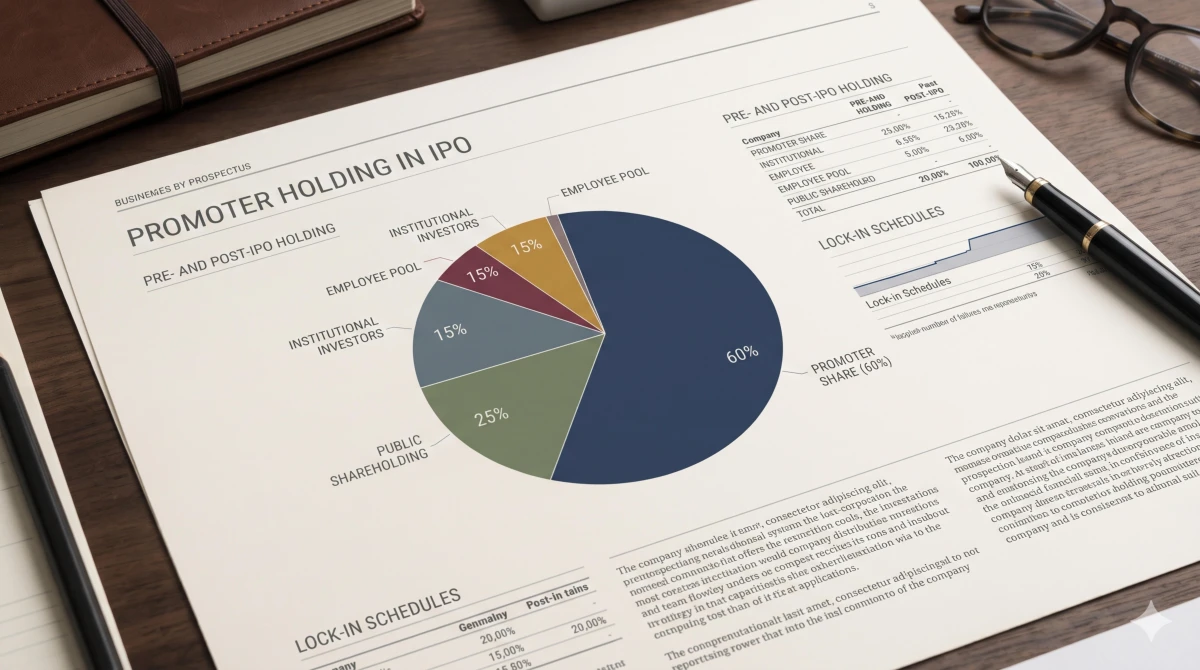
Promoters are the people or entities who control the company, usually its founders or a parent company. SEBI also tracks the promoter group, which covers relatives and related entities. Promoter holding is the combined share of both, shown in the RHP as a pre-issue and a post-issue percentage.
Two thresholds shape that number. SEBI's ICDR Regulations require promoters to contribute at least 20% of post-issue capital, called the Minimum Promoters' Contribution (MPC). After listing, companies must also generally keep a minimum public shareholding of 25%, though very large issuers get extra time to reach it. That is why a giant like Hyundai Motor India can sit above 80% on listing day. Always confirm the exact figures in the RHP, as SEBI has eased some norms for large issuers.
How the Stake Changes: Three Real IPOs
Promoter holding falls in two ways. In an offer for sale (OFS), promoters sell existing shares and the money goes to them, not the company. In a fresh issue, the company creates new shares, which dilutes everyone without any promoter selling. Many IPOs combine both.
| IPO | Structure | Promoter holding before | After | Listing outcome |
|---|---|---|---|---|
| Hyundai Motor India (Oct 2024) | Pure OFS by parent | 100% | 82.5% | Weak listing |
| Ola Electric (Aug 2024) | Fresh issue of ₹5,500 cr plus OFS | 45.14% (promoter and group) | 36.78% | Flat at issue price of ₹76 |
| Tata Technologies (Nov 2023) | Pure OFS by Tata Motors and two investors | 66.79% | 55.39% | Listed at ₹1,200 vs ₹500 issue price |
Hyundai's entire ₹27,870 crore offer was an OFS, so none of it reached the company. Ola Electric raised fresh capital and also let founder Bhavish Aggarwal sell about 3.79 crore shares at ₹76, roughly ₹288 crore. Same word, "dilution," three different stories.
Practical Tips
SEBI's Lock-In Rules: When Promoters Can Sell
Lock-in stops promoters from exiting right after the IPO. The clock runs from the date of allotment, and the length depends on how the money is used.
| Promoter shares | Standard mainboard IPO | Most fresh-issue money goes to capex or related debt repayment | SME IPO |
|---|---|---|---|
| Minimum contribution (20% of post-issue capital) | 18 months | 3 years | 3 years |
| Holding above the minimum | 6 months | 1 year | 50% after 1 year, 50% after 2 years |
Non-promoter pre-IPO shareholders on the mainboard are locked in for 6 months. Since 2021, the standard promoter lock-in has been 18 months (earlier it was 3 years). The 2025 amendment brought back the longer period for capex-heavy issues.
Meera finds this schedule in the RHP's Capital Structure chapter. The promoter's excess shares become free to sell six months after allotment, so she puts that date in her calendar. It is when extra supply could reach the market.
Practical Tips
Three Myths About Promoter Holding
| Myth | Reality |
|---|---|
| Higher promoter holding means a safer IPO | It shows control, not price discipline. Hyundai's parent held 82.5% post-IPO and the listing was weak. |
| Promoters selling in an IPO is always a red flag | Not automatically. Tata Motors sold through a pure OFS and the stock listed at a 140% premium. Ask why they are selling and at what price. |
| Lock-in means promoters can never sell | Only the locked portion is restricted. Holdings above the minimum are released earlier, and expiry dates are known in advance. |
Five Checks Before You Apply
| Check | Where to look in the RHP | What it tells you |
|---|---|---|
| Pre- vs post-issue holding | Summary and Capital Structure | Size of the dilution |
| OFS vs fresh issue split | The Offer and Objects of the Issue | Who receives the money |
| Pledged shares | Capital Structure and Risk Factors | Whether promoters have borrowed against their stake |
| Related party dealings | Restated financials, related party note | Money flowing between the company and promoter entities |
| Lock-in expiry dates | Capital Structure | When extra shares can reach the market |
None of these is a verdict on its own. Together they show whether promoters are building the business or monetising it.
What Meera Did
Meera's IPO was a pure OFS where the money went to the selling parent, not the company. That did not rule it out, but it changed her question from "is the promoter stake too low?" to "is the price fair?" She noted the lock-in expiry date and moved on to valuation.
Promoter holding tells you who is in control. The sell-down tells you what they think of the price.
Before your next bid, open the RHP, find the Capital Structure chapter, and write down three numbers: pre-issue holding, post-issue holding, and the lock-in expiry date.
KEY TAKEAWAYS
Promoter holding is the combined stake of promoters and their group, shown before and after the IPO in the RHP. Promoters generally must hold 20% of post-issue capital, locked in for 18 months, or 3 years when most fresh-issue money funds capex. Holding above that minimum is usually free after 6 months, or 1 year in capex-linked issues. A falling stake can come from an OFS or a fresh issue, and the two mean different things. High holding does not guarantee a good listing, as Hyundai showed, and a big sell-down does not rule one out, as Tata Technologies showed. Always check pledges, related party dealings and lock-in expiry dates in the RHP.