Index
Index
What is Object of issue in IPO
When a company files for an IPO, one section of the prospectus matters more than almost any other for judging intent: the "Objects of the Issue." This is where the company must legally spell out what it will do with the money you hand over. Will it build factories, repay debt, fund research, or simply pass the cash to early investors who are selling out? SEBI requires this disclosure precisely because the answer changes the entire investment case. A company raising money to grow is a very different bet from one where existing shareholders are heading for the exit. This guide shows you how to find, read, and interpret the Objects of the Issue so you know where your money actually goes.
Practical Tips
What Does "Objects of the Issue" Mean?
Every IPO raises money in one or both of two ways. A fresh issue creates brand-new shares, and the money raised flows into the company's bank account to be spent on the business. An Offer for Sale (OFS) is when existing shareholders — promoters, founders, or early venture investors — sell some of their existing shares to the public; that money goes to those sellers, not to the company.
The Objects of the Issue applies only to the fresh issue. SEBI's ICDR (Issue of Capital and Disclosure Requirements) Regulations require the company to state, object by object, how much of the fresh proceeds will be deployed and roughly when. You will find it in the DRHP (the draft prospectus) and finalised in the RHP (the red herring prospectus) before the IPO opens. If an IPO is 100% OFS — meaning no fresh shares are issued at all — there are technically no "Objects," because the company receives nothing. That is an important signal in itself.
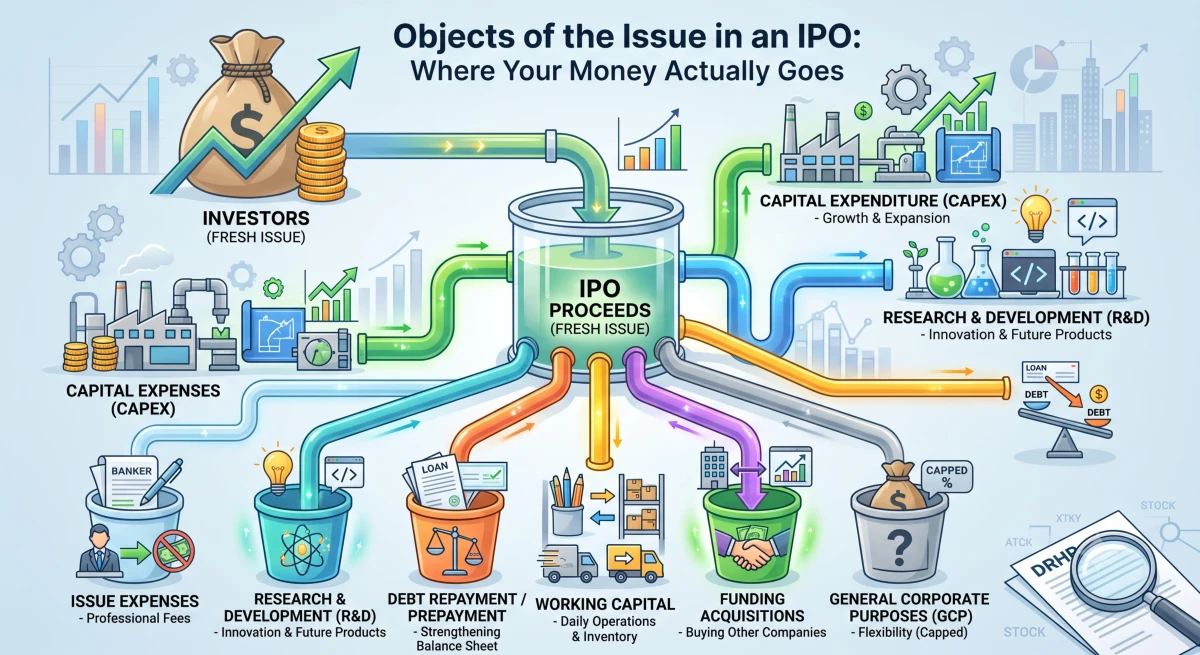
The Common Categories of Objects
Most Objects of the Issue fall into a handful of recognisable buckets. Understanding what each one signals helps you read the quality of an IPO at a glance.
| Object | What it means | What it signals |
|---|---|---|
| Capital expenditure (capex) | Building plants, buying machinery, expanding capacity | Growth-oriented; company is investing in future output |
| Debt repayment / prepayment | Paying off existing loans | Reduces interest cost, but money doesn't create new growth |
| Working capital | Funding day-to-day operations, inventory, receivables | Common for growing businesses; watch if it dominates |
| Research & development | Product and technology development | Long-horizon bet; common in tech, EV, pharma |
| Funding acquisitions | Buying other companies | Can accelerate growth but adds integration risk |
| General corporate purposes (GCP) | Unspecified flexibility | SEBI caps this — usually 25% of proceeds |
| Issue expenses | Banker, legal, and marketing fees | Standard cost of going public |
SEBI limits "general corporate purposes" so a company cannot raise money without telling investors how it will be used. If a large chunk is parked under GCP or vague "inorganic growth" heads, that is a flag worth noting.
NOTE-For SME IPOs, the cap is even stricter: limited to 15% of the issue size or ₹10 crore, whichever is lower.
Practical Tips
Fresh Issue vs OFS: Why the Split Matters
The ratio of fresh issue to OFS is one of the most revealing numbers in any IPO. When the fresh issue is large, most of your money strengthens the company — it can build, hire, repay debt, or invest. When the OFS is large, most of your money simply changes hands from the public to existing shareholders who are selling.
Neither is automatically bad. A pure OFS can be perfectly legitimate: SEBI rules sometimes require promoters to dilute holdings to meet minimum public shareholding, and early venture investors are entitled to exit after years of backing a company. Insurance and some regulated sectors have IPOs that are largely OFS by design. But the split tells you who benefits. Bajaj Housing Finance's September 2024 IPO, for instance, was a ₹6,560 crore issue split into a ₹3,560 crore fresh issue and a ₹3,000 crore OFS. The fresh portion had a single clean object — to augment the company's capital base to support future onward lending, exactly what a growing NBFC needs. The OFS let the parent, Bajaj Finance, pare down its stake. Both goals were transparent, and the stock listed at a 114% premium.
The caution is different: an IPO that is almost entirely OFS, priced richly, with insiders selling heavily deserves a harder look. You are buying shares from people who know the business best and are choosing this price to sell.
How to Read the Objects Section Like an Analyst
Once you find the Objects of the Issue in the DRHP or RHP, run through a short checklist rather than skimming it.
First, check the fresh-vs-OFS ratio. A meaningful fresh issue means the company gets working capital to grow. Second, see what the fresh money funds. Capex, R&D, and capacity expansion are forward-looking. Debt repayment is fine in moderation — it cuts interest costs — but if the primary object is retiring loans, the raise is more about fixing the balance sheet than expanding it. Third, look at how much sits in "general corporate purposes." SEBI caps it, but a company pushing right up to the limit is asking for a blank cheque. Fourth, read the deployment schedule. Companies must state the financial years in which they expect to spend each object. Money that will not be deployed for years is money sitting idle. Fifth, check for related-party spending. If the "capex" or "acquisition" involves buying assets from the promoter's other companies, read the fine print — that can be a route for insiders to benefit.
Finally, remember that objects can be changed. Companies can vary the use of proceeds after listing, but only with shareholder approval (a special resolution) and by offering an exit to dissenting shareholders. So the objects you read are a plan, not a contract.
Block 9 — Practical Tip
Objects of the Issue in SME IPOs
The Objects section deserves extra attention in SME (small and medium enterprise) IPOs. These smaller issues are often dominated by working-capital needs and general corporate purposes, and the disclosures, while required, can be thinner than mainboard prospectuses. Because SME IPOs carry higher risk and lower liquidity, a vague or working-capital-heavy objects table combined with a large promoter OFS is a combination worth treating with real caution. The same reading discipline applies — just with a lower tolerance for vagueness, since the safety net of institutional scrutiny is smaller than on the mainboard.
Where to Find the Objects of the Issue
The Objects of the Issue is a dedicated, clearly headed section — usually titled "Objects of the Offer" or "Objects of the Issue" — that appears early in the DRHP and RHP, typically within the first 60–80 pages, right after the summary. You can download these documents free from the IPO360 website, SEBI website, the NSE and BSE websites, or the lead managers' sites. Do not rely on a broker's one-line IPO summary or a WhatsApp forward for this — those often report only the headline issue size and skip the breakdown entirely. Open IPO 360 website and read the actual prospectus, go to the Objects section, and read the table. It takes five minutes and tells you more about management's intent than any grey market premium ever will.
Practical Tips
Growth-oriented objects (capex, R&D, capacity, working capital for expansion) are generally healthier signals than a raise dominated by debt repayment.
Check the fresh-issue-to-OFS ratio: a large OFS means most of your money benefits sellers, not the company.
SEBI caps "general corporate purposes" (typically 25%); a company crowding that limit is seeking flexibility with less accountability.
Objects are a plan, not a promise — companies can vary them later with shareholder approval, and actual utilisation can differ, as Ola Electric's later variation showed.
Always read the objects table in the actual DRHP/RHP, not a broker summary — it's free and takes five minutes.