Index
Index
IPO Analysis · Part 10 of 13
Priya is reading the DRHP of a packaged-foods company she likes (a fictional example). The brand is familiar, sales are growing and profits look healthy. Then, on page 240, she notices that 31% of the company's raw material is bought from a firm owned by the promoter's brother. Nothing about this is illegal. But when buyer and seller are family, who decides the price?
That question is what related party transactions are about. Every offer document has a section on them, and most applicants skip it.
Practical Tips
Who Counts as a Related Party
The definition is wider than "the promoter's company". The offer document follows the Indian accounting standard on related party disclosures (Ind AS 24), so it covers the following groups.
| Related party | Typical example in an IPO |
|---|---|
| Promoters and promoter group | Founder's family firm supplying raw material |
| Directors, key managerial personnel and their relatives | Office rent paid to a director |
| Subsidiaries, associates, joint ventures | Loan given to a group subsidiary |
| Entities influenced by promoters or directors | Brother's firm acting as top distributor |
| Parent or group companies (MNC subsidiaries) | Royalty paid to a foreign parent |
Offer documents report these transactions for the three financial years covered by the restated financials, plus any stub period. SEBI's rules also pull in "group companies": firms with which the issuer had related party transactions during that three-year window are counted as group companies, even if they are not subsidiaries.
Where to Find RPTs in the DRHP and RHP
You will not find everything in one place, which is why they get missed. Look in the dedicated related party section, the notes to the restated financial statements, the Risk Factors, and the chapters on "Our Promoters and Promoter Group" and "Group Companies". Read them together. A company may describe a promoter's firm as a "key supplier" in the business section and only reveal the family link in the notes.
what the DRHP and RHP contain
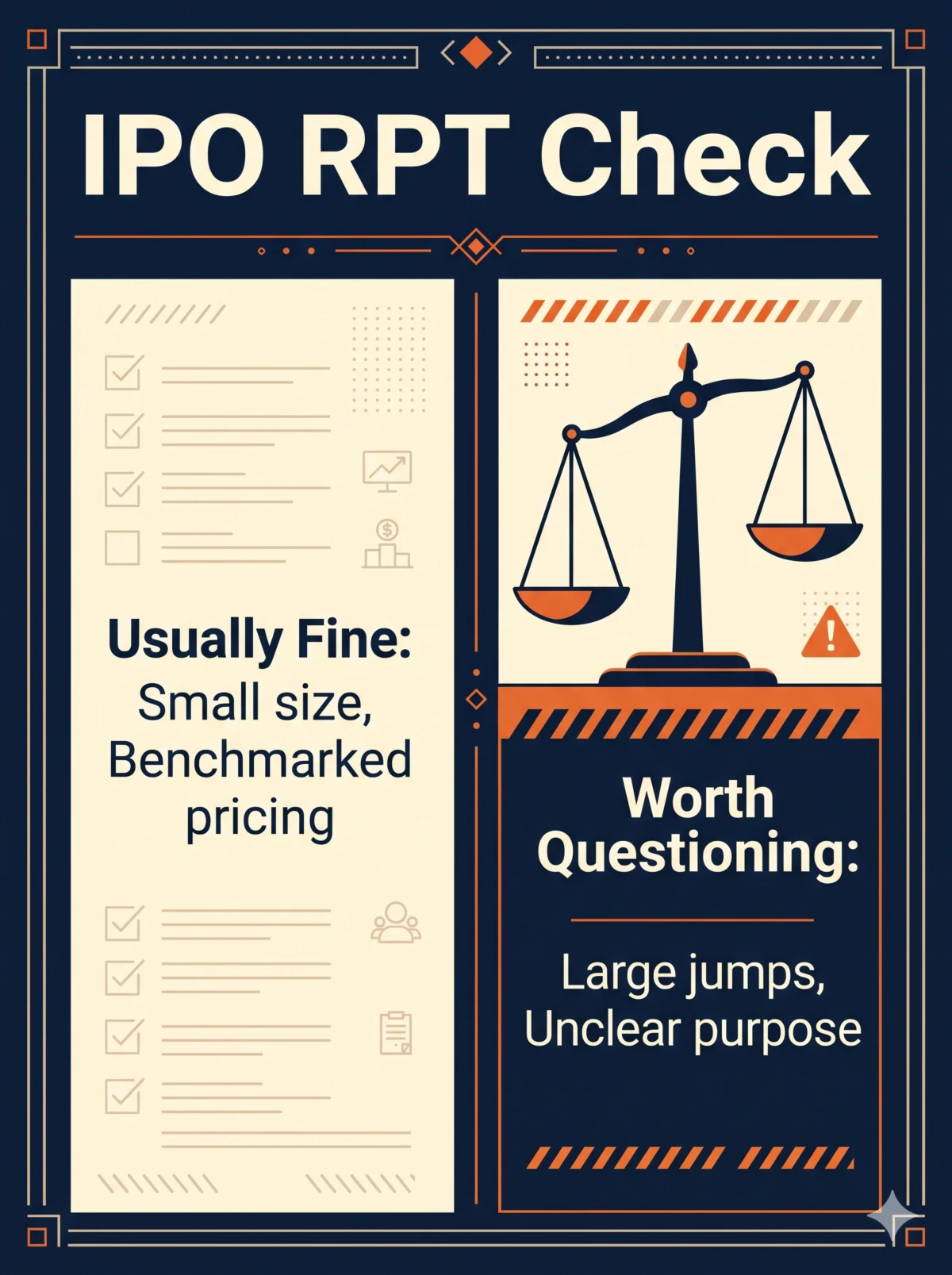
Myth: related party transactions mean the promoter is cheating. Reality: many are structural, especially for subsidiaries of multinationals. The better question is whether the terms hold up against what an outsider would pay.
| What you see | Usually fine | Worth questioning |
|---|---|---|
| Size versus revenue | Small and stable | Large, or jumped just before the DRHP |
| Pricing | Benchmarked to market or independently valued | "Arm's length" claimed, no evidence shown |
| Purpose | Real need, such as rent for a factory or royalty for technology | Loans with no interest, repayment date or clear use |
| Counterparty | Established operating business | Recently formed promoter-group firm |
| Direction of money | Flows both ways | Mostly from the company to promoter entities |
Practical Tips
A Real Case: Hyundai Motor India
Hyundai Motor India's RHP (Oct 2024) shows RPTs at scale, openly disclosed. The company pays royalty to its Korean parent, Hyundai Motor Company, and buys a large share of its supplies from related parties.
| Item | FY22 | FY23 | FY24 |
|---|---|---|---|
| Royalty to parent (% of revenue) | 2.32% | 2.39% | 2.23% |
| Supplies sourced from related parties | 34.60% | 33.98% | 38.28% |
The RHP also disclosed a new royalty agreement at 3.5% of sales revenue, up from roughly 2.3% to 2.4% earlier, and flagged that any further increase could hurt profitability. An investor who read this section knew the margin pressure before applying. That does not make it a verdict on the IPO: listing-day performance also depends on pricing and market mood.
Enforcement history shows why disclosure matters. In the DLF case, SEBI held that DLF had failed to disclose related party transactions in its 2007 IPO prospectus.
What Changes After Listing
Once listed, the company falls under SEBI's Listing Regulations. All RPTs need audit committee approval, and "material" ones also need shareholder approval. In November 2025, SEBI replaced the flat test (the lower of ₹1,000 crore or 10% of turnover) with a scale-based one.
| Annual consolidated turnover | Material RPT threshold |
|---|---|
| Up to ₹20,000 crore | 10% of turnover |
| ₹20,000 to ₹40,000 crore | ₹2,000 crore + 5% of turnover above ₹20,000 crore |
| Above ₹40,000 crore | ₹3,000 crore + 2.5% of turnover above ₹40,000 crore, capped at ₹5,000 crore |
For most IPO-sized companies the practical effect is similar to before; the relief mainly helps very large issuers. SME IPOs have extra safeguards: issue proceeds cannot be used to repay loans from promoters, the promoter group or related parties. See our guide to SME listing requirements
Your Five-Minute RPT Check
First, add up total RPTs and compare them with revenue and expenses. Second, find the largest related party and note when it was formed. Third, ask whether the price is benchmarked, and compare it with listed peers. Fourth, check every loan or advance for interest, a repayment date and a stated purpose. Fifth, read the trend across all years, not just the latest.
Priya did exactly this. The brother's firm supplied 31% of raw material in the latest year, up from 12% three years earlier. The DRHP called the pricing "at arm's length" but showed no benchmark. She marked it a yellow flag, not a verdict, and went on to compare the company's margins with listed peers before deciding.
KEY TAKEAWAYS
- A related party transaction is any deal between the company and promoters, directors, relatives, subsidiaries or promoter-linked firms.
- RPTs are not automatically bad; the questions are size, pricing, purpose and trend.
- Look for them in the RPT section, financial statement notes, Risk Factors and promoter chapters.
- SEBI checks disclosure, not fairness, so pricing evidence is yours to judge.
- A sudden jump, a new promoter-group counterparty or interest-free loans deserve a closer look.
After listing, material RPTs need shareholder approval under SEBI's scale-based thresholds