Index
Index
Why the DRHP and RHP Actually Matter to You
Every company that wants to list on India's stock exchanges has to file two versions of essentially the same document with SEBI — first a DRHP, then an RHP. If you've been reading IPO news and keep seeing these two acronyms tossed around without explanation, that's a gap worth closing before you apply for your next issue. The DRHP and RHP aren't just paperwork for lawyers and merchant bankers to argue over. Together, they contain almost everything a retail investor needs to judge whether an IPO is worth applying for: the company's real financials, its risk factors, what it plans to do with the money it raises, and eventually — the price you'll actually pay. This article breaks down what each document is, how they differ, and which parts are actually worth your time.
Practical Tips
What is a DRHP (Draft Red Herring Prospectus)?
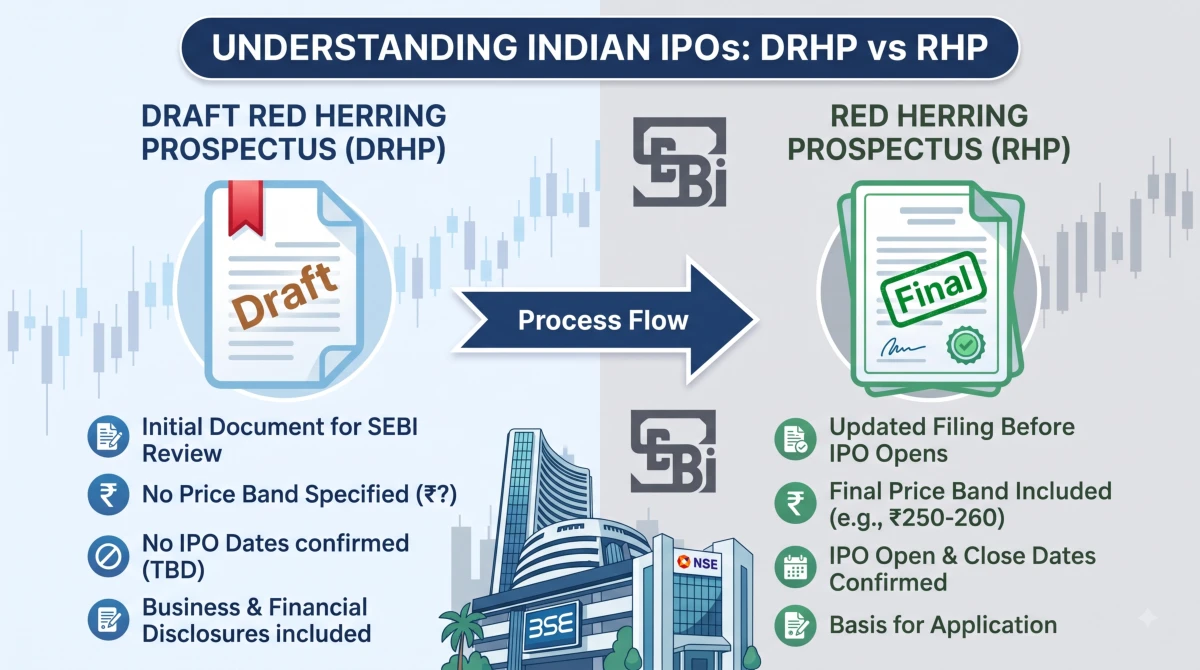
A DRHP is the first formal offer document a company files with SEBI and the stock exchanges when it decides to go public. It's prepared by the company along with its Book Running Lead Managers (BRLMs) — the investment banks running the IPO — under SEBI's ICDR (Issue of Capital and Disclosure Requirements) Regulations.
It contains the company's business description, industry overview, restated financial statements (usually three to five years), risk factors, promoter and management details, litigation history, and the "objects of the issue" — what the company plans to do with the money raised.
The name "red herring" comes from the bold red-ink disclaimer printed on the cover page, stating that the document is incomplete and doesn't contain the final price or exact issue size. That's the whole point of a DRHP: it's meant to be reviewed and picked apart before anything is finalized. Once filed, SEBI puts the DRHP up on its website for 21 days of public comment before beginning its own review.
What is an RHP (Red Herring Prospectus)?
The RHP is what the DRHP becomes after SEBI's review is complete and the company is ready to actually open its IPO. It's filed with the Registrar of Companies (RoC), typically just a day or two before the issue opens to the public.
The core business and financial disclosures carry over from the DRHP, updated where needed. What's new in the RHP is everything the DRHP left out: the price band (or fixed price), the confirmed issue size, and the exact dates the issue opens and closes. Anchor investor allocations, when applicable, are typically announced the day before the issue opens to retail and other investors, based on the RHP price band.
In practice, the RHP is the document you should actually be reading before you click "apply" — it's the one with numbers you can act on, not just numbers to evaluate the business by.
DRHP vs RHP: Key Differences
| Aspect | DRHP | RHP |
|---|---|---|
| Filed with | SEBI and stock exchanges | Registrar of Companies (RoC) |
| Price band | Not included | Included |
| Issue size | Indicative | Final, confirmed |
| Issue open/close dates | Not included | Included |
| Purpose | Regulatory review, public comment | Investor-facing, basis for application |
| Public availability | Public (unless filed via confidential route) | Public, shortly before the IPO opens |
| Financial statements | Restated, audited | Same, updated if required |
The short version: the DRHP is about disclosure and scrutiny, the RHP is about execution. Everything that changes between the two — price, size, dates — is exactly the information you were missing when you first read the DRHP.
Practical Tips
From DRHP to RHP: The SEBI Observation Process
Once a DRHP is filed, SEBI (working alongside the stock exchanges) reviews it and issues what's called "observations" — a list of clarifications, additional disclosures, or corrections the company needs to address. SEBI's regulations target roughly 30 days to issue these observations, but that clock often resets if SEBI comes back with follow-up queries, which is common for larger or more complex issues.
The company and its BRLMs have to respond to every observation and update the draft accordingly before the RHP can be filed. This is why the gap between a DRHP and its corresponding RHP varies so much — some companies move from DRHP to listing in two to three months, others take a year or longer, especially if SEBI raises concerns about related-party transactions, litigation, or valuation disclosures.
This is also why a DRHP being filed is not the same as an IPO being imminent. Plenty of DRHPs sit in the SEBI pipeline for months, and some never convert to an RHP at all if the company withdraws or lets its approval lapse.
What to Actually Check in a DRHP or RHP Before You Apply
Most retail investors never open the DRHP or RHP at all — which is understandable, given these documents routinely run past 300 pages. But three sections do most of the useful work:
Risk Factors: This is the most candid section in the entire document, precisely because SEBI requires companies to disclose everything that could go wrong, in order of severity. It's routinely the most skipped section and arguably the most important one.
Objects of the Issue: This tells you where the money is actually going — whether it's a fresh issue funding expansion or debt repayment, or an Offer for Sale (OFS) where existing shareholders are simply cashing out and the company itself gets none of the proceeds. An IPO that's mostly OFS isn't automatically a red flag, but it changes what you're actually funding.
Basis for Issue Price: Companies are required to explain, in their own words, why they believe their IPO price is justified — usually referencing accounting ratios and comparable listed peers. It's self-serving by nature, but reading how a company justifies its own valuation tells you a lot about how aggressively it's being priced.
Practical Tips
Where to Download DRHP and RHP Documents
Both documents are public filings and are available from several sources: SEBI's own website under its "Public Issues" section, the websites of the exchanges the company plans to list on (BSE and/or NSE), and the website of the lead Book Running Lead Manager for the issue. Most companies also host the documents on a dedicated IPO microsite once the issue is announced.
If you're tracking an upcoming IPO on IPO360, the DRHP and RHP (once filed) are linked directly from that IPO's details page, so you don't have to hunt across SEBI and exchange filings separately.
The Confidential Pre-Filing Route: A Newer Way to File a DRHP
SEBI introduced a confidential pre-filing framework that lets companies file their DRHP privately with SEBI, without immediately publishing it, loosely modeled on a similar option available to companies in the US. This gives a company the chance to get initial regulatory feedback and test its readiness for an IPO without committing to a public process — useful if it wants flexibility on timing, or wants to keep its plans quiet from competitors for longer.
The DRHP still has to be made public eventually — at least 21 days before the IPO actually opens — so the confidentiality is temporary, not permanent. It doesn't change what ends up in the RHP; it only changes when the public first gets to see the DRHP. OYO and Shadowfax are among the more prominent 2025 examples of companies using this route.