Index
Index
What is IPO Lot Size?
Every time you apply for an IPO in India, you cannot buy just one share. You must apply in fixed bundles called lots. The lot size is the minimum number of shares you can bid for in a single application, and every larger bid must be placed in exact multiples of that number. If an IPO has a lot size of fifty shares, you may apply for fifty, one hundred, one hundred and fifty, and so on, but never for seventy or ninety. This single number quietly controls the smallest amount of money you need to participate, how your application is categorised, and how many lots you can realistically apply for. Understanding lot size is therefore the first practical step before you place any IPO bid.
Practical Tips
How is IPO Lot Size Decided?
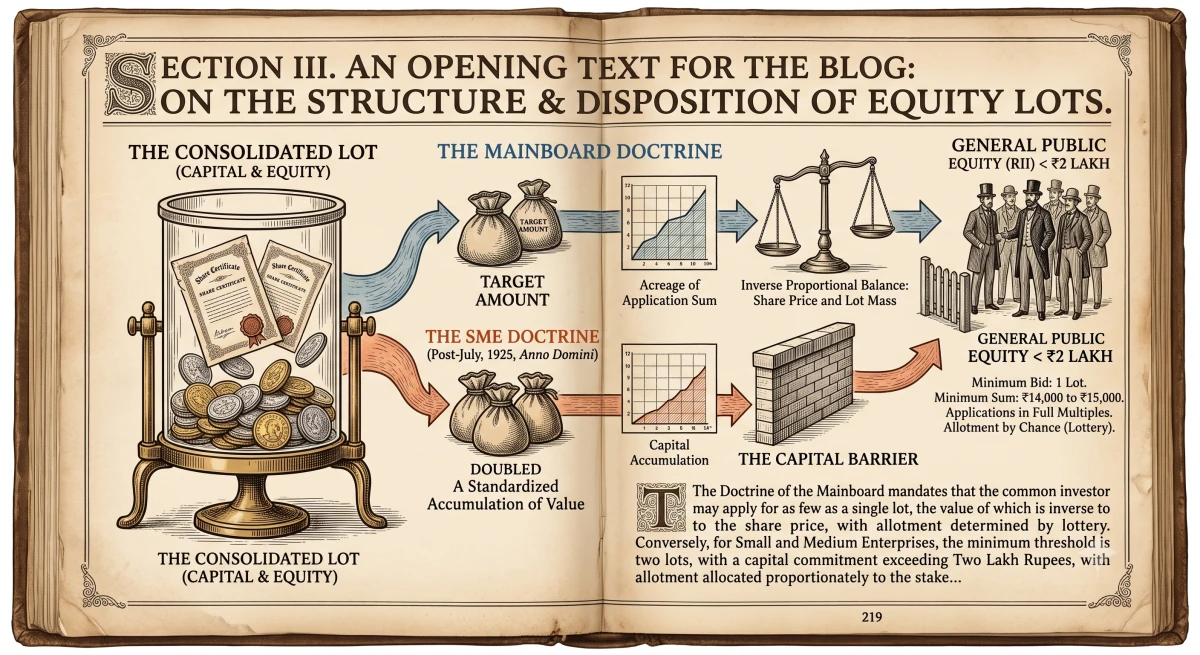
Lot size is not a random figure. It is calculated backward from the price band. SEBI's Issue of Capital and Disclosure Requirements framework requires that the minimum application amount for a retail investor in a mainboard IPO falls within a fixed rupee band, currently between roughly fourteen thousand and fifteen thousand rupees per lot. The company and its book running lead managers take the upper price of the band and divide this target amount by that price to arrive at a share count that keeps the minimum bid inside the prescribed range.
Consider a simple example. If an IPO is priced at a band with an upper limit of five hundred rupees per share, and the target minimum application is around fifteen thousand rupees, the lot size will be set at thirty shares, since thirty multiplied by five hundred equals fifteen thousand. A cheaper share leads to a larger lot, and an expensive share leads to a smaller lot. This is why a low-priced IPO might have a lot of two hundred and fourteen shares, while a premium-priced offer might have a lot of just eleven shares. The rupee value stays roughly constant even as the share count swings widely.
Practical Tips
Lot Size and the Two Lakh Retail Boundary
Lot size directly determines how many lots a retail investor can apply for. In a mainboard IPO, the retail individual investor category is capped at an application value of two lakh rupees. Any bid above two lakh rupees automatically moves you out of the retail category and into the Non-Institutional Investor category, where allotment rules, funding, and competition are entirely different.
Because of this ceiling, you can only apply for as many lots as fit inside two lakh rupees. If a single lot costs fifteen thousand rupees, you can apply for a maximum of thirteen lots as a retail investor, since thirteen lots cost one lakh ninety-five thousand rupees, while fourteen lots would breach the two lakh limit. The higher the lot value, the fewer lots you can stack within the retail window. This matters during heavily oversubscribed IPOs, where seasoned investors deliberately apply for the maximum permissible retail lots to hold their best odds in the lottery.
Mainboard vs SME IPO Lot Size
The biggest difference in lot economics lies between mainboard and SME IPOs, and the gap widened sharply in 2025.
For mainboard IPOs, the retail minimum remains one lot, valued at roughly fourteen thousand to fifteen thousand rupees, keeping the segment accessible to ordinary investors. For SME IPOs, the picture changed on the first of July 2025. Following amendments to the SEBI ICDR Regulations, the older retail individual investor category in SME issues was replaced by an Individual Investor category, and the minimum bid was raised to two lots with an application value of just above two lakh rupees. The practical effect is that the smallest possible SME IPO application now starts above two lakh rupees, roughly fifteen times the mainboard minimum. SEBI made this change deliberately to filter casual and speculative participation out of the riskier SME segment and to keep it limited to investors with genuine risk appetite.
The table below summarises the current position.
| Feature | Mainboard IPO | SME IPO (post-July 2025) |
|---|---|---|
| Minimum lots to apply | 1 lot | 2 lots |
| Approx. minimum value | ₹14,000 – ₹15,000 | Just above ₹2,00,000 |
| Retail category | Retail Individual Investor (RII) | Individual Investor |
| Cut-off price option | Available for retail | Not available for any category |
| Allotment method (retail) | Lottery when oversubscribed | Proportionate |
How Lot Size Affects Your Allotment Odds
A common misconception is that a bigger lot size gives you a better chance of allotment. In reality, in a mainboard IPO the mechanics work quite differently, and lot size interacts with allotment in a way that depends heavily on the type of issue.
When a mainboard IPO is oversubscribed in the retail category, allotment is done by lottery on the basis of the minimum lot. Every retail applicant, whether they applied for one lot or thirteen, is first placed in a draw for a single minimum lot. If the oversubscription is severe, applying for more lots does not raise your probability of getting that first lot, because the lottery guarantees at least one lot to as many applicants as possible before distributing any excess. This is why many experienced investors apply for a single lot across multiple family demat accounts rather than many lots in one account.
SME IPOs behave differently. Because allotment there is proportionate rather than a pure lottery, the number of lots you apply for can directly influence how many shares you receive. This is one more reason the two segments should never be treated the same way.
Practical Tips
Lot Size for HNI and Employee Categories
Lot size continues to govern applications above the retail limit, but the minimums change. In a mainboard IPO, any application above two lakh rupees falls into the Non-Institutional Investor category. This is often split further, with the Small NII band covering applications between two lakh and ten lakh rupees, and the Big NII band covering applications above ten lakh rupees. Investors in these categories must still bid in exact multiples of the lot size, so they calculate the number of lots needed to cross the relevant threshold and apply accordingly.
Reserved categories such as employees or eligible shareholders, where a company offers them, also apply in lot multiples, subject to their own value caps disclosed in the offer document. In every case, the underlying rule is identical. You bid in whole lots, and the lot size sets the granularity of every application, from the smallest retail bid to the largest institutional one.
How to Find the Lot Size of an IPO
You never need to calculate lot size yourself. It is disclosed clearly in several official places before an IPO opens. The Red Herring Prospectus states the lot size and the minimum bid quantity in its offer details. The stock exchange circular and the registrar's notes also carry it, and every reputable IPO tracking page displays the lot size alongside the price band, the minimum retail investment, and the maximum retail lots permitted.
Before applying, always confirm three numbers together: the lot size in shares, the value of one lot at the upper price band, and the maximum number of lots you may apply for as a retail investor. Reading these together tells you exactly how much money will be blocked through the UPI or ASBA mandate and whether your intended bid keeps you inside the retail category. A quick check here prevents the frustrating situation of a bid slipping into the NII category by accident, where the competition and funding requirements are far steeper.