Index
Index
Mainboard vs SME IPO: What Sets Them Apart
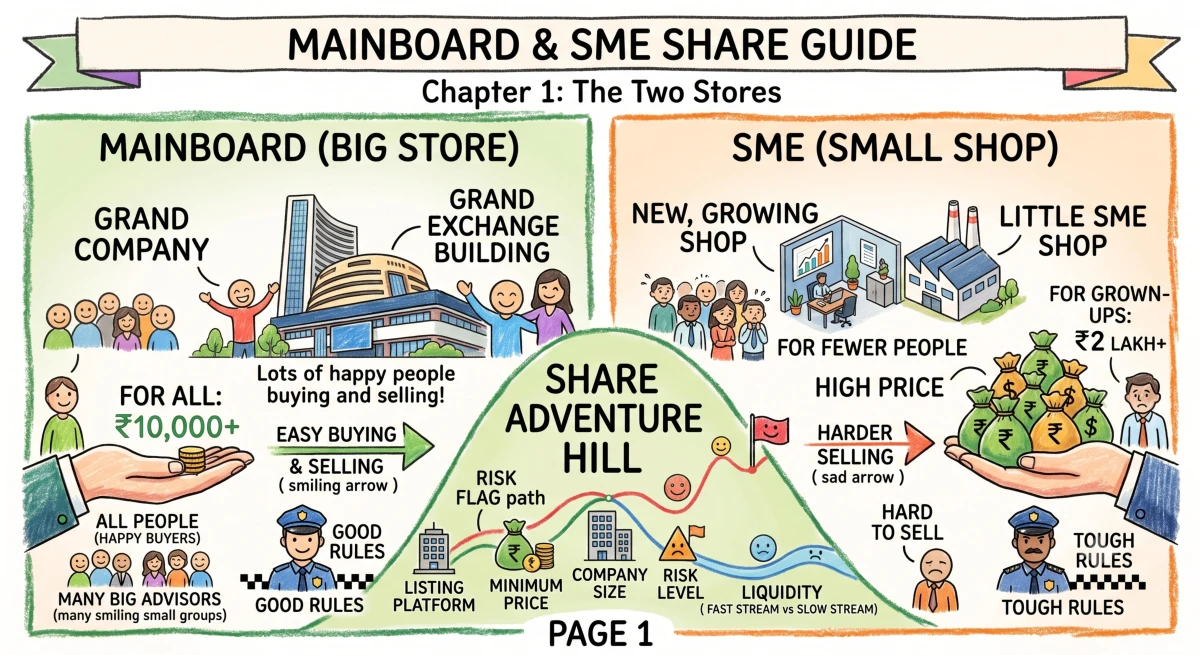
When you scroll through upcoming IPOs on IPO360, you will notice two distinct labels: Mainboard and SME. Both allow a company to raise money from the public and list its shares, but they operate under very different rules, target different investors, and carry very different levels of risk. A mainboard IPO is what most people picture when they think of a public issue: large, well-known companies listing on the main platforms of the BSE and NSE. An SME IPO, on the other hand, is a smaller public offering by a growing enterprise, listed on dedicated platforms called BSE SME and NSE Emerge. Understanding the difference is essential before you apply, because the amount of money you need, the liquidity you can expect, and the risk you take on are not remotely comparable.
Practical Tips
What is a Mainboard IPO?
A mainboard IPO is a public issue by a company that meets the full eligibility norms laid down under the SEBI ICDR Regulations. These are typically larger, more established businesses with substantial revenue, a longer operating history, and a wider shareholder base. Companies such as Hyundai Motor India, Bajaj Housing Finance, and LIC all took the mainboard route. Shares list directly on the main platforms of the BSE and NSE, where thousands of institutional and retail investors trade every day.
Mainboard issues are open to three broad investor categories: Qualified Institutional Buyers, Non-Institutional Investors, and Retail Individual Investors. The retail category reserves a meaningful portion of the issue for small investors, who can apply for as little as one lot, usually costing between ₹14,000 and ₹15,000. Because these companies are large and closely scrutinised, mainboard IPOs generally attract deeper analyst coverage, higher subscription levels, and stronger secondary-market liquidity once listed.
What is an SME IPO?
An SME IPO is a public issue by a small or medium enterprise, listed on dedicated platforms built for smaller companies: BSE SME and NSE Emerge. These platforms were launched in 2012 to give growing businesses an easier route to public capital than the demanding mainboard eligibility criteria. Since then, hundreds of companies have raised funds through this channel. Over 760 companies are currently listed on the BSE SME platform
However, the rapid growth also brought concerns about speculative trading and weak disclosures, which prompted SEBI to tighten the framework significantly. The updated rules were incorporated into the ICDR Regulations in March 2025, with the revised bidding process becoming operational from July 2025. As a result, SME IPOs today are meant for informed investors with a higher risk appetite, not casual first-time applicants. The companies are smaller, the financials are often less proven, and the shares can be far harder to buy and sell after listing.
The Biggest Difference: Minimum Investment
The single most important practical difference for a retail investor is the amount of money required to apply. In a mainboard IPO, the minimum application is one lot, typically in the range of ₹14,000 to ₹15,000, keeping it accessible to ordinary retail participants.
SME IPOs are a different matter entirely. In the new rules, the minimum application size is now two lots, valued over Rs 2 lakh, replacing the earlier lower thresholds that allowed smaller retail investments. This applies across all categories. Before July 2025, an investor could apply in an SME IPO with roughly ₹1 lakh. The existing Retail Individual Investor category has been replaced by Individual Investor, who can apply for up to 2 lots with a minimum application size of ₹2 lakhs or above. This was a deliberate move by SEBI to filter out casual retail participation and ensure only serious, committed investors enter the SME space.
The table below summarises how the two routes compare across the factors that matter most.
| Factor | Mainboard IPO | SME IPO |
|---|---|---|
| Listing platform | Main BSE and NSE boards | BSE SME, NSE Emerge |
| Minimum application | ~₹14,000–₹15,000 (one lot) | Above ₹2 lakh (two lots) |
| Investor categories | QIB, NII, Retail | QII, Individual Investor |
| Company size | Large, established | Small and medium |
| Liquidity after listing | High | Often low and thin |
| Regulatory scrutiny | Full ICDR norms | Platform-specific, tightened in 2025 |
| Analyst coverage | Extensive | Limited or none |
| Typical risk level | Moderate | High |
Practical Tips
SME IPOs are a different matter entirely. In the new rules, the minimum application size is now two lots, valued over Rs 2 lakh, replacing the earlier lower thresholds that allowed smaller retail investments. This applies across all categories. Before July 2025, an investor could apply in an SME IPO with roughly ₹1 lakh. The existing Retail Individual Investor category has been replaced by Individual Investor, who can apply for up to 2 lots with a minimum application size of ₹2 lakhs or above. This was a deliberate move by SEBI to filter out casual retail participation and ensure only serious, committed investors enter the SME space.
The table below summarises how the two routes compare across the factors that matter most.
Factor Mainboard IPO SME IPO
Listing platform Main BSE and NSE boards BSE SME, NSE Emerge
Minimum application ~₹14,000–₹15,000 (one lot) Above ₹2 lakh (two lots)
Investor categories QIB, NII, Retail QII, Individual Investor
Company size Large, established Small and medium
Liquidity after listing High Often low and thin
Regulatory scrutiny Full ICDR norms Platform-specific, tightened in 2025
Analyst coverage Extensive Limited or none
Typical risk level Moderate High
Block 6 — Practical Tip
Label: IMPORTANT
Body: The ₹2 lakh minimum is not optional and applies across every investor category in an SME IPO. If you cannot comfortably commit at least ₹2 lakh to a single, higher-risk application, the SME route is not designed for you. The mainboard route, where you can apply for one lot, remains the accessible entry point for most retail investors.
Eligibility and Disclosure Norms
Mainboard companies must satisfy the full set of SEBI ICDR eligibility conditions, including profitability, net worth, and net tangible asset thresholds, along with detailed disclosures in the DRHP and RHP. These filings are examined closely, and the issue is managed by merchant bankers who carry significant compliance obligations.
SME IPOs historically had far lighter requirements, which is exactly why SEBI stepped in. Under the 2025 framework, the norms have been tightened meaningfully. There is now a requirement of INR 1 crore of minimum operating profit (EBITDA) for two out of three financial years before filing of the DRHP. The Offer for Sale portion has been restricted to 20% of the total issue size, and selling shareholders cannot sell more than 50% of their pre-issue shareholding on a fully diluted basis. SEBI has also increased the required minimum number of allottees from 50 to 200 to broaden participation. The allotment method for Non-Institutional Investors in a book-built SME issue has moved from proportionate allotment to a draw of lots.
Bidding Rules and Flexibility
The July 2025 rules also removed some of the flexibility that SME investors previously enjoyed. The cut-off price option has been removed, along with the ability to cancel or revise bids downward, enforcing greater price discipline. In a mainboard IPO, retail investors can still bid at the cut-off price, which automatically accepts the final issue price, and they retain the ability to modify or withdraw their bid during the application window.
This means the two processes now feel different even at the application stage. A mainboard application is forgiving: you can tick cut-off, change your mind, and apply with a small amount. An SME application is rigid: you must bid a specific price within the band, you cannot cancel or reduce your bid once placed, and you must commit above ₹2 lakh. This rigidity is intentional, designed to discourage speculative flipping and ensure only genuinely interested investors participate.
Liquidity and Risk After Listing
Perhaps the most underappreciated difference shows up after listing. Mainboard shares trade actively, with many buyers and sellers at any moment, so you can usually exit your position at a fair price whenever you want. SME shares are a different story. Trading volumes on BSE SME and NSE Emerge are often thin, and it is common to see days where a stock barely trades. This makes it difficult to sell in size without moving the price against yourself, and it can trap investors who need to exit quickly.
SME companies are also inherently riskier. They are smaller, less diversified, and more vulnerable to a single lost customer, a funding crunch, or a management misstep. There is limited analyst coverage, so you often have to rely on the offer document and your own judgement. The higher ₹2 lakh entry barrier exists precisely because the downside can be severe. A grey market premium on an SME IPO should be treated with even more caution than on a mainboard issue, because thin post-listing liquidity can distort both the GMP and the actual listing behaviour.
Which Route is Right for You?
For most retail investors, the mainboard route is the sensible default. The lower entry cost, deeper liquidity, heavier regulatory oversight, and wider information availability all reduce the practical risk you carry. You can participate meaningfully with a modest amount and exit without much difficulty.
The SME route is best suited to investors who genuinely understand small-company risk, can commit at least ₹2 lakh to a single application, and are prepared for the possibility of poor liquidity or a sharp fall after listing. It is not a shortcut to quick gains, and the tightened 2025 framework reflects SEBI's view that the segment had become too speculative. If you are still building your understanding of how public issues work, begin with well-covered mainboard IPOs, use the offer documents to learn how to read financials, and treat SME issues as an advanced category to approach only once you are comfortable evaluating a company on your own.