Index
Index
If you've watched a company like Tata Capital or LG Electronics list on the stock exchange and wondered how ordinary investors got to buy those shares before anyone else, you've already brushed up against what an IPO is. An IPO i.e. an Initial Public Offering is the moment a privately held company sells its shares to the general public for the first time and becomes listed on a stock exchange like the NSE or BSE. Before an IPO, a company is owned by a small group: founders, early employees, and private investors. After it, anyone with a Demat account can own a piece of it. This guide walks you through exactly what happens, why companies do it, and what you as a retail investor need to understand before you apply.
Practical Tips
What Does "Going Public" Actually Mean?
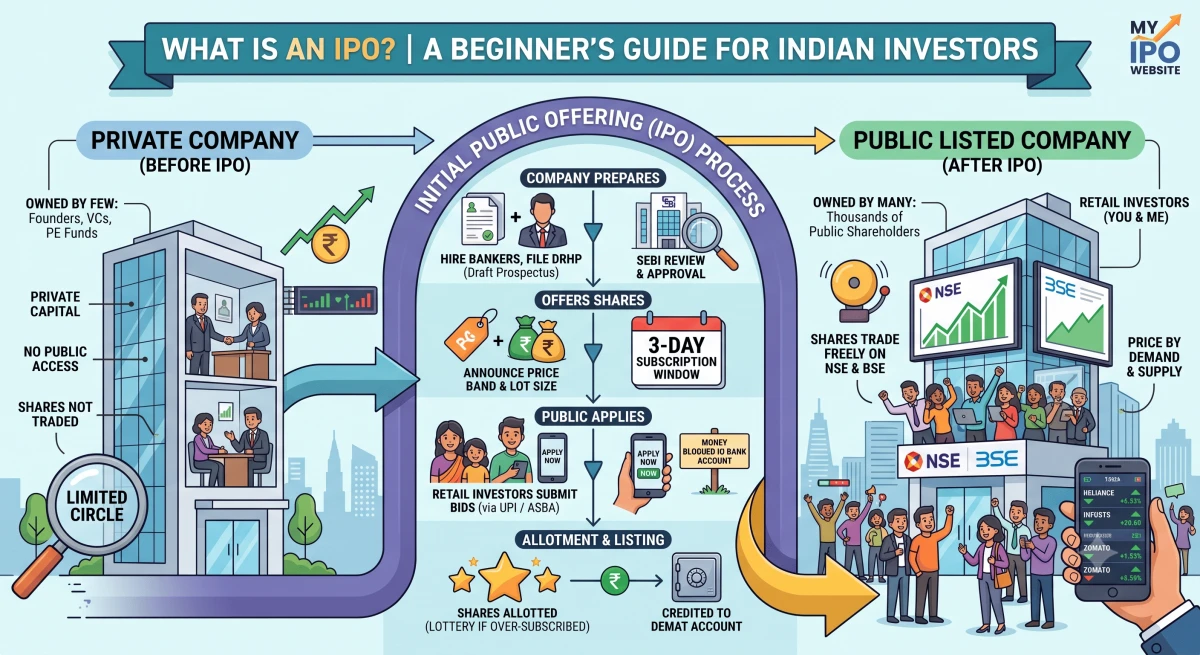
Every large listed company you know — Reliance, Infosys, Zomato — started as a private company. Private companies raise money from a limited circle: promoters put in their own capital, then venture capital or private equity funds invest in later rounds. Their shares are not available to you and me, and there's no easy way to buy or sell them.
"Going public" changes this. When a company launches an IPO, it offers shares to the public at large for the first time. Once the IPO closes and the shares list, they trade freely on the exchange, and their price moves every second based on demand and supply. The company is now answerable to thousands of public shareholders, must publish quarterly results, and falls under the full oversight of SEBI (the Securities and Exchange Board of India) and the stock exchanges.
In simple terms: an IPO is the bridge between being a private company owned by a few and a public company owned by many.
Why Do Companies Launch IPOs?
Companies don't go public on a whim — it's an expensive, heavily regulated process. There are usually a few core reasons:
Raising fresh capital. This is the most common one. The company issues new shares and the money goes into its bank account — to build factories, repay debt, fund expansion, or invest in growth. This portion is called the fresh issue.
Giving early investors an exit. Founders, employees with ESOPs, and early private investors may want to sell some of their holdings. When existing shareholders sell their shares in an IPO, it's called an Offer for Sale (OFS). Here the money goes to the selling shareholders, not to the company.
Prestige, visibility, and currency. Being listed raises a company's profile, makes it easier to attract talent, and gives it publicly traded shares it can use for acquisitions or employee incentives.
Most Indian IPOs are a mix of fresh issue and OFS. Understanding the split matters: a company raising money mostly through OFS isn't putting new capital into the business — the promoters are simply cashing out.
The IPO Process in India: Step by Step
Here's the journey a company takes from deciding to go public to actually listing:
- Appoint merchant bankers. The company hires Book Running Lead Managers (BRLMs) — investment banks that manage the entire process, price the issue, and market it to investors.
- File the DRHP. The company submits a Draft Red Herring Prospectus to SEBI. This is a detailed document covering its financials, risks, business model, and how it plans to use the money.
- SEBI review. SEBI examines the DRHP, raises queries, and eventually gives its observations. The company then files the RHP (Red Herring Prospectus) with the price band.
- Price band and dates announced. The company sets a price band (e.g. ₹100–₹105 per share), the lot size, and the 3-day subscription window.
- Anchor investors bid. One day before the IPO opens to the public, large institutional investors (anchor investors) are allotted shares to build confidence.
- Public subscription. For three business days, retail investors, HNIs, and QIBs place their bids through UPI or ASBA.
- Allotment. After the issue closes, shares are allotted. If the IPO is oversubscribed, retail investors get shares via a lottery.
- Listing. The shares list on the exchange, usually on a T+3 basis (three business days after the issue closes), and trading begins.
Practical Tips
Key IPO Terms Every Beginner Should Know
The IPO world is full of jargon. Here are the terms you'll run into immediately:
| Term | What it means |
|---|---|
| Price Band | The range within which you bid, e.g. ₹100–₹105 |
| Cut-off Price | The final price decided at the top of the band; retail investors usually bid here |
| Lot Size | The minimum number of shares you can apply for; you can't buy just one share |
| Fresh Issue | New shares sold; money goes to the company |
| Offer for Sale (OFS) | Existing shares sold; money goes to selling shareholders |
| Oversubscription | When applications exceed shares available (e.g. "22 times subscribed") |
| GMP | Grey Market Premium — an unofficial, unregulated price hint before listing |
| Listing Gain | The profit (or loss) on listing day versus the IPO price |
| Anchor Investor | Large institutions allotted shares a day before the IPO opens |
You don't need to memorise all of these at once — but understanding price band, lot size, and oversubscription will get you through your first application comfortably.
Mainboard vs SME IPOs
Not all IPOs are the same size. In India there are two broad categories:
Mainboard IPOs are the large, well-known companies that list on the main NSE and BSE platforms. They have stricter eligibility norms, larger issue sizes, and broad institutional participation. In 2025, there were 100+ mainboard IPOs.
SME IPOs are smaller companies that list on dedicated SME platforms (NSE Emerge and BSE SME). They have lighter listing requirements, much smaller issue sizes, and larger lot sizes — meaning your minimum investment is often ₹2 lakh or more. In 2025, SME issues actually outnumbered mainboard ones, with 250+ SME listings.
What Beginners Should Know Before Applying
An IPO is not a guaranteed profit machine. It's easy to assume that "getting into an IPO" means quick listing-day gains, but the reality is more sober. In 2025, even though the market was booming, the median listing gain across mainboard IPOs fell to under 4% — down sharply from around 15% in 2024. Plenty of well-hyped IPOs listed flat or below their issue price.
History has clear examples on both sides. Bajaj Housing Finance (Sep 2024) delivered a spectacular 114% listing gain. Tata Technologies (Nov 2023) became a multibagger. But Paytm (Nov 2021) fell about 27% on listing day and disappointed investors for years, and Ola Electric (2024) struggled after its debut despite heavy pre-listing excitement.
The lesson: apply to an IPO because you've read the RHP and believe in the business at that price — not because the grey market premium is high or because everyone on social media is excited. Treat listing gains as a bonus, not a plan.
Practical Tips
What You Need to Apply for an IPO
Getting started is simpler than most beginners expect. You need three things:
- A Demat account — where your allotted shares are held electronically. You can't apply for an IPO without one.
- A trading account and a UPI ID (or net banking) — to place and fund your application. Most people apply through their broker's app (Zerodha, Groww, Upstox) using UPI, or through their bank's ASBA facility.
- Sufficient funds — when you apply, the application amount is blocked in your bank account (not debited) until allotment. If you don't get shares, the block is released automatically.
Once you have a Demat account, applying takes just a few minutes: select the IPO, choose your lot quantity, bid at cut-off price, and approve the UPI mandate. Then you wait for the allotment date to find out if you got shares.