Index
Index
What is Face Value in an IPO?
Face value is the original, nominal value assigned to a single share by the company when it is created — recorded in the company's books and its Memorandum of Association. It's also called par value or nominal value. In Indian IPOs, face value is almost always a small, round number: ₹1, ₹2, ₹5, or ₹10. When Tata Technologies came to market in November 2023, each share had a face value of ₹2, even though investors paid ₹500 to buy one. That gap is the source of most of the confusion around this term. Face value is an accounting figure, not the price you pay and not what the share is "worth." This guide clears up exactly what it is, where you'll see it, and — just as important — what it does not tell you.
Practical Tips
Face Value vs Issue Price vs Market Price
These three numbers are easy to mix up, so let's separate them clearly.
Face value is the fixed nominal value in the company's books. Issue price (or offer price) is what you actually pay to buy the share in the IPO — decided through the price band. Market price is what the share trades at on the exchange after listing, driven by demand and supply.
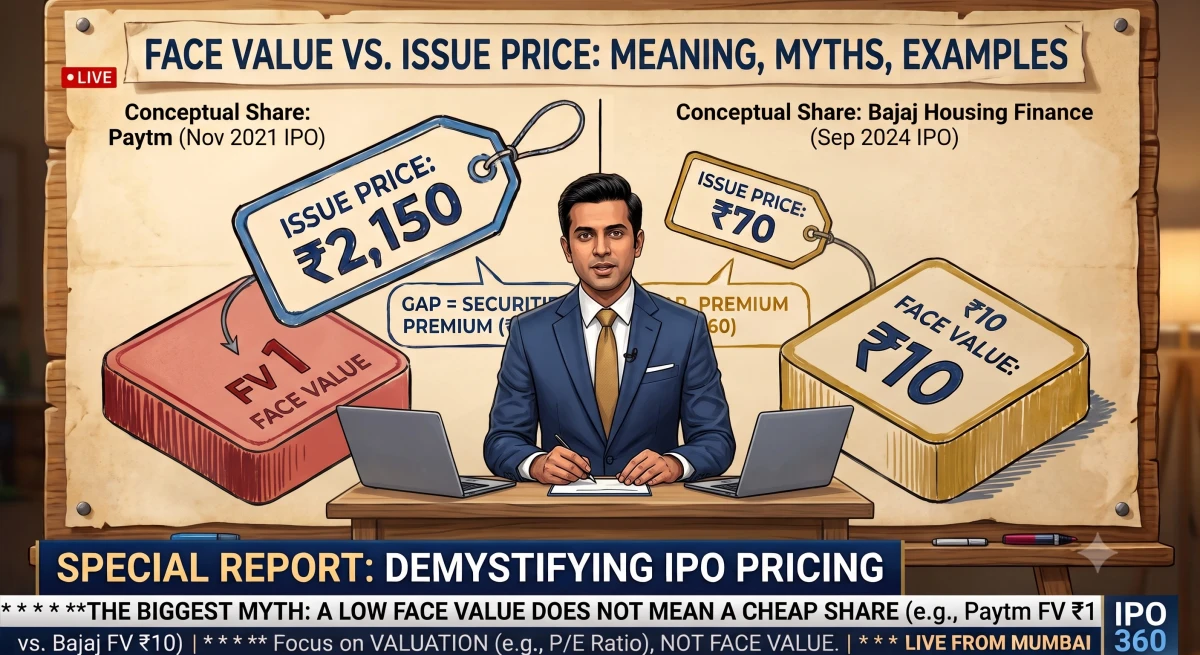
The gap between the issue price and the face value is the share premium. When a company issues shares above face value, that extra amount is collected in a "Securities Premium Account" and used for business purposes.
Here's how the three compare across real IPOs:
| IPO | Face Value | Issue Price | Premium Over Face Value |
|---|---|---|---|
| Paytm (Nov 2021) | ₹1 | ₹2,150 | ₹2,149 |
| Tata Technologies (Nov 2023) | ₹2 | ₹500 | ₹498 |
| LIC (May 2022) | ₹10 | ₹949 | ₹939 |
| Hyundai Motor India (Oct 2024) | ₹10 | ₹1,960 | ₹1,950 |
| Bajaj Housing Finance (Sep 2024) | ₹10 | ₹70 | ₹60 |
| Ola Electric (Aug 2024) | ₹10 | ₹76 | ₹66 |
Notice Paytm's face value was just ₹1 while its issue price was ₹2,150 — the entire ₹2,149 gap was premium. Face value and price move independently.
Why Does Face Value Matter?
If face value isn't the price, why do companies bother stating it? Because it anchors several important calculations.
Dividends are traditionally expressed as a percentage of face value. A company declaring a "200% dividend" on a ₹10 face value share is paying ₹20 per share; the same 200% on a ₹1 face value share is just ₹2. This is why you must always check face value before judging a dividend percentage — the headline number is meaningless without it.
Earnings Per Share (EPS) and other per-share metrics depend on the total number of shares, which is influenced by how the company divides its capital into face-value units. Accounting entries like share capital on the balance sheet are recorded at face value (shares issued × face value), with anything above it sitting in the premium account. Face value is also the reference point for stock splits and bonus issues.
Practical Tips
The Biggest Myth: Low Face Value Means a Cheap Share
A common beginner mistake is assuming a share with a ₹1 or ₹2 face value is "cheaper" or better value than one with a ₹10 face value. This is wrong.
Face value has no connection to whether a share is expensive or attractively priced. Paytm had a ₹1 face value but an issue price of ₹2,150 — hardly cheap. Bajaj Housing Finance had a ₹10 face value but an issue price of only ₹70. If you ranked these by face value alone, you'd draw exactly the wrong conclusion.
What actually tells you whether a share is reasonably priced is valuation — metrics like the price-to-earnings (P/E) ratio, which compares the issue price to the company's earnings, and how that stacks up against listed peers. Face value plays no role in that judgment. Treat it as an accounting label, not a value signal.
Face Value and Stock Splits
Face value isn't always permanent. Companies can change it through a stock split, which divides each share into smaller units and reduces the face value proportionally — without changing the total value of your holding.
For example, if a company splits its ₹10 face value share in a 10:1 ratio, the face value becomes ₹1 and one share becomes ten. If you held 100 shares worth ₹500 each (total ₹50,000), you'd now hold 1,000 shares worth ₹50 each — still ₹50,000. Splits are usually done to make a high-priced share more affordable and improve liquidity. The reverse, a consolidation (or reverse split), increases face value and reduces share count. So when you see a company's face value today, remember it may differ from its original IPO face value if a split has happened since.
Practical Tips
Where to Find the Face Value of an IPO
You never have to guess a company's face value — it's disclosed in official documents. The Draft Red Herring Prospectus (DRHP) and Red Herring Prospectus (RHP) both state it clearly, usually on the cover page and in the "Capital Structure" section. IPO tracking platforms and your broker's IPO page also list it in the basic details table alongside the price band and lot size.
Because face value is fixed and disclosed upfront, it's one of the few IPO numbers that won't change during the bidding process (unlike the final issue price, which is set within the band after bidding). Check it once, note it, and move your attention to the details that actually drive returns — the business, the financials, and the valuation.