Index
Index
INTRODUCTION
"Listing gain" is one of the most-quoted numbers in the IPO cycle, and one of the least understood. Financial news reports it as a single headline figure — "Stock X lists at 44% gain" — but that number can mean at least three different things depending on which price you're comparing to which. Whether you made money, how much, and whether that money is even yours yet (after tax and after the day's circuit limit) all hinge on getting the calculation right. This article walks through the actual formula, where people get it wrong, and what the number looks like once tax is factored in.
Practical Tips
The Basic Formula
At its simplest, listing gain measures how much the market valued a share above (or below) what IPO investors paid for it, expressed as a percentage:
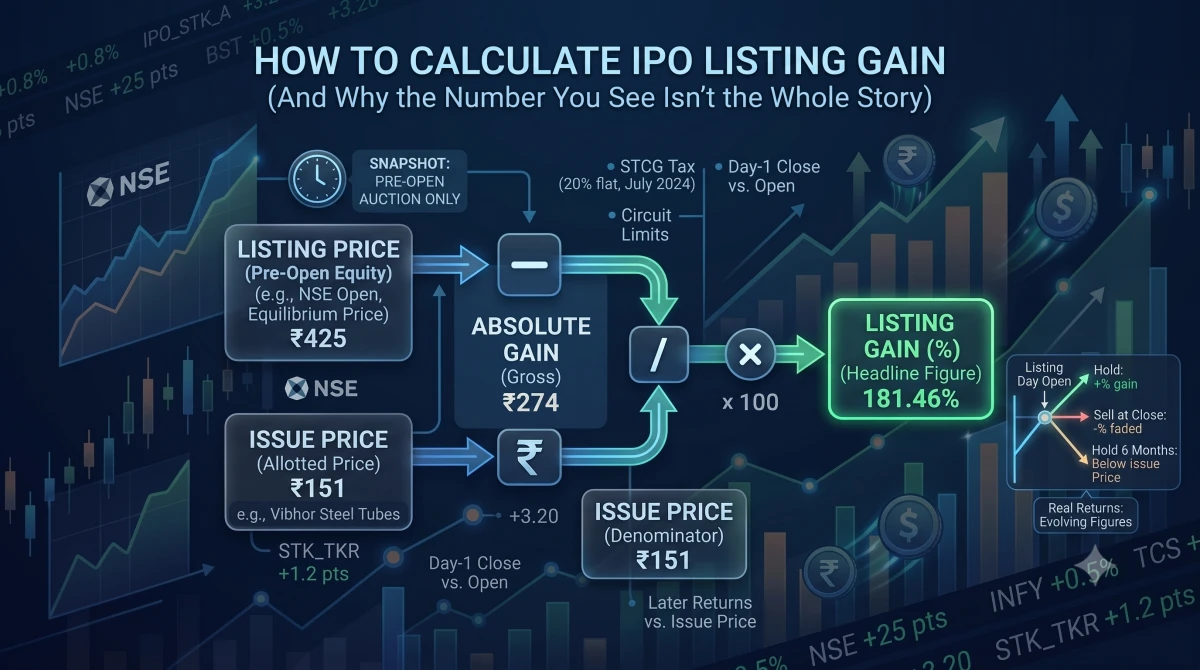
Listing gain (%) = [(Listing Price − Issue Price) / Issue Price] × 100
Two things about this formula trip people up. First, "issue price" means the final price at which shares were actually allotted — for a book-built IPO with a price band, this is the price fixed at the end of bidding (often, though not always, the upper end of the band), not the lower end of the band you might have bid for headroom against. Everyone who got allotted shares in a given IPO paid the same issue price, regardless of what price they bid within the band, so there's no per-investor variation here.
Second, "listing price" specifically means the price discovered in the pre-open call auction — the price the stock actually opens at on the exchange. This is the number GMP is trying to predict beforehand, and it's the number most listing-day headlines are built around.
Three Numbers People Call "Listing Gain" — And They're Not the Same
This is where most confusion happens, because a stock's price can move meaningfully within its first trading day. Three distinct figures exist for any IPO's first day:
- Listing-price gain — based on the opening/equilibrium price. This is the number set in the pre-open auction and is what's usually meant when a report says a stock "listed at X% premium."
- Day-1 closing gain — based on where the stock actually closes at 3:30 PM on listing day. This can be higher (if the stock rallies further, within its circuit band) or lower (if it fades) than the listing price.
- Current return — the ongoing, day-to-day gain or loss versus the issue price, measured from the current market price at any later point. This isn't a "listing gain" at all — it's an evolving return that has nothing to do with listing day specifically, but is often confused with it in casual conversation.
The distinction matters because your actual profit depends on when you actually sell, not on the headline figure. A stock that "listed at 20% gain" but closed the day at 12% gain, and is now trading 5% below issue price a month later, produces three completely different outcomes for three different investors — even though all three might describe the IPO the same way.
Worked example — Vibhor Steel Tubes (Feb 2024). Issue price: ₹151. Lot size: 99 shares (cost per lot: ₹14,949). Listing price on NSE: ₹425. Listing gain = [(425 − 151) / 151] × 100 = 181.46%. In rupee terms, that's a gain of ₹274 per share, or ₹27,126 per lot — before any tax or brokerage — on a lot that cost ₹14,949 to buy.
When the Number Is Negative
The same formula works identically for a weak listing — it just produces a negative percentage, and the rupee math turns into a loss rather than a gain.
Take Paytm's November 2021 listing: issue price ₹2,150, lot size 6 shares, cost per lot ₹12,900. The stock opened at ₹1,950. Listing gain = [(1,950 − 2,150) / 2,150] × 100 = −9.3%. In rupee terms, that's a loss of ₹200 per share, or ₹1,200 per lot, at the moment of listing — before the stock kept sliding through the day to close at ₹1,564, a day-1 closing loss of −27.25%, or ₹3,516 per lot on paper.
This is worth internalising precisely because IPO coverage skews toward celebrating gains: the same formula, and the same rupee math, applies whether the number in the bracket is positive or negative.
Listing Gain vs. Real Returns: A Reality Check
A strong listing-day number doesn't necessarily translate into a good investment. Across the roughly 344 companies that went public in calendar year 2025, average listing-day gains moderated sharply to around 9-10%, down from about 30% in 2024 and 29% in 2023. More tellingly, while the large majority of that year's IPOs initially listed above their issue price, roughly half had slipped back below their issue price by the end of the year — meaning the listing-day gain many of those investors saw on paper had fully evaporated within months.
The gap between "listing gain" and "actual return" comes down to one simple fact: listing gain is a snapshot of a single moment — the pre-open auction on one specific morning. It says nothing about whether that price holds. An investor who sold at listing captured whatever the formula above calculated; an investor who held captured something else entirely, for better or worse.
Practical Tips
Quick Reference: The Numbers That Actually Matter
| What you want to know | Formula | Based on |
|---|---|---|
| Headline "listing gain" | (Listing Price − Issue Price) / Issue Price × 100 | Pre-open equilibrium price |
| Day-1 actual result | (Day-1 Close − Issue Price) / Issue Price × 100 | 3:30 PM closing price |
| Gain per lot (rupees) | (Listing Price − Issue Price) × Lot Size | Your actual allotment |
| Post-tax gain (if sold within 12 months) | Gross Gain × (1 − 0.20) | Applicable to STCG on listed equity |
| Current return (any later date) | (CMP − Issue Price) / Issue Price × 100 | Ongoing, not a "listing" figure at all |
The one figure this table deliberately leaves out is a prediction — GMP-implied gain is a market estimate, not a calculation off a confirmed price, and belongs in a different conversation from the ones above, which are all computed after the fact from real, confirmed prices.
KEY TAKEAWAY
(1) Listing gain = (Listing Price − Issue Price) / Issue Price × 100, where "listing price" is the pre-open equilibrium price, not the day's closing price. (2) Everyone allotted shares pays the same issue price, so the formula doesn't vary by what you bid within the price band. (3) Listing-price gain, day-1 closing gain, and current return are three distinct numbers — know which one a headline is actually quoting. (4) The same formula applies to losses; a negative listing day produces a real rupee loss per lot, calculated the same way. (5) A strong listing gain is a one-day snapshot, not a guarantee — roughly half of 2025's IPOs had slipped below issue price within months despite most listing at a premium. (6) Any gain booked within 12 months is taxed as short-term capital gains at a flat 20%, with no exemption threshold — the headline percentage is always a pre-tax figure.