Index
Index
INTRODUCTION
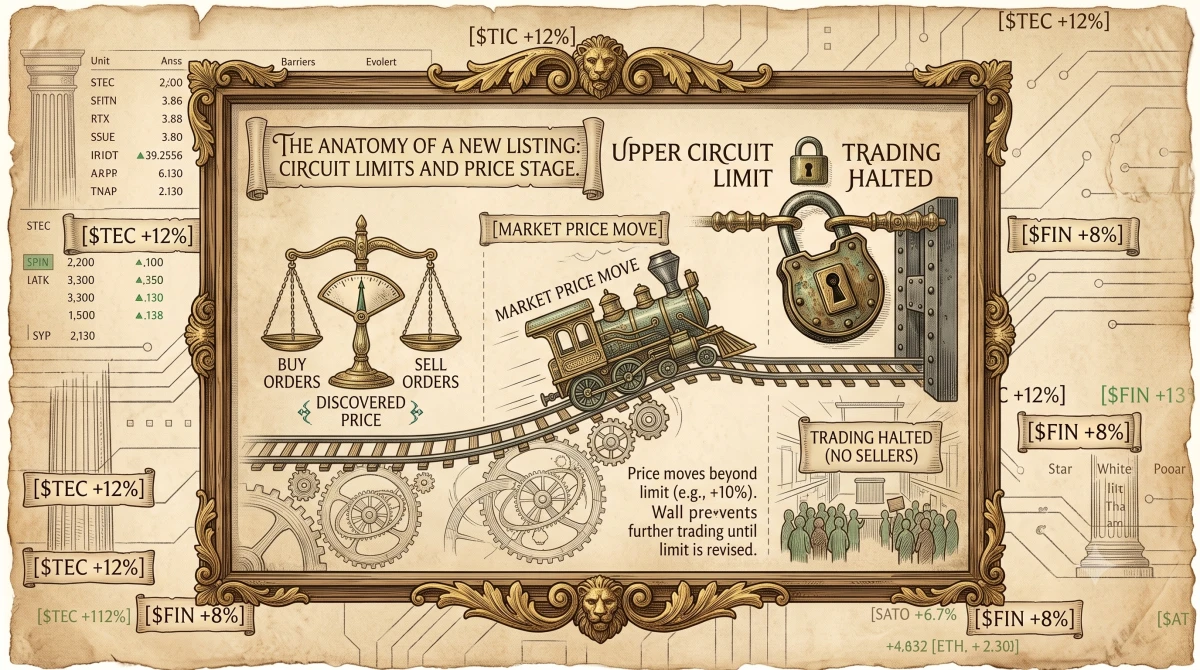
A common source of listing-day confusion is investors watching their sell order sit unexecuted while the screen shows a green "upper circuit" price. This isn't a glitch — it's the mechanism working exactly as designed. Unlike a normal trading day, an IPO doesn't simply start trading at 9:15 AM based on the previous day's close, because there is no previous close to anchor to. Exchanges instead run a special price-discovery process, followed by a tighter-than-usual circuit band for the rest of the day. Understanding both halves of this mechanism — not just the headline listing price — explains why some stocks trade freely on debut while others freeze solid with no buyers or sellers able to transact.
Practical Tips
Why Listing Day Doesn't Start Like a Normal Trading Day
For an already-listed stock, the previous day's closing price anchors the day's circuit limits from the opening bell. A newly listed IPO has no such anchor — its only reference point is the issue price, which was fixed weeks earlier and may bear little resemblance to actual market demand on debut. Opening it to unrestricted continuous trading at 9:15 AM would risk chaotic, thinly-informed price swings in the first few minutes.
To avoid this, SEBI requires a special pre-open session (SPOS) for every IPO and relisting, structured as a call auction rather than continuous trading. It runs for a full 60 minutes, roughly 9:00 AM to 10:00 AM, compared to the 15-minute pre-open window used for ordinary stocks. Within that hour, orders are collected for the first stretch, matched and an equilibrium price is struck in the final minutes, and a short buffer period follows before continuous trading takes over closer to 10:00 AM.
How the Equilibrium Price Is Actually Discovered
During the order-collection phase, buyers and sellers submit limit orders without seeing live matching happen in real time — this is what makes it a call auction rather than continuous trading. Once the window closes, the exchange calculates the equilibrium price: the single price at which the maximum quantity of shares can be matched between buyers and sellers. If more than one price satisfies that condition, the exchange picks the one with the smallest order imbalance, and if there's still a tie, the price closest to the issue price wins.
Because NSE and BSE run this auction independently, the equilibrium price each exchange discovers can differ. When it does, a Common Equilibrium Price (CEP) is calculated as the volume-weighted average of the two. For example, if BSE discovers ₹120 for 300 matched shares and NSE discovers ₹100 for 500 matched shares, the CEP works out to (120×300 + 100×500) ÷ 800 = ₹107.50 — and this becomes the reference price both exchanges use for the circuit band described below.
Practical Tips
The Circuit Band That Takes Over Once Trading Begins
Once the discovered price (or CEP, or fallback issue price) is set, normal continuous trading begins for the rest of the day — but within a fixed band around that reference price. The width of the band depends entirely on issue size, not on whether the company is a mainboard or SME listing: issues of ₹250 crore or less get a 5% band on either side, while issues above ₹250 crore get a 20% band.
This distinction catches many investors off guard, because a stock can be a fully mainboard, NSE/BSE-listed company and still trade under the tighter 5% band purely because the issue itself was small. Vibhor Steel Tubes (Feb 2024), a ₹72.17 crore mainboard IPO, is a clean illustration: despite listing at a 181% premium over its ₹151 issue price, it traded under a 5% band all day — not the wider 20% band some investors assumed applied to a "regular" mainboard stock — and closed pinned at the upper circuit with unmatched buy orders still queued.
What a Locked Circuit Actually Means for Your Order
When a stock's price hits the top or bottom of its band, trading doesn't stop — it freezes at that exact price. Orders can still be placed at the circuit price, but they only execute if a matching counter-order exists. An upper-circuit lock means buyers vastly outnumber sellers at that price; your sell order joins a queue, and whether it executes depends entirely on whether other holders are also willing to sell at the frozen price, or whether the circuit lifts on a later session as sentiment shifts.
Vibhor Steel Tubes again illustrates this well: it closed listing day pinned at its 5% upper circuit with buy demand still unmet, and the very next session, sentiment reversed sharply enough that the stock hit the 5% lower circuit instead — a round trip from "no sellers available" to "no buyers available" within 48 hours, entirely within a narrow 5% band each day. Neither move reflected a considered view of the business; both were mechanical consequences of a thin float meeting a tight circuit.
Practical Tips
SME IPOs Add the Trade-for-Trade Rule
Most SME IPOs (and small mainboard issues, as above) also fall under the ₹250 crore threshold, so the same 5% band applies. But SME listings carry an additional constraint worth knowing before you plan to sell: many are placed under the trade-for-trade (T2T) segment for an initial period after listing. In T2T, every trade must be settled with actual delivery — you cannot buy and sell the same shares within a single settlement cycle the way you can with a normal, intraday-eligible stock. SME shares also trade in fixed market lots rather than single shares, so a sell order must be placed for a full lot or a multiple of it, not an arbitrary quantity.
From Day Two Onward: Standard Exchange Circuit Filters
The special listing-day mechanism — the call auction and the issue-size-based band — applies only on day one. From the second trading session, the stock moves into the exchange's ordinary, periodically reviewed circuit filter framework, which assigns bands (commonly 5%, 10%, or 20%, depending on the security's volatility, market capitalisation, and surveillance category) the same way it does for any other listed stock. This band isn't necessarily the same as the one used on listing day, and exchanges can revise it over time as trading volumes and volatility stabilise. Rather than assuming a fixed number, it's worth checking the live circuit filter list on the NSE or BSE website for the specific stock before placing an order in the days immediately following listing.
A Regulatory Change Worth Watching
In May 2026, SEBI issued a consultation paper proposing changes to the pre-open price discovery process, in response to concerns that some IPOs list at artificially depressed prices relative to demand, triggering repeated upper-circuit locks over several sessions with almost no genuine sellers able to transact. One proposal under discussion is a minimum requirement of five unique PAN-based buyers and five unique PAN-based sellers for the auction to be considered a valid price discovery, intended to prevent the equilibrium price from being set by a handful of orders. As of this writing, this remains a consultation proposal and has not been notified as a final rule — worth monitoring, but not yet something that changes how the mechanism described above actually works.
KEY TAKEAWAYS
IPO listing day begins with a 60-minute special pre-open call auction, not continuous trading, to discover a fair opening price. Once trading resumes, a circuit band applies around that price — 5% for issues up to ₹250 crore, 20% above that — regardless of whether the listing is SME or mainboard. If the auction can't find an equilibrium price, the band is set around the issue price instead. A locked circuit freezes the price but doesn't guarantee your order executes — it only matches if a counter-order exists. SME and small mainboard issues often add the trade-for-trade rule, ruling out same-day intraday selling. From day two onward, the stock switches to the exchange's standard circuit filter, which may differ from the listing-day band.