Index
Index
INTRODUCTION
On listing day, an IPO stops being an application and becomes a traded stock. For most retail investors, this is the day that decides whether applying was worth the effort. It is also the day on which many investors make avoidable mistakes: placing orders at the wrong time, misreading the opening price, or selling in a panic during the first hour.
Listing day follows a fixed sequence set by SEBI and the stock exchanges. Shares arrive in your demat account a day earlier. A special pre-open auction then discovers the listing price between 9:00 and 9:55 AM, and regular trading begins at 10:00 AM within a price band that applies only to newly listed stocks. This guide walks through each stage and explains the rules for mainboard and SME listings. It also uses real debuts to show what investors should, and should not, read into the opening price.
Practical Tips
What Happens Before Listing Day: The T+3 Countdown
Since 1 December 2023, SEBI has made the T+3 timeline mandatory for public issues. Here, T is the day the issue closes. The countdown tells you when to expect allotment, when your shares will be credited, and when you can sell. Hyundai Motor India's October 2024 IPO shows the schedule clearly.
| Day | Stage | Hyundai Motor India (Oct 2024) |
|---|---|---|
| T | Issue closes for bidding | Thursday, 17 October |
| T+1 | Basis of allotment finalised | Friday, 18 October |
| T+2 | Shares credited to demat; unallotted funds unblocked | Monday, 21 October |
| T+3 | Shares list on NSE and BSE | Tuesday, 22 October |
Weekends and exchange holidays do not count as working days, which is why Hyundai's T+3 fell on a Tuesday. By the evening of T+2, allotted shares normally appear in your demat holdings, although some broker apps take a few hours longer to show them. If your application was unsuccessful, the blocked amount should be released on the same day. Before listing, the exchanges also publish a notice confirming the trading symbol, the listing group and the settlement details for the new stock.
Listing Day Timeline: Hour by Hour
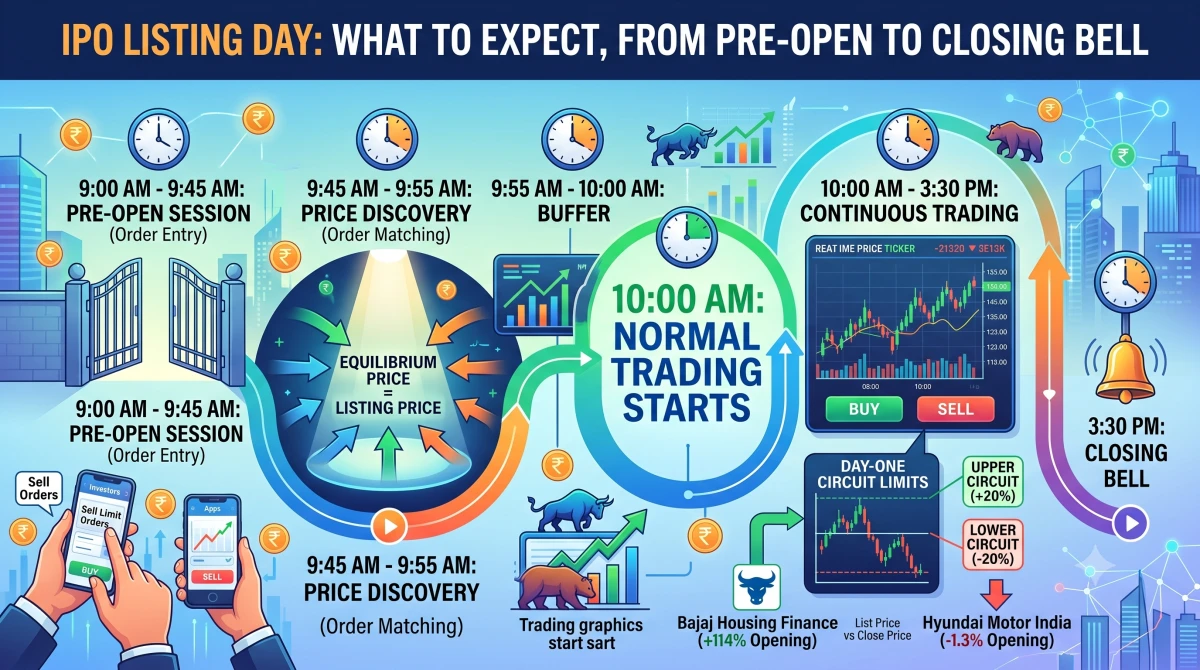
A newly listed stock does not begin trading at 9:15 AM with the rest of the market. Instead, it goes through a special pre-open session. This is a call auction that the exchanges run for IPOs on their first day of trading, including SME IPOs, and for relisted securities.
| Time (IST) | What Happens | What You Can Do |
|---|---|---|
| 9:00 – 9:45 AM | Order collection; the window closes at a random moment by 9:45 AM | Place, modify or cancel limit orders |
| 9:45 – 9:55 AM | Order matching; the equilibrium price is determined and becomes the listing price | No new orders or changes |
| 9:55 – 10:00 AM | Buffer period; unmatched orders move to the normal market | Wait |
| 10:00 AM – 3:30 PM | Continuous trading within the listing-day price band | Buy or sell like any listed share |
The random close is deliberate. No participant knows the exact moment the window shuts, which makes it harder to distort the opening price with large orders in the final seconds.
Investors should also be aware of a separate rule change. From 7 September 2026, NSE revised its regular 9:00–9:15 AM pre-open session and stopped accepting market orders after 9:05 AM. That change applies to securities that are already listed. It does not replace the special pre-open session used for IPO listings, which keeps its own timings and rules.
How the Listing Price Is Discovered
The company, the lead managers and the grey market do not set the listing price. The listing price is the equilibrium price from the pre-open auction: the single price at which the largest number of shares can change hands. Every buy order at or above that price, and every sell order at or below it, is eligible to execute at that one price.
A simplified example shows how this works. Assume an IPO was issued at ₹100 and the following cumulative orders are standing when the window closes.
| Price | Buy Orders at or Above (shares) | Sell Orders at or Below (shares) | Matchable Quantity |
|---|---|---|---|
| ₹105 | 9,000 | 4,000 | 4,000 |
| ₹110 | 7,000 | 6,500 | 6,500 |
| ₹115 | 5,000 | 8,000 | 5,000 |
The largest matchable quantity is 6,500 shares, at ₹110. That makes ₹110 the listing price, a 10% premium to the issue price. An allottee who placed a sell limit order at ₹104 still receives ₹110, because all matched trades execute at the equilibrium price.
No price band applies during the mainboard special pre-open session. This is why listing premiums and discounts can be far larger than a normal daily move. The orders that make up the auction reflect several factors: subscription levels (especially QIB demand), market sentiment on the day, and how the issue was valued.
Price Bands and Circuit Limits on Day One
Once trading starts at 10:00 AM, the stock can only move within a band calculated on the equilibrium price. The width of that band depends on the issue size and the platform, under a SEBI framework that dates back to 2012.
| Listing Type | Special Pre-Open Session | Band After 10:00 AM | Other Day-One Conditions |
|---|---|---|---|
| Mainboard, issue above ₹250 crore | No price band | Up to 20% of equilibrium price | Intraday trading permitted |
| Mainboard, issue up to ₹250 crore | No price band | 5% of equilibrium price | Trade-for-trade settlement for the first 10 trading days |
| SME IPO | Opening price capped at 90% above issue price (NSE Emerge) | 5% | Trading in fixed lots |
Exchanges can apply a narrower band than the maximum, so check the actual band in the listing notice. Ola Electric (August 2024) moved the full 20% on debut and closed at its upper limit of ₹91.20. Bajaj Housing Finance (September 2024) was capped at ₹165, which was 10% above its listing price.
NSE introduced the SME opening cap on 4 July 2024. In the same week, several SME stocks had opened at very large premiums. Diensten Tech listed 140% above its issue price, and Divine Power Energy opened at ₹155 against an issue price of ₹40, a premium of roughly 287%.
Practical Tips
What Real Listing Days Looked Like
| IPO | Issue Price | Listing Price (NSE) | Listing-Day Close | What Stood Out |
|---|---|---|---|---|
| Bajaj Housing Finance (Sep 2024) | ₹70 | ₹150 (+114%) | ₹165 | Subscribed 63.61 times; demand carried into the auction |
| Ola Electric (Aug 2024) | ₹76 | ₹76 (flat) | ₹91.20 (+20%) | Grey market had signalled a discount; stock hit upper circuit after listing |
| Hyundai Motor India (Oct 2024) | ₹1,960 | ₹1,934 (−1.3%) | ₹1,845 | Retail portion subscribed only 0.50 times; fell further after listing |
| Paytm (Nov 2021) | ₹2,150 | About 9% below issue price | About 27% below issue price | Weak listing deepened through the session |
Three patterns stand out.
First, the listing price and the closing price can tell very different stories. An investor who judged Ola Electric at 10:00 AM saw a flat listing, while one who waited until the close saw a 20% gain. Hyundai and Paytm moved the other way, with both stocks closing well below their listing prices.
Second, the grey market can be wrong about the day itself, as Ola Electric's pre-listing discount showed.
Third, heavy institutional demand tends to show up in the auction, but it does not guarantee that gains will hold after the first session. Bajaj Housing Finance is an example. By December 2024, after its three-month anchor lock-in ended, the stock was trading around ₹133. That was still well above the issue price, but below its debut-day close.
Selling on Listing Day: Placing the Order Correctly
Allottees who plan to sell have two practical choices.
The first is to place a sell limit order during the pre-open window. If your limit price is at or below the equilibrium price, the order can be matched and executed at the listing price. If your limit is above the equilibrium price, the order does not execute in the auction and carries into the normal session at 10:00 AM. The special pre-open session accepts limit orders only, so every order needs a price.
The second choice is to wait for continuous trading and sell after watching the first few minutes. This gives you more information. It also exposes you to the volatility that newly listed stocks typically show in the first hour, when spreads can be wide and prices can swing several percentage points within minutes. If you place a limit order during the session, set it close to the prevailing price. Avoid market orders in thinly traded SME counters.
Tax should also be part of the decision. Shares sold on listing day have been held for less than 12 months, so any gain is taxed as a short-term capital gain at 20% under Section 111A. Securities transaction tax also applies to the sale.
Practical Tips
A Listing Day Checklist Using IPO360
Most listing-day errors come from missing a step the evening before. A short routine helps avoid them.
Start on the evening of T+2 by confirming your allotment on IPO360's allotment status tracker at ipo360.in/allotment-status. Then check that the shares appear in your broker's holdings. If the tracker shows an allotment but your holdings do not, check your CDSL or NSDL depository statement before assuming there is a problem, because broker apps can lag.
Next, review the final subscription data and the last GMP reading on IPO360's Live GMP Tracker at ipo360.in/gmp. Treat GMP as a sentiment signal rather than a price forecast, for the reasons the examples above illustrate.
Finally, decide before 9:00 AM whether you will sell in the pre-open auction, sell during the session, or hold. Note the price band that applies to the stock so that an upper or lower circuit does not catch you by surprise.
Investors who did not receive an allotment and want to buy on listing day should be more cautious. Buying at the open means paying a price that already reflects the listing premium, and the first-day band allows a sharp fall just as easily as a rise.
KEY TAKEAWAYS
IPOs list on T+3, and allotted shares are normally credited to your demat account by the evening of T+2.
The special pre-open session takes limit orders from 9:00 to 9:45 AM, the listing price is discovered by 9:55 AM, and trading begins at 10:00 AM.
The listing price is the auction's equilibrium price, and every matched order executes at that single price.
On day one, mainboard issues above ₹250 crore can move up to 20%, smaller issues are limited to 5% with trade-for-trade settlement, and SME openings on NSE Emerge are capped at 90% above the issue price.
The listing price and the closing price often diverge, as Ola Electric, Hyundai Motor India and Paytm showed.
Confirm your allotment, check your holdings and set your selling plan the evening before, using IPO360's allotment tracker and Live GMP Tracker.