Index
Index
INTRODUCTION
You apply for an IPO on a Monday. By Thursday, you're either holding shares that are trading on the exchange, or you have your money back in your account. That three-working-day turnaround isn't a coincidence or a courtesy — it's a specific SEBI-mandated schedule called T+3, where every stakeholder in the chain (registrar, banks, depositories, exchanges) has a fixed deadline for their part of the process. Miss understanding this timeline and you'll be refreshing your allotment status a day too early, or wondering why your demat account still shows nothing the morning after allotment. Here's exactly what happens on each of the three days, and why it's structured the way it is.
Practical Tips
From T+6 to T+3: Why the Timeline Changed
Until late 2023, an IPO took six working days to list after closing — a schedule that had been in place since 2018, when SEBI introduced UPI as a payment mechanism alongside ASBA for retail applications. SEBI proposed halving this in a May 2023 consultation paper, arguing that faster listing benefits everyone in the chain: issuing companies get access to the capital they've raised sooner, unsuccessful applicants get their blocked funds released faster, and the window for informal grey-market trading before an official listing shrinks.
The board approved the change in June 2023. It was rolled out in two phases — voluntary for issues opening on or after September 1, 2023, and mandatory for every issue opening on or after December 1, 2023. Every mainboard IPO since then has followed T+3. The shift followed closely on SEBI's move to a T+1 settlement cycle for ordinary secondary-market trades earlier the same year, part of a broader push to compress timelines across the market.
The T+3 Timeline, Day by Day
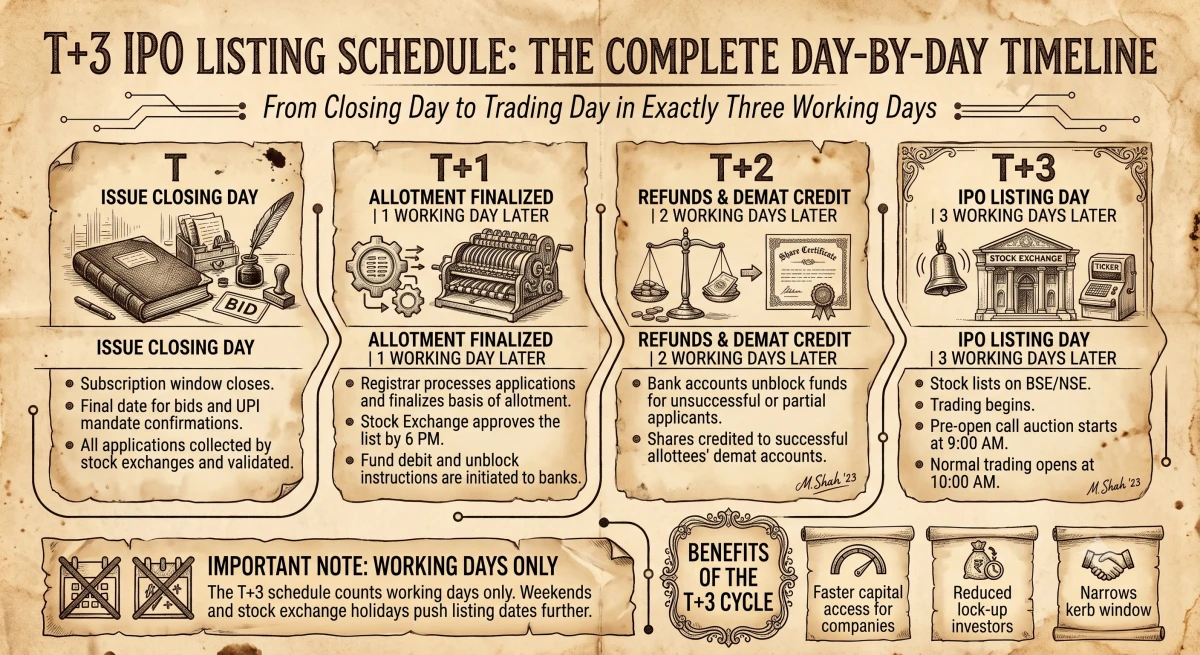
"T" is always the issue closing date — the last day you can submit or revise a bid. Everything else is counted in working days from there.
| Day | What happens |
|---|---|
| T (closing day) | Bidding closes. Applications, bid modifications, and UPI mandate validation with depositories are completed. |
| T+1 | Registrar finalises the basis of allotment and submits it to the stock exchange for approval, by 6 PM. Rejected applications are finalised. Fund transfer instructions (debit for allottees, unblock for non-allottees) are initiated. |
| T+2 | Refunds are processed for unsuccessful or partially successful applicants. Shares are credited to the demat accounts of successful allottees. |
| T+3 | Listing day. Trading begins with the pre-open call auction at 9:00 AM, and normal trading opens at 10:00 AM. |
Note that these are working days, not calendar days — weekends and market holidays push every subsequent date forward, which is why a Friday closing date typically means a Wednesday listing rather than a Tuesday one.
Practical Tips
What Happens Behind the Scenes on Each Day
The compressed timeline works because most of the manual back-and-forth that used to stretch across six days has been automated or moved earlier. On T day itself, along with bid collection, exchanges validate UPI mandate details directly with depositories in real time, rather than waiting for a separate reconciliation step later. This is also why UPI-based ASBA applications need mandate confirmation before the bid window closes — a mandate that isn't approved in time can mean your bid doesn't count, regardless of when you submitted it.
T+1 is where the heaviest lifting happens. The registrar runs the allotment process (category-wise: retail, HNI, QIB, and any others applicable to that issue), finalises which applications are rejected on technical grounds, and submits the basis of allotment to the stock exchange for sign-off — all by 6 PM. Once approved, fund transfer instructions go out in two separate files: one instructing banks to debit successful applicants' blocked amounts, and one instructing an unblock for everyone else.
T+2 is execution day for those instructions. Banks release blocked funds back to unsuccessful applicants, and depositories credit shares into the demat accounts of successful allottees — which is why your shares typically show up the evening before listing, not the morning of.
Why This Timeline Matters for You as an Investor
The practical benefit of T+3 over the old T+6 schedule is that your money is tied up for half as long. Under ASBA, your application amount was only ever blocked in your bank account, not debited — but it was still unavailable for other use until the unblock instruction went through. A shorter cycle means unsuccessful applicants regain access to their funds sooner, and successful allottees get tradeable shares faster, reducing the window where GMP-driven expectations sit disconnected from an actual, tradeable price.
It also has a secondary effect SEBI explicitly called out when proposing the change: a shorter gap between closing and listing narrows the window for informal, unregulated trading of shares before they're officially listed — commonly referred to as kerb trading, distinct from the grey market premium quoted before allotment.
Practical Tips
What If Something Goes Wrong in the Process
The T+3 framework leaves very little slack, which is largely the point — SEBI ran extensive back-testing and stress simulations with exchanges, banks, NPCI, depositories, and registrars before making it mandatory, specifically to confirm the compressed timeline could hold up under real transaction volumes. In practice, delays are rare and tend to be issue-specific rather than systemic — for instance, a technical glitch in UPI mandate confirmation on T day can push a small number of applications into the rejected category on T+1, which is one of the more common reasons an individual investor doesn't see the allotment they expected. If your status shows "rejected" rather than "not allotted," checking the specific reason against your application details is usually more useful than assuming it was purely proportionate allotment at play.
KEY TAKEAWAYS
1) T+3 means listing happens exactly three working days after the issue closes, mandatory for all mainboard IPOs since December 1, 2023. (2) T+1: allotment is finalised and approved by the exchange by 6 PM. (3) T+2: refunds are released and shares are credited to successful allottees' demat accounts. (4) T+3: trading begins, starting with the 9:00–10:00 AM pre-open call auction. (5) The schedule counts working days only — weekends and holidays push listing dates further out. (6) Compared to the earlier T+6 schedule, this halves the time your funds and shares are effectively locked up in the process.