Index
Index
Applying for an SME IPO Under the 2025 Framework
Applying for a Small and Medium Enterprise IPO in India is procedurally similar to a mainboard application, but the rules governing categories, bid sizes, and modifications are meaningfully different — and they changed materially on 1 July 2025. Under the SEBI (ICDR) Amendment Regulations, 2025, and follow-on circulars from NSE Emerge and BSE SME, the old Retail Individual Investor category has been retired for SME issues, replaced by an Individual Investor category with a higher entry threshold. Cut-off price bidding is no longer permitted for any category, and downward modification or cancellation of bids is disallowed once submitted. This guide walks through the current process end to end, including who can apply, which channel to use, and where applications typically fail.
Practical Tips
Who Can Apply and Under Which Category
Any Indian resident individual with a demat account and PAN can apply for an SME IPO, along with NRIs, HUFs, corporates, mutual funds, banks, insurance companies, and foreign portfolio investors. What differs from mainboard IPOs is the category structure. Effective 1 July 2025, SEBI has replaced the Retail Individual Investor category with an Individual Investor category, defined as an applicant who bids for two lots with a total application value above ₹2 lakhs and up to (but not including) the sNII threshold. Any application of three lots or more falls under the Non-Institutional Investor category, which is split into small NII (sNII) covering applications up to ₹10 lakhs, and big NII (bNII) covering applications above ₹10 lakhs. Qualified Institutional Buyers form the third category. Two important reservations to remember: 35 percent of the net offer is reserved for Individual Investors, 15 percent for NIIs, and up to 50 percent for QIBs in a book-built SME IPO. The exact split appears in the RHP.
What You Need Before the Issue Opens
Before an SME IPO opens for subscription, you should have four things in place. First, an active demat account with any depository participant — SME shares list only in dematerialised form, so this is non-negotiable. Second, a PAN linked to that demat account. Third, an ASBA-enabled savings bank account with sufficient balance to cover a bid of at least ₹2 lakhs plus a small buffer. Fourth, a UPI ID created on that same bank account if you plan to apply through a broker. Third-party UPI IDs — meaning a UPI ID linked to a bank account not in your own name — are not accepted, and applications made with them are rejected at the exchange level. Also confirm that your broker supports SME IPO bidding on its platform; not every discount broker routes SME issues, and if yours does not, you will need to fall back to the ASBA net-banking route.
How to Apply via UPI Through Your Broker
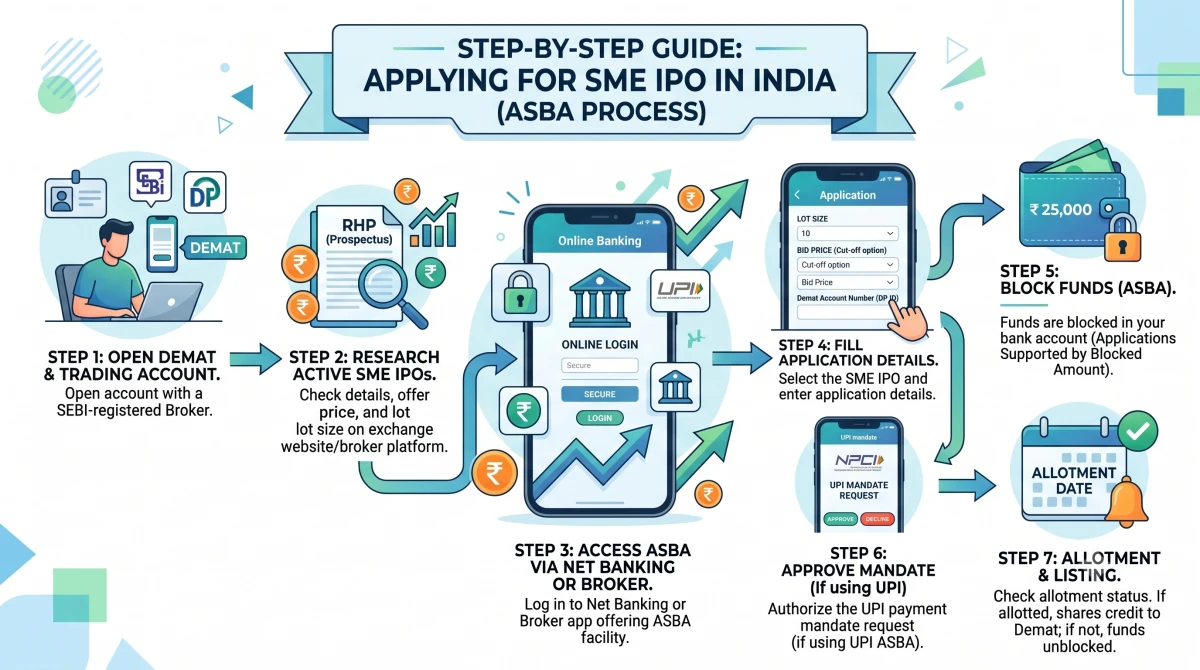
The UPI route is the most common way retail-scale investors apply for SME IPOs, provided the total bid stays under the ₹5 lakh UPI transaction ceiling. Log in to your broker's app or website, navigate to the IPO section, and select the SME IPO you want to bid on. Enter the number of lots — minimum two — and the bid price within the announced price band. Note that you cannot select "cut-off" as your bid price for SME IPOs; you must enter a specific price. Provide your UPI ID and submit the application. Within a few minutes, you will receive a UPI mandate request in the app linked to that UPI ID (for example, Google Pay, PhonePe, BHIM, or your bank's own app). Open the request and approve it before the mandate expiry, which is typically the same day or the next working day depending on the issue schedule. Approving the mandate blocks the bid amount in your bank account. If the mandate is not approved before the exchange cut-off, the bid is treated as invalid and dropped.
Practical Tips
How to Apply via ASBA Net Banking
If your total bid exceeds ₹5 lakhs, or if your broker does not support SME IPO bidding via UPI, you must use ASBA through your bank's net banking portal. Log in to net banking, look for the IPO or ASBA section (labels vary — HDFC, ICICI, SBI, Axis, and Kotak all offer it), and select the SME issue. You will need to enter your PAN, your 16-digit demat account number, the depository (CDSL or NSDL), the number of lots, and the bid price. Submit the application. Instead of a UPI mandate, the bank directly places a lien on the bid amount in your account — the funds remain in your account and continue to earn interest, but you cannot use them until the block is released post-allotment. ASBA is the only channel available to bNII applicants and QIBs, and it is also the safer option for sNII bids that sit close to the ₹5 lakh UPI limit, where mandate approval sometimes fails on high-throughput issues.
Category-Wise Application Sizes at a Glance
The table below summarises how bid size maps to category under the SME IPO framework effective 1 July 2025. Note that the exact rupee value of two lots varies by issue — a lot could be worth anywhere from ₹1,00,000 to ₹1,50,000 depending on the price band, so total application values differ across IPOs.
| Category | Bid Size | Application Value | Application Channel |
|---|---|---|---|
| Individual Investor | Exactly 2 lots | Above ₹2 lakhs, below sNII threshold | UPI or ASBA |
| Small NII (sNII) | 3 lots or more | Up to ₹10 lakhs | UPI (if ≤ ₹5 lakhs) or ASBA |
| Big NII (bNII) | 3 lots or more | Above ₹10 lakhs | ASBA only |
| QIB | As per RHP | As per RHP | ASBA only (non-anchor) |
One more thing to note: cut-off price bidding is disabled across every SME IPO category, which is a departure from mainboard practice where Retail Individual Investors can bid at cut-off. On an SME issue, you must specify a price within the band or at the upper end, and downward revision of that price after submission is not permitted.
Common Reasons SME IPO Applications Are Rejected
A surprising share of SME IPO applications never make it to the allotment pool because of avoidable errors. The most frequent is failing to approve the UPI mandate before expiry, which invalidates the bid regardless of intent to apply. Second is a mismatch between the name on the PAN, the demat account, and the bank account — even minor discrepancies flag the application for rejection during registrar verification. Third is applying with a third-party UPI ID or from a bank account not in the applicant's own name, both of which are hard-rejected at the exchange. Fourth is submitting multiple applications under the same PAN, which is prohibited across brokers, family demats, and even across different UPI IDs — the registrar's PAN-level deduplication catches this at allotment. Fifth is submitting a bid at cut-off price out of habit from mainboard applications; the SME system will reject the bid outright. Finally, insufficient bank balance at the moment of blocking is a common failure mode on the closing day.
After You Apply: Allotment and Listing
Once bidding closes, the registrar runs the allotment process, which under the new framework uses a draw of lots even for the NII category in book-built SME IPOs — previously this was proportionate. Allotment is typically finalised within two to three working days of issue closure, and shares credit to your demat on T+1 or T+2 depending on the exchange schedule. Blocked amounts for unallotted portions are released back to your bank account by the sponsor bank on the same day. Listing on NSE Emerge or BSE SME follows shortly after.
SUMMARY
Applying for an SME IPO from 1 July 2025 requires a bid of two lots with a total value above ₹2 lakhs — the old ₹1 lakh Retail category no longer exists. Use UPI through your broker if the total is under ₹5 lakhs, and ASBA net banking above that. Cut-off pricing is disabled for every category, downward modification and cancellation are blocked, and bidding closes at 4:00 PM on the last day. Approve the UPI mandate on time, apply from your own PAN and own bank account, and avoid multiple applications under the same PAN. NII allotment now runs on a draw of lots, not proportionate, so a larger bid does not proportionally improve your odds.