Index
Index
SME to Mainboard Migration: Why the Route Has Narrowed
Every SME IPO promoter, at some point, thinks about the mainboard. Raise on BSE SME or NSE Emerge, build a track record for a few years, then move up to the main exchange with its institutional participation, deeper liquidity, and broader analyst coverage. For a long time this was largely a procedural upgrade — meet a modest financial bar, get shareholder approval, file with the exchange, and the securities were transferred. That is no longer the position. Both exchanges rewrote their criteria during 2025, and migration has become a second qualification round rather than a graduation ceremony. This article walks through what SME-to-mainboard migration now involves under the revised framework, how NSE Emerge and BSE SME criteria differ, and what the migration data actually shows.
Practical Tips
What Migration Actually Means
Migration is a transfer of an existing listing, not a new public issue. The securities already trade on the SME platform, the shareholder register already exists, and no offer document is filed with SEBI. What changes is the exchange platform on which the securities trade, and consequently the entire regulatory and market microstructure that governs the company.
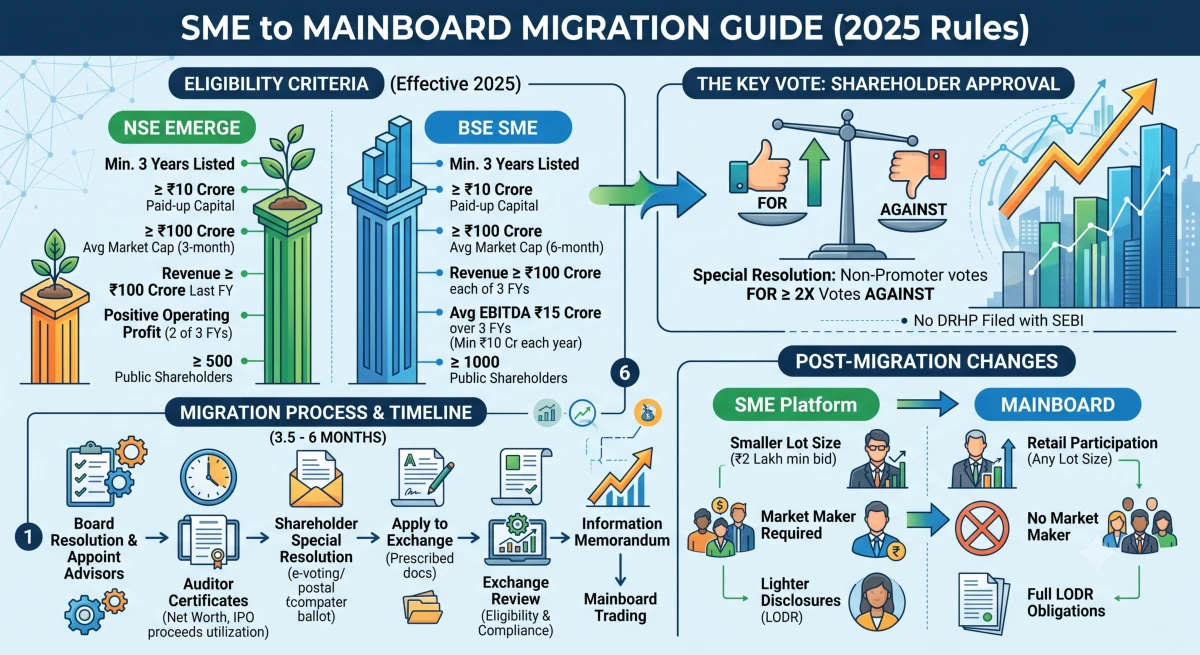
Once on the mainboard, three things change immediately. The ₹2 lakh minimum bid size that defines SME trading disappears, which allows retail participation at any ticket size. The mandatory market maker requirement — which under Regulation 261 of SEBI ICDR obligates SME issuers to keep a market maker in place for three years post-listing — falls away. And the company moves from the lighter SME disclosure regime to the full LODR obligations that apply to mainboard issuers, including the complete quarterly reporting cadence, corporate governance thresholds, and continuous disclosure requirements.
The statutory basis sits in Regulation 277 of the SEBI ICDR Regulations, which permits an SME-listed issuer to migrate provided it meets the receiving exchange's eligibility criteria and passes a shareholder special resolution with the two-thirds non-promoter test described later. SEBI's own role in migration is minimal — the substantive gate is set by the exchange, not by the regulator directly.
The 2025 Rewrite — What Changed and Why
Before the 2025 amendments, the migration bar sat far lower. Companies with paid-up capital of about ₹10 crore and market cap of ₹25 crore could migrate after two years of SME listing. The floor was low enough that a modestly profitable SME with a light float could complete the move. The consequence was uneven — some genuinely mature companies migrated, but so did companies whose mainboard trading was thin, governance was under-developed, and price behaviour was speculative. Migration events themselves became a trigger for grey market speculation, and the regulatory response was to tighten.
The tightening came through two channels. NSE issued Circular NSE/CML/67671 dated 24 April 2025, effective 1 May 2025, which introduced a hard revenue floor, an EBITDA test, a raised market cap threshold, and a longer minimum listing tenure. BSE followed with its own revised framework effective 11 August 2025, which pushed the public shareholder count to 1,000 and introduced a stricter three-year EBITDA average. Alongside these exchange-level changes, SEBI's ICDR Amendment Regulations of 4 March 2025 loosened one aspect of the older framework: SME issuers whose paid-up capital crossed ₹25 crore through further issues were no longer forced to migrate, provided they voluntarily complied with the LODR Regulations, 2015. The SME platform now functions as a viable long-term listing venue in its own right, not a mandatory waiting room.
Practical Tips
NSE Emerge and BSE SME — Where the Criteria Diverge
Both exchanges converge on the core financial architecture — three years listed, ₹10 crore paid-up capital, ₹100 crore market cap, 20 per cent promoter holding — but the tests around profitability, revenue, and public shareholders diverge materially. Companies that satisfy one exchange's criteria may not satisfy the other's, and the choice of migration route is not automatic even where a company is dual-listed.
| Criterion | NSE Emerge to NSE Mainboard | BSE SME to BSE Mainboard |
|---|---|---|
| Minimum listing tenure | 3 years on Emerge | 3 years on BSE SME |
| Paid-up equity capital | ≥ ₹10 crore | ≥ ₹10 crore |
| Average market capitalisation | ≥ ₹100 crore (3-month average) | ≥ ₹100 crore (6-month average) |
| Revenue from operations | ≥ ₹100 crore in the last FY | ≥ ₹100 crore or market cap ≥ ₹100 crore in each of the last 3 FYs |
| EBITDA test | Positive operating profit in at least 2 of the last 3 FYs | Average EBITDA of ₹15 crore over last 3 FYs, with minimum ₹10 crore in each year |
| Public shareholders | ≥ 500 on application date | ≥ 1,000 on application date |
| Promoter holding | ≥ 20% at application; must be ≥ 50% of holding on SME listing date | ≥ 20%, fully dematerialised |
| Compliance history | No material regulatory action in preceding 3 years | 3 years of LODR compliance, no SCORES complaints pending, no ESM/ASM/GSM in prior 2 months |
The BSE EBITDA test — average ₹15 crore over three years, with a ₹10 crore floor in each year — is the single hardest gate in the framework. A company can be profitable, growing, and compliant, and still fail this test if any one of the three years was weak. NSE's positive-EBITDA-in-two-of-three test is materially easier to clear. On the other hand, BSE accepts a market cap route as an alternative to the revenue floor for each of the three preceding years, which gives well-valued but modest-revenue companies an alternative path that NSE does not offer.
The Migration Process, Step by Step
The migration timeline runs 3.5 to 6 months from board decision to trading commencement on the mainboard, depending on how clean the company's compliance record is and how quickly the exchange completes its review. The sequence is broadly standardised.
The board of directors first passes a resolution to explore migration and appoints advisors. The company then obtains an auditor's certificate on net worth and on the utilisation of IPO proceeds since the SME listing. Shareholder approval follows through a special resolution passed by postal ballot or e-voting, subject to the twice non-promoter test described earlier. The company then files a migration application with the exchange along with the prescribed documents — the migration confirmation in the exchange's format, auditor certificates, a credit rating agency certificate on IPO proceeds utilisation and any subsequent issues, board and shareholder resolutions, SCORES authentication ID, an LODR compliance certificate, and disclosure of any change in company control since listing.
The exchange conducts a compliance and eligibility review, which for BSE additionally checks that the company is not currently in any enhanced surveillance category — ESM, ASM, GSM, or T-to-T — with a two-month cooling-off period after any exit from these categories. Once the exchange approves migration, the company files an information memorandum in lieu of a prospectus, and the securities are transferred to the mainboard. Trading commences on the mainboard on the notified date, and the SME listing simultaneously ceases.
Why Companies Migrate — and What They Give Up
The upside of migration is well documented. Institutional investors, mutual funds, and foreign portfolio investors are typically restricted from participating meaningfully in SME scrips because of the platform's liquidity profile and the ₹2 lakh minimum ticket size. Migration unlocks this pool. Analyst coverage tends to follow — SME research is largely retail-oriented and volume-driven, whereas mainboard companies get regular institutional research desk coverage. Valuation multiples typically re-rate upward after migration, reflecting both the deeper investor pool and the higher governance and disclosure standard.
The trade-offs are less discussed. LODR compliance costs are materially higher than the SME regime — full quarterly reporting, related party transaction disclosures, insider trading compliance under SEBI PIT Regulations, audit committee and independent director thresholds, and continuous disclosure obligations. Promoters accustomed to the lighter SME framework often underestimate the ongoing cost. Additionally, once on the mainboard, the company loses the SME segment's protective attributes — the market maker is gone, price discovery is fully open, and thinly traded stocks can face sustained downward pressure if institutional interest does not materialise. Not every migrated stock re-rates upward. Some drift sideways or lower for months after migration, particularly if the underlying business does not scale into the higher expectations that mainboard listing invites.
Migration by the Numbers
The historical data tells a striking story about how much the 2025 changes altered the pipeline. Between 2015 and 2025, of approximately 1,420 companies that listed on BSE SME and NSE Emerge, only around 336 — roughly 24 per cent — completed migration to the mainboard. Migration activity peaked in 2020 with 38 completions on NSE Emerge alone, followed by 31 in 2021 and 30 in 2022. It then fell sharply — only 15 in 2023, and just four in 2024 as the market absorbed the first round of tightening. The 2025 recovery to 15 completions on NSE Emerge, followed by two more in early 2026 and 23 total migrations in the twelve months ending May 2026, suggests that a new cohort of companies that listed under the tighter norms is beginning to qualify. As of mid-2026, roughly 199 BSE SME companies and 158 NSE Emerge companies have completed the migration since inception, for a running total near 360.
The pattern is that migration has stopped being a routine expectation and has become a filter. Under the old framework, roughly one in three SME issues eventually made the move. Under the new framework, the practical rate is likely to be much lower, and the companies that do migrate will on average be materially larger, more profitable, and more widely held than the migrated cohort of the 2015-2022 period.
Why Migrations Fail
Meeting the financial thresholds is necessary but not sufficient. Migration applications routinely stall or are rejected on issues that promoters underweight during planning. The most common failure point is public shareholder count — many SME scrips trade thinly because promoters retain a large holding and the float sits with a handful of allottees. A company can be profitable and compliant, and still fail on the 500 or 1,000 shareholder floor. The second failure point is liquidity history. Both exchanges look at trading days and average daily turnover, and stocks that trade only intermittently or on low volume do not qualify, however healthy the underlying financials. A third is the compliance record — pending SCORES complaints, an unresolved LODR observation, or recent surveillance categorisation all block migration until cleared, and the BSE two-month cooling-off after exiting any surveillance category can push a planned migration back materially. Promoter shareholding drift is a fourth — NSE's requirement that promoters hold at least 50 per cent of what they held at the SME listing date catches companies whose promoter groups have sold down aggressively in the years post-listing.
SUMMARY
- Migration is a transfer of an existing SME listing to the mainboard of the same exchange — no fresh IPO, no DRHP, governed by Regulation 277 of SEBI ICDR.
- Under the 2025 framework, migration requires three years of SME listing, ₹10 crore paid-up capital, ₹100 crore market cap, exchange-specific EBITDA and revenue tests, and 500 (NSE) or 1,000 (BSE) public shareholders.
- BSE's ₹15 crore three-year EBITDA test with a ₹10 crore floor each year is the single hardest gate in the framework; NSE's positive-EBITDA-in-two-of-three test is materially easier.
- Shareholder approval by special resolution is mandatory, with the additional test that non-promoter votes in favour must exceed non-promoter votes against by at least 2:1.
- Migration unlocks institutional access, removes the market maker requirement and ₹2 lakh lot size, and typically supports valuation re-rating — but LODR compliance costs rise sharply and no upward re-rating is guaranteed.
- Migration volumes collapsed from a peak of 38 (NSE Emerge, 2020) to just four in 2024, then recovered to 15 in 2025, indicating that the tighter framework is producing a smaller but more mature migrated cohort.