Index
Index
What is the Market Maker Role in SME IPOs?
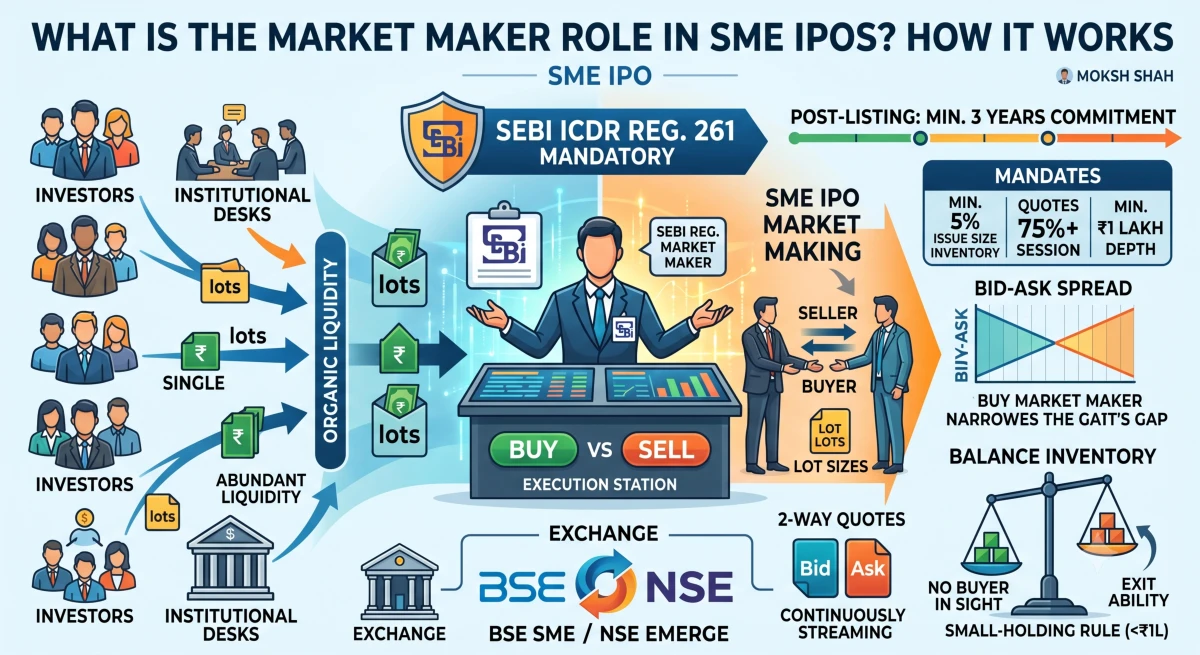
If you've ever applied for a mainboard IPO and an SME IPO, you may have noticed something odd: mainboard stocks trade freely from day one with no guaranteed counterparty, while SME stocks come with someone whose entire job, by regulation, is to buy from you when you want to sell and sell to you when you want to buy. That someone is the market maker, and their presence is not optional. Every company listing on BSE SME or NSE Emerge must have one, for a minimum of three years, under Regulation 261 of the SEBI ICDR Regulations, 2018.
For retail investors, this is one of the more consequential but least understood parts of SME investing. The market maker affects how easily you can exit a position, how tight the bid-ask spread is on a thinly traded stock, and why SME shares sometimes move in ways that seem disconnected from company fundamentals. Understanding the mechanics helps you read SME price action correctly instead of mistaking market-maker behaviour for genuine demand or panic.
Practical Tips
Why SME IPOs Need a Mandatory Market Maker
Mainboard-listed companies typically have enough natural trading volume — institutional desks, high-frequency traders, and a broad retail base — that liquidity takes care of itself. SEBI does not mandate a market maker for mainboard stocks because that liquidity emerges organically from scale.
SME companies don't have that scale. A typical SME IPO might allot shares to a few hundred or a few thousand investors, trading in lots rather than single shares, on exchange platforms (NSE Emerge, BSE SME) that see a fraction of mainboard volume. Without a mechanism to guarantee a counterparty, an investor could place a sell order on a quiet SME stock and simply not get filled — the price could gap down sharply on the one trade that does happen, or the stock could go days without a single transaction.
SEBI addressed this structural gap by making market making compulsory. The market maker's job is to stand ready on both sides of the order book — bidding to buy and offering to sell — so that liquidity exists even when organic investor interest is thin on a given day
Practical Tips
How the Market Maker Is Appointed
The market-making arrangement is set up well before listing day. The issuer's lead merchant banker identifies and appoints one or more SEBI-registered stockbrokers who hold trading membership on the relevant SME exchange. A formal three-party Market Making Agreement is then signed between the issuer, the merchant banker, and the market maker, before the offer document is filed. This agreement spells out the quoting obligations, the inventory arrangement, and the three-year commitment period, and a copy is submitted to the SME exchange along with the prospectus.
Exchanges typically permit up to five market makers per stock, selected on criteria including capital adequacy — larger, better-capitalised issues sometimes have more than one market maker sharing the obligation. The market maker's identity is disclosed in the offer document itself, so it's visible to any investor reading the RHP before applying.
It's worth distinguishing this from underwriting, a separate and equally mandatory obligation for SME IPOs. Underwriting guarantees the issue gets fully subscribed at the time of the IPO — if retail and other demand falls short, the underwriter(s) step in to pick up the shortfall. Market making is a post-listing function: it doesn't affect whether the IPO gets subscribed, only what happens to liquidity after the stock starts trading. The two obligations run on different timelines but both must be arranged before the DRHP is filed
What the Market Maker Actually Does, Day to Day
Once the stock lists, the market maker's obligations look like this:
| Requirement | Detail |
|---|---|
| Quoting duration | Two-way quotes (bid and ask) for at least 75% of every trading session |
| Minimum quote depth | Each quote must support a value of at least ₹1,00,000 |
| Starting inventory | Minimum 5% of the total issue size, allotted to the market maker at IPO allotment |
| Commitment period | Minimum 3 years from the date of listing |
| Small-holding rule | Must buy an investor's entire holding in one lot if that holding is valued below ₹1 lakh |
| Execution guarantee | Must execute at the quoted price and quantity |
In practice, the market maker holds an inventory of shares (from that initial 5% allocation, replenished through ongoing trading) and continuously narrows the gap between what it's willing to pay (bid) and what it's willing to sell for (ask). This spread is the market maker's compensation — they buy slightly below the prevailing price and sell slightly above it, pocketing the difference across many small trades, in addition to an upfront fee the issuer typically pays for the three-year service commitment.
If the market maker's inventory runs low on one side — say, too many investors are buying and its sell-side stock is depleted — it has to release inventory or rebalance before it can keep quoting fresh buy orders, a mechanism designed to keep the two-way quoting genuinely functional rather than one-sided.
What This Means for You as an SME Investor
The market maker's presence is generally good news for retail investors trying to exit a position — it means there is, by regulation, always someone on the other side of your trade. But it comes with caveats worth internalising before you apply for or hold an SME IPO.
First, market-maker-driven liquidity is not the same as organic demand. A stock trading steadily doesn't necessarily mean investors are eager to own it — it may simply mean the market maker is doing its job of keeping quotes tight. Don't read narrow spreads or consistent trading activity as a signal of strong fundamental interest.
Second, the market maker's guaranteed quoting is bounded by the ₹1 lakh depth requirement. If you're trying to sell a position significantly larger than that in one go, you may still move the price more than you'd expect, because the mandatory quote depth is a floor, not a ceiling on how much liquidity is actually available at any moment.
Third, and increasingly relevant: SEBI has been actively reviewing whether the current market-making framework is proportionate. In August 2026, SEBI Chairman Tuhin Kanta Pandey publicly flagged the compulsory three-year market-making requirement — alongside the 100% underwriting mandate — as a cost driver pushing up the expense of SME listings, with proposals reportedly under discussion to ease both requirements. Nothing has been formally notified as of this writing, but it's a live regulatory conversation. If changes do come through, they could affect how long-term liquidity guarantees look for SME IPOs launched after any amendment, so it's worth tracking rather than assuming today's three-year rule is permanent.
Practical Tips
Market Maker vs. Organic Liquidity: Reading SME Price Action
One practical skill worth building as an SME investor is distinguishing price moves driven by genuine investor demand from moves that are simply an artifact of thin volume interacting with the market maker's mechanics. Because SME stocks trade in comparatively small volumes, even a handful of large orders can swing the price noticeably, and the market maker's quotes — while continuous — are only obligated to cover ₹1 lakh per side. A sudden spike or dip on low volume is more consistent with volume-driven volatility than with a fundamental reassessment of the company.
This is also why grey market premium (GMP) tends to be a weaker predictor for SME IPOs than for mainboard ones — the same illiquidity that necessitates a market maker also makes pre-listing price discovery noisier. If you're evaluating an SME IPO, treat the market-making structure as a liquidity backstop, not a signal of the stock's quality or demand.
Voluntary Withdrawal and Replacement
Market makers can exit their obligation before the three-year period ends, but not without notice. A market maker wishing to withdraw voluntarily must give the exchange at least one month's prior notice. The merchant banker is then responsible for ensuring a replacement market maker is appointed within one month, so that the stock is never left without continuous quoting coverage for an extended stretch. This handover mechanism is part of why the exchange and merchant banker remain involved even after listing — market making isn't a one-time appointment that's forgotten once the IPO closes.
SUMMARY
Every SME IPO must have a SEBI-registered market maker under Regulation 261, appointed before the DRHP is filed and independent of the promoter group. The market maker gets at least 5% of the issue as opening inventory and must quote two-way prices for at least 75% of each trading session, with a minimum depth of ₹1 lakh per quote, for a minimum of three years post-listing. This exists specifically because SME stocks lack the natural liquidity of mainboard shares. Market-maker-driven trading activity is not the same as organic investor demand, so don't read it as a fundamental signal. Underwriting and market making are separate, both-mandatory obligations covering different timelines — subscription versus post-listing liquidity. And as of August 2026, SEBI is actively reviewing whether the three-year market-making mandate should be eased, so the framework described here may evolve for future SME issues.