Index
Index
Investor Categories · Part 8 of 9 | Rules verified as of October 2026
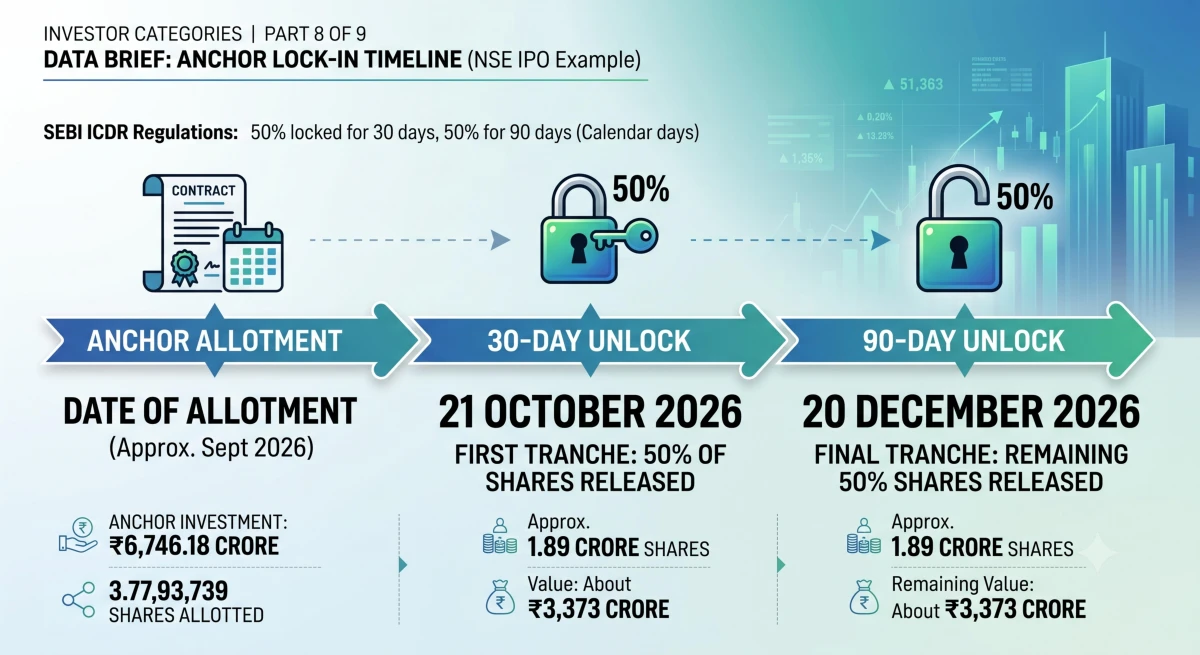
₹3,373 crore. That is roughly what half of NSE's anchor holding is worth at the ₹1,785 issue price, and from 21 October 2026 those shares are free to sell. The other half follows on 20 December. Anchor lock-ins are the most predictable supply events in an IPO's life, yet most retail investors only notice them when the stock has already dropped. This guide uses NSE's IPO as a live example and SEBI's own data to show what the dates mean and what they don't.
Practical Tips
The Rule in One Table
| Item | Rule |
|---|---|
| First tranche | 50% of anchor shares, locked for 30 days |
| Second tranche | Remaining 50%, locked for 90 days |
| Counted from | Date of allotment, in calendar days (not trading days) |
| Applies to | Anchor investors only |
| Retail, NII, regular QIB | No lock-in, can sell from listing day |
The staggered design is deliberate. Before April 2022 the entire anchor allotment unlocked on day 30, which created a single cliff of supply. Splitting it removes that cliff, though it does not remove the supply itself.
The Live Example: NSE's Two Dates
| NSE IPO (September 2026) | Figure |
|---|---|
| Anchor bid date | 16 September 2026 |
| Anchor price | ₹1,785 per share |
| Anchor shares | 3,77,93,739 (29.89% of the issue) |
| Anchor money raised | ₹6,746.18 crore |
| First unlock (50%) | Wed, 21 October 2026: about 1.89 crore shares, about ₹3,373 crore |
| Second unlock (50%) | Sun, 20 December 2026 (first trading day: Mon, 21 December) |
The first unlock equals about 0.76% of NSE's post-issue share capital, which sounds trivial. Against the shares that were sold to the public, though, it is close to 15% of the entire issue. Measure an unlock against the shares changing hands, not against total capital. These dates come from Chittorgarh's lock-in table, so confirm them against the exchange disclosures before acting on them.
Practical Tips
What SEBI's Data on 242 IPOs Found
SEBI examined mainboard IPOs listed between April 2022 and October 2025. The results are more nuanced than the usual "lock-in ends, stock drops" story.
| Measure | Finding |
| Anchor holdings sold by the 30-day unlock | 3.2% on average |
| Anchor holdings sold by the 90-day mark | 17.3% on average |
| IPOs where over 10% of the anchor portion was sold at the first unlock | Average price impact about -3.5%, median about -6% |
| Price impact at the 90-day unlock | Much more muted |
| FPIs: share of anchor allotment value | 43.8% |
| FPI selling pace | About 3% after the first unlock, 9% by day 60, 20% after the second unlock |
Two readings matter here. Selling was spread across the full 90 days rather than bunched on expiry day, and FPIs sold faster than mutual funds. SEBI's data does not prove that anchor selling alone caused the price falls, only that heavy early selling and weaker prices tended to coincide.
How Past Unlocks Played Out
| Stock | Event | What happened |
|---|---|---|
| Paytm (Dec 2021) | 30-day anchor unlock (old single-stage rule) | Fell nearly 8% on the day, as much as 13% intraday, closing at ₹1,380 against a ₹2,150 issue price; anchors held ₹8,235 crore |
| Zomato (Aug 2021) | 30-day anchor unlock | Fell about 8% after a strong listing, as anchors booked profits |
| Ola Electric (Nov 2024) | 90-day anchor unlock | Fell over 5% early in the session as roughly 18.18 crore shares, about 4% of the company, became sellable |
Edelweiss counted 25 of 41 IPOs in 2021 that ended lower on the day their lock-in expired. Ola Electric is a useful corrective to the "90-day unlocks are muted" average: when the released stake is large relative to trading volume, even the second unlock can move the price.
Practical Tips
What to Do Before 21 October
If you hold NSE shares, note the two dates and decide your plan before them, not on the day. If you are thinking of buying, the unlock is a reason to check volume and price action around the date, not a reason to avoid or chase the stock. The anchor lock-in tells you when selling becomes possible. Whether it happens depends on how the price sits against what the anchors paid, which for NSE is ₹1,785.
KEY TAKEAWAYS
Anchor shares unlock in two stages: 50% after 30 days and 50% after 90 days, counted in calendar days from allotment. Retail, NII and regular QIB allottees have no lock-in. SEBI's 242-IPO study found anchors sold only 3.2% of their holdings after the first unlock and 17.3% by day 90. Heavy early selling, above 10% of the anchor portion, was linked to an average price impact of about -3.5%. Unlock days like Paytm's and Ola's show real falls are possible but not automatic. For NSE, watch 21 October and 20 December, and measure the unlocking shares against trading volume.