Index
Index
Investor Categories · Part 6 of 9
Rohan owns exactly one share of a large listed bank — bought years ago, mostly forgotten. When that bank's asset management arm announces an IPO, Rohan finds out his one forgotten share might get him into a separate, less crowded queue for allotment. This is the shareholder quota, and unlike the employee quota, it has nothing to do with where you work — it's entirely about what's already sitting in your demat account, and exactly when it got there.
Practical Tips
Why This Quota Exists
Not every IPO has one. It only applies when the company going public already has a listed parent or promoter — a subsidiary listing, essentially. SBI Mutual Fund (parent: State Bank of India), Canara HSBC Life Insurance (parent: Canara Bank), and Bajaj Housing Finance (parent: Bajaj Finance) have all used this structure. The logic is straightforward: existing shareholders of the parent already have some stake in the group's success, so the issuer gives them a dedicated pool instead of making them compete in the general retail or HNI queues.
Because it's a discretionary reservation rather than a mandatory SEBI category like retail or QIB, the exact percentage, and whether it exists at all, is the issuer's call — always confirm it in the specific RHP rather than assuming.
The Record Date Is Everything
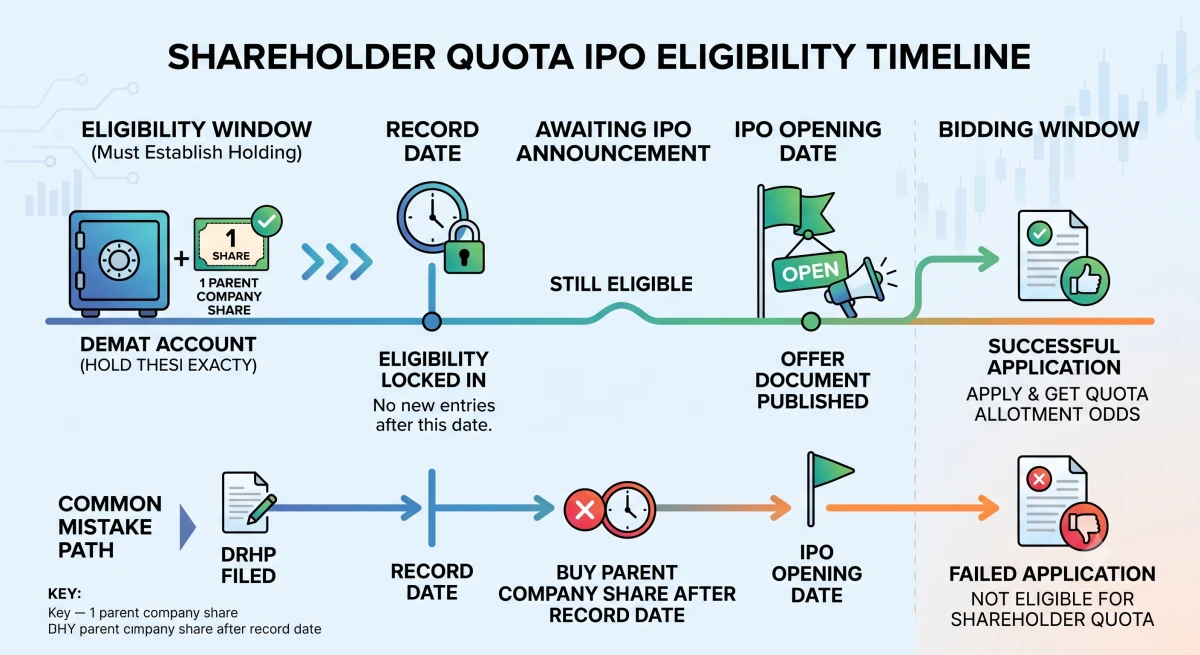
Eligibility hinges on one date, set independently of the IPO's own subscription window. If you held even one share of the parent company in your demat account on or before that date, you qualify — regardless of how many shares, and regardless of whether you still hold them by the time the IPO opens. Sell them the next day, and you're still eligible; you just can't buy your way in after the fact.
The application itself must come from the same demat account that held the parent company's shares on the record date. A shareholder who applies from a different account — a spouse's, say, or a newer trading account — loses the benefit even if they technically owned the shares.
Practical Tips
Rohan's Case: The SBI Mutual Fund IPO
SBI Mutual Fund's IPO, priced in a ₹545–₹574 band with a 26-share lot, reserved 1,30,55,629 shares — about 6.41% of the total issue — for existing SBI shareholders and HUFs, with eligibility fixed to holding SBI shares on or before a record date in early July. Rohan's single SBI share, sitting untouched in his demat account since before that date, was enough. He wasn't required to have bought the shares recently or to hold a minimum value — one share, held on time, in the right account, was the entire qualifying criterion.
Bid Size Still Decides How You're Treated
Qualifying for the shareholder pool doesn't erase the retail-versus-HNI distinction — it sits on top of it. Bid up to ₹2 lakh within the shareholder quota, and you're generally treated on retail-like terms: cut-off price bidding, lottery-style allotment if the quota is oversubscribed. Bid above that, and the shareholder-quota application behaves more like an HNI bid — proportionate allotment, no cut-off pricing.
One more thing worth knowing: applying under the shareholder quota doesn't use up your right to also apply separately under retail or HNI in the same IPO. They're independent pools, and applying in both is legal — Rohan can submit a shareholder-quota bid and a separate retail bid if he wants a second shot at allotment.
One Difference From the Employee Quota Worth Flagging
Unlike the employee category, the shareholder quota rarely comes with a price discount — it's the same issue price as everyone else, just a separate, usually less crowded pool competing for allotment. The benefit here is odds, not price. If you're a shareholder of a company whose subsidiary or listed arm has filed a DRHP, the one thing worth checking today isn't whether to apply — it's simply whether your holding predates whatever record date eventually gets announced, since that's the one thing you can no longer change after the fact.
KEY TAKEAWAYS
The shareholder quota reserves up to 10% of an IPO for existing shareholders of a listed parent or promoter company, under SEBI ICDR Regulation 33. It only exists when the issuer has such a parent, and it's discretionary, not mandatory. Eligibility depends on holding at least one parent-company share, in the same demat account you'll apply from, before a fixed record date — selling afterward doesn't disqualify you, but buying in after the record date won't qualify you either. Bid size still determines retail-like or HNI-like treatment within the quota, and applying here doesn't prevent a separate retail or HNI application. Unlike the employee quota, there's usually no price discount attached.