Index
Index
INTRODUCTION
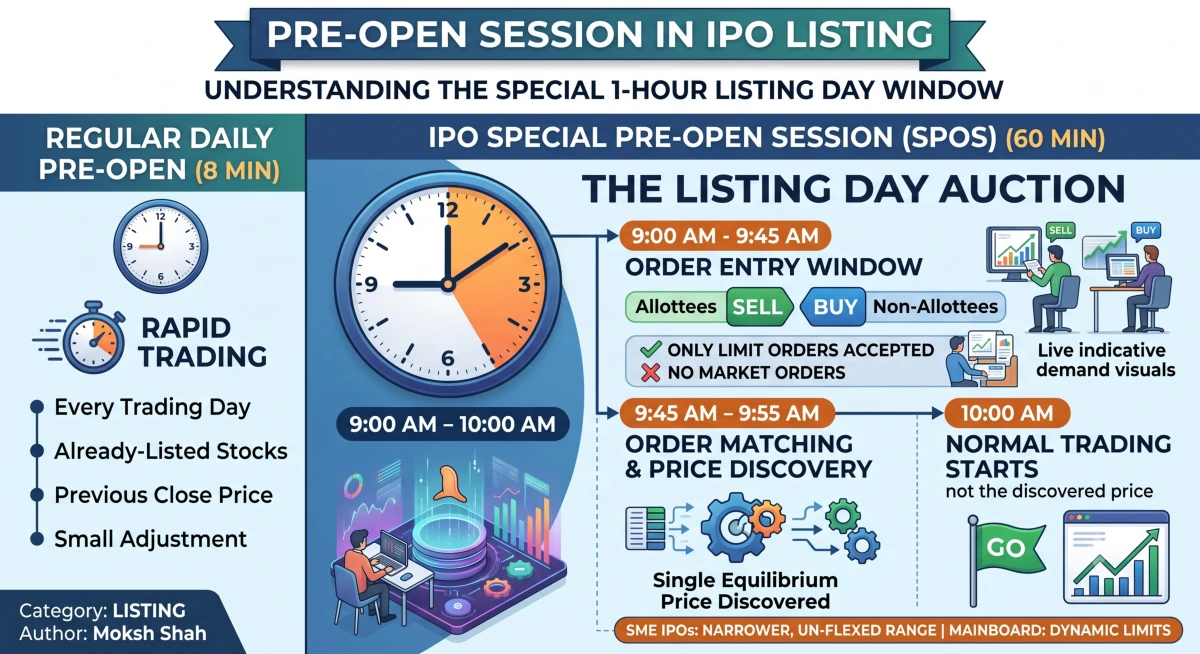
If you've traded regular stocks before, you've seen a "pre-open" session — an eight-minute window every morning at 9:00 AM before the market opens. IPO listing day has a completely different, much longer version of this, and confusing the two causes real mistakes: investors who expect their sell order to fire off the second the market "opens" at 9:15 AM, only to find nothing happens until 10:00 AM, or investors who place a market order and watch it get rejected outright. This article covers what the IPO pre-open session actually is from your seat as an investor — who can trade in it, how to place orders correctly, and the decisions worth thinking through before 9 AM on listing day.
Practical Tips
Regular Pre-Open vs. the IPO Special Pre-Open Session
These are two different mechanisms that happen to share a name:
| Regular Daily Pre-Open | IPO Special Pre-Open Session (SPOS) | |
|---|---|---|
| When it applies | Every trading day, for already-listed stocks | Only on a stock's first day of trading after an IPO |
| Duration | 9:00 AM – 9:08 AM (8 minutes) | 9:00 AM – 10:00 AM (60 minutes) |
| Reference price used | Previous day's closing price | The IPO issue price |
| Purpose | Small adjustment before continuous trading resumes | Discover an opening price from scratch, since none exists yet |
If you've only ever traded post-listing stocks, the IPO version will feel unfamiliar — it's a much longer window, and the stakes are different because there's no prior closing price to anchor expectations.
Who Can Place Orders in the Pre-Open Session
This isn't restricted to people who got IPO allotment. Any investor with a demat and trading account can place a buy or sell order for the stock during the 9:00–9:45 AM entry window, on either NSE or BSE, through the same broker app you use for regular trading — usually flagged as "Pre-Open" or "IPO Listing" on the order screen. In practice:
Allottees who intend to book listing-day gains place sell orders. Investors who missed the allotment but are still interested in the stock, or who believe the discovered price will move further after 10 AM, place buy orders. Both sides feed into the same auction, and price discovery happens because of that mix — not because of the company or its bankers.
Practical Tips
What Happens to Your Order After You Place It
Between 9:00 and roughly 9:35–9:45 AM (the system randomly closes entry sometime in that last window so no one can time a last-second order), you can freely modify or cancel what you've placed. Once entry closes, your order is locked — no edits, no cancellations — and the exchange runs the matching process in one shot at a single equilibrium price. If your limit order falls within that matched range, it executes at the equilibrium price, not necessarily your exact limit. If it doesn't get matched but still falls within the applicable price band, it's automatically carried into normal trading at your original limit price, on a price-time priority basis. The full mechanics of how that equilibrium price itself gets calculated are covered separately.
Common Mistakes Investors Make in This Window
A few patterns show up repeatedly on listing mornings. Placing a market order, expecting it to behave like normal trading — it simply won't be accepted; the session only takes limit orders. Panic-pricing a sell order far below where GMP or sentiment suggests the stock will open, out of fear of missing the window, which risks an unnecessarily bad execution if the order does get matched near your low limit. Assuming the broker will "auto-sell" allotted shares at listing without any order being placed — it won't; if you don't place an order, you simply don't participate in SPOS at all, and your shares sit until you act in normal trading. And misreading a "price freeze" message as a rejection — it usually just means your order price fell outside the current operating range and needs adjusting, not that something went wrong with your account.
Practical Tips
Should You Place Your Sell Order in the Pre-Open Session, or Wait?
There's no universally correct answer, and IPO360 won't claim there is. Selling in the pre-open session gets you the auction-discovered price with no slippage — every matched order on that side gets the same equilibrium price, which is about as fair an execution as you'll get. Waiting until after 10:00 AM means trading in a live market that could move further in your favour, but is capped for the day by the applicable price band, so a stock with genuinely strong demand can't run away indefinitely on day one anyway. What tends to separate the two approaches in practice: investors who applied specifically for listing gains generally place their sell order in the pre-open window to lock in the auction price; investors treating the allotment as a longer-term holding often skip the window entirely and let normal trading determine their entry or exit later.
SME IPOs: A Slightly Different Pre-Open
SME IPO listings go through the same SPOS structure and timings, but with two differences worth knowing. The operating range during the auction is tighter and capped at –20% to +90% of the issue price, and it is never flexed by the exchange, unlike mainboard IPOs. And SME listings typically have a designated market maker who is obligated to provide two-way quotes, which adds a layer of liquidity to the auction that many mainboard IPOs don't have in the same way. If you're placing pre-open orders for an SME allotment, expect the price discovery to feel somewhat more contained than a large mainboard listing.
What to Check Before 9 AM on Listing Day
A short checklist worth running through the night before: confirm the shares have actually been credited to your demat account (check the day before listing, not the morning of). Decide your sell-vs-hold approach in advance rather than deciding live under time pressure — the pre-open window moves fast once entry closes. If you're placing a sell order, have a limit price in mind based on where the stock has been trending, rather than reacting to it live. And make sure your broker account is funded and the app is open well before 9 AM, since order entry can close as early as 9:35 AM without warning.
KEY TAKEWAYS
The IPO pre-open session (SPOS) runs 9:00–10:00 AM on listing day, distinct from the 8-minute daily pre-open used for already-listed stocks. Any demat holder — not just allottees — can place buy or sell limit orders between 9:00–9:45 AM; market orders aren't accepted. Orders can be freely modified or cancelled until entry closes, then lock in for matching. Unmatched orders within the price band carry into normal trading at your limit price. Placing no order means your shares simply move into normal trading at 10:00 AM instead of getting the auction-discovered price. SME IPOs use a narrower, unflexed price range and typically have a market maker adding liquidity to the auction.