Index
Index
INTRODUCTION
Most investors assume the price a stock opens at on listing day is either the issue price plus grey market premium, or something the company and its bankers quietly agree on beforehand. Neither is true. The listing price is discovered fresh, in public, by a specific exchange mechanism called the Special Pre-Open Session (SPOS) — a one-hour call auction that runs before normal trading begins. GMP can inform expectations, but it has no formal role in the calculation, and it is frequently wrong. This article walks through exactly how NSE and BSE arrive at the number you see flash on your screen at 10:00 AM.
Practical Tips
The Issue Price Is Fixed. The Listing Price Isn't.
The issue price is decided during the book-building process and is final before the IPO even closes — it's the price every allottee pays. The listing price is a completely separate number, discovered by the market on the morning shares first become tradeable. There is no rule that ties the two together beyond one thing: the issue price serves as the "base price" the exchange uses to set boundaries for how far the discovered price is allowed to move during the auction itself. The issue price is decided during the book-building process and is final before the IPO even closes — it's the price every allottee pays.
This is why an IPO can be oversubscribed 50 times and still list at a discount, or why an IPO with modest subscription can occasionally surprise on the upside. Subscription numbers tell you about demand at the issue price during the bidding window. The listing price reflects demand and supply among a different, broader set of participants — including those who didn't get allotment and are placing fresh buy orders — at 9 AM on listing day.
Inside the Special Pre-Open Session (SPOS)
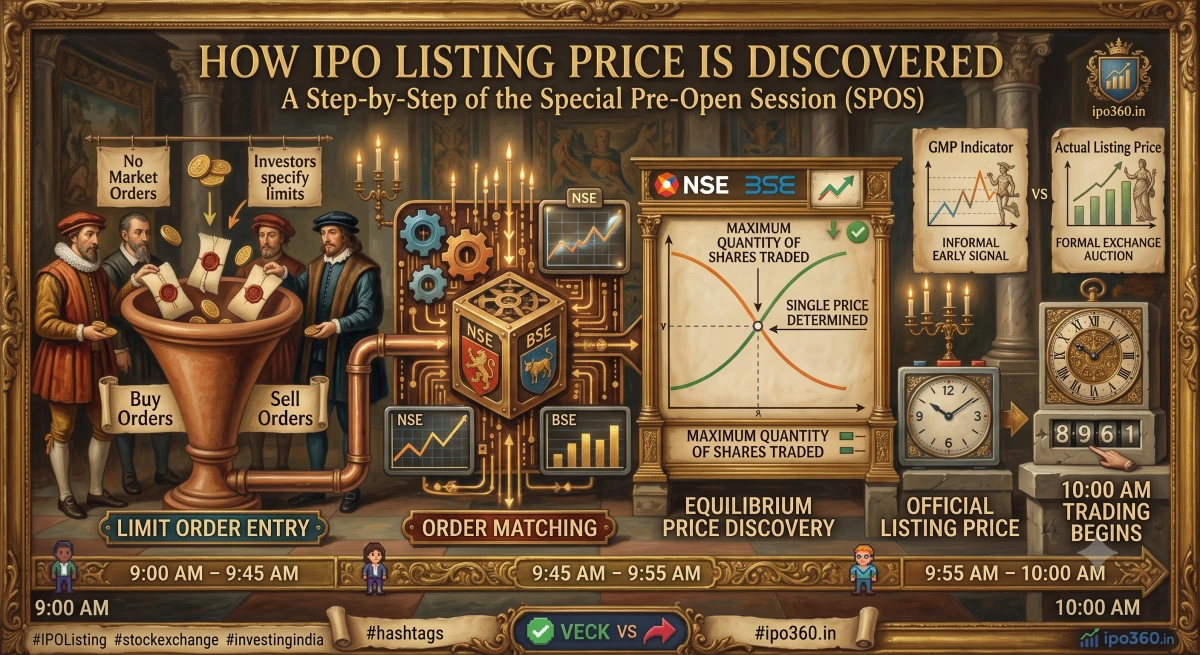
The SPOS is conducted independently, and simultaneously, on both NSE and BSE. It runs in three phases:
| Time | Phase | What Happens |
|---|---|---|
| 9:00 AM – 9:45 AM | Order entry | Investors place, modify, or cancel buy/sell limit orders. No trades are executed. The system randomly closes entry sometime between 9:35 and 9:45 AM so no one can time a last-second order. |
| 9:45 AM – 9:55 AM | Order matching | The exchange calculates the equilibrium price and matches eligible buy and sell orders at that single price. No modifications or cancellations are allowed once this starts. |
| 9:55 AM – 10:00 AM | Buffer | Transition period before normal continuous trading begins. |
| 10:00 AM onward | Normal trading | The stock trades continuously within a price band built around the discovered price. |
Only limit orders are accepted during SPOS — you specify the maximum you're willing to pay or the minimum you're willing to accept, not a market order. This is one of the design features that prevents the wild first-minute swings that were common before the call-auction mechanism was introduced in 2012.
Practical Tips
The 'Dummy' Price Range That Applies Even Before a Price Exists
Since there's no previous day's closing price to anchor a circuit filter, exchanges apply a temporary "operating range" during SPOS itself, purely to stop obviously non-genuine orders from distorting the auction:
| Security Type | Operating Range (around issue price) |
|---|---|
| Mainboard IPO | –50% to +100% |
| SME IPO | –20% to +90% |
| Re-listed securities | –85% to +50% |
Two things worth knowing here. First, exchanges can widen ("flex") this range in 10% steps if there's genuinely heavy demand pushing against the ceiling — except for SME IPOs, where the range is never flexed. Second, SEBI added extra surveillance to this process: exchanges now flag any client whose cancelled order quantity exceeds 5% of total cancellations in the session, or where more than half of that client's orders were cancelled, specifically to catch attempts to fake demand and then pull the orders before matching.
The SME cap matters in practice: because SME price discovery in the SPOS itself is capped at +90% over issue price, a stock that goes on to post gains well beyond that (Vibhor Steel Tubes' 196% run in February 2024 is a well-known example) typically builds most of that gain across several subsequent sessions of daily upper circuits, not in the opening auction alone.
What Happens After 10 AM: Price Bands for Normal Trading
Once SPOS ends, the stock moves into regular continuous trading — but it isn't unrestricted from the first tick. SEBI's framework sets a price band for that first day's normal session, calculated as a percentage of the just-discovered equilibrium price:
| Issue Size | Price Band (equilibrium price discovered) | Price Band (no equilibrium price discovered) |
|---|---|---|
| Up to ₹250 crore | 5% of equilibrium price | 5% of issue price |
| Above ₹250 crore | 20% of equilibrium price | 20% of issue price |
This is a separate concept from the price band you see during the IPO bidding period (the price range investors bid within, such as ₹1,865–₹1,960 for Hyundai Motor India). That earlier band closes once the issue price is fixed. This one only opens once the listing price is discovered.
When NSE and BSE Disagree: The Common Equilibrium Price
Because SPOS runs independently on both exchanges, it's possible for NSE and BSE to land on different equilibrium prices for the same stock. If that gap exceeds the applicable price band, the exchanges don't let normal trading start at two different reference points. Instead, they compute a Common Equilibrium Price (CEP) — a volume-weighted average of the two exchanges' discovered prices — and apply the same price band around that CEP on both exchanges. Unmatched SPOS orders that fall within the new band get carried into normal trading; the rest are cancelled. This mechanism exists specifically to stop arbitrage-driven volatility between the two exchanges on day one.
GMP vs. the Discovered Price: Why They Often Don't Match
Grey market premium is an unofficial, informal indicator based on off-exchange deals among a relatively small set of participants. The SPOS equilibrium price is a formal auction among every buyer and seller who shows up with a real order at 9 AM — a much larger and more diverse pool. The two frequently diverge, sometimes sharply:
| IPO | GMP / Pre-Listing Signal | Actual Discovered Listing Price |
|---|---|---|
| Tata Technologies (Nov 2023) | GMP implied roughly 78% over issue price | Listed at a 140% premium |
| IREDA (Nov 2023) | Grey market trading around 37% premium | Listed at a 56.25% premium |
| Hyundai Motor India (Oct 2024) | GMP implied a modest premium (~2%) | Listed at a ~1.3% discount, closed the day down further |
| Bajaj Housing Finance (Sep 2024) | Strong grey market interest, but underpriced the eventual move | Closed listing day up 114% |
| Paytm (Nov 2021) | Grey market signal was thin and inconclusive | Listed down 27% |
The pattern isn't that GMP is useless — it's directionally right more often than not — but it consistently fails to capture how much fresh institutional and retail demand shows up specifically in the SPOS window, which GMP dealers have no visibility into.
What This Means for You on Listing Morning
If you're holding an allotment and deciding whether to sell at open, the only number that matters is the one discovered in SPOS — not the GMP you tracked the night before. Practically, that means:
You can't place a market order and expect a guaranteed price before 9:45 AM; only limit orders are accepted, and nothing executes until the matching phase. A limit order placed too far outside the operating range will simply freeze and get cancelled, not execute at the boundary. And once normal trading opens at 10:00 AM, the stock can only move within the day's price band (5% or 20% of the equilibrium price, depending on issue size) — so even a blockbuster listing has a hard ceiling for day one.
IPO360's Live GMP Tracker (ipo360.in/gmp) is useful for gauging sentiment heading into listing day, but treat it as an indicator, not a forecast — the comparisons above show how far off it can be, in either direction.
KEY TAKEAWAYS
The listing price is discovered, not decided — by a one-hour SPOS call auction from 9:00–10:00 AM on NSE and BSE, run independently on each exchange. The equilibrium price is whichever price clears the maximum matchable volume, with the issue price used only as a temporary reference for the pre-auction operating range (–50%/+100% for mainboard, –20%/+90% for SME). After 10 AM, normal trading is capped at a 5% band (issue size ≤ ₹250 crore) or 20% band (issue size > ₹250 crore) around that discovered price. If NSE and BSE diverge beyond the applicable band, a Common Equilibrium Price is computed. GMP is a useful early signal but has no role in the actual calculation and has been wrong — in both directions — on IPOs as large as Hyundai Motor India and Tata Technologies.