Symbiotec Pharmalab Limited
Sector: Pharmaceuticals & Biotechnology (API / CDMO)
1. Overview
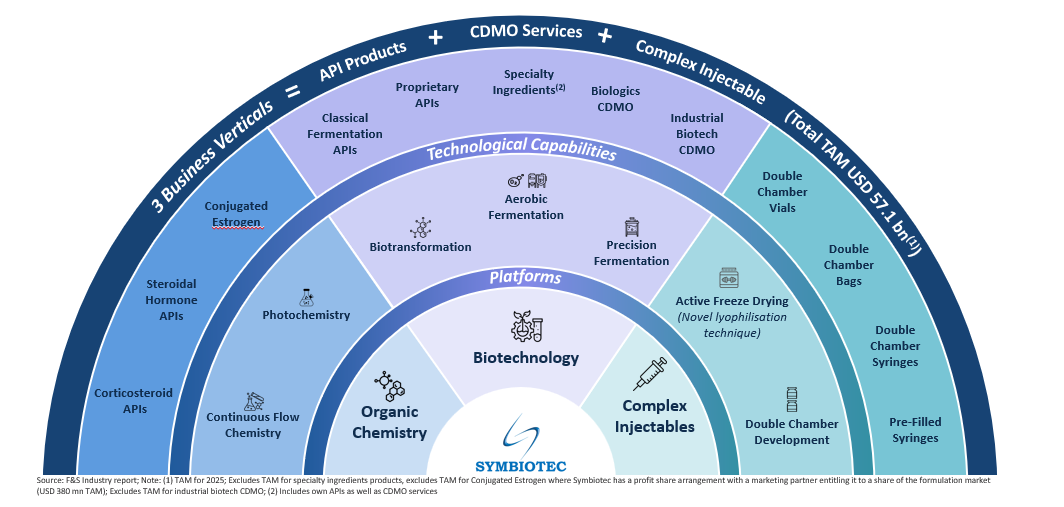
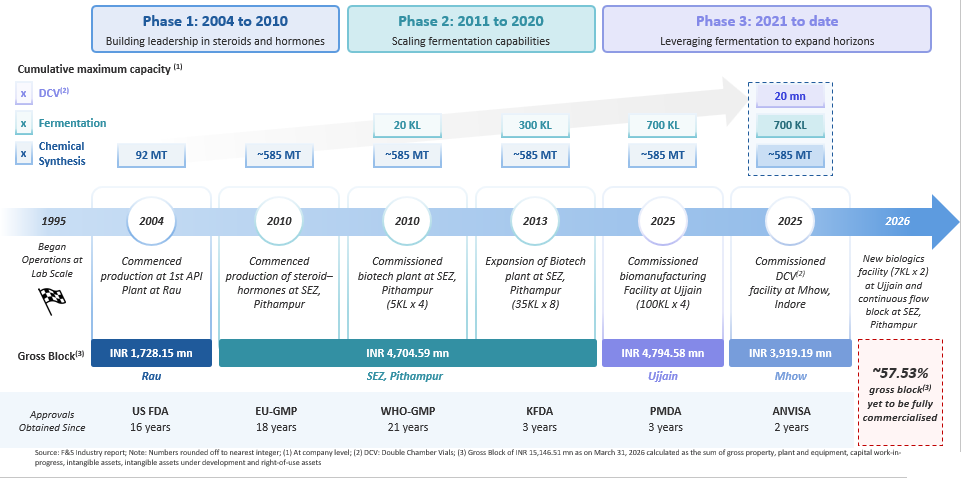
Symbiotec Pharmalab Limited is a research and development-driven, science-based pharmaceutical and biotechnology company operating across three integrated platforms — organic chemistry, biotechnology, and complex injectables. The Company was incorporated in 2002, though its operating lineage dates back to 1995 when it began as a lab-scale steroidal-hormone API manufacturer under the erstwhile proprietorship Symbiotec Laboratories. Over 30 years it has evolved into an industrial-scale, backward-integrated platform.
The Company holds a global leadership position in corticosteroid and steroidal-hormone active pharmaceutical ingredients (APIs) in volume terms in Fiscal 2026, commanding a global volume market share of 38.2% in corticosteroids and 23.8% in steroidal-hormone APIs (excluding androstenedione and hydroxyprogesterone caproate). It is the only Indian and global company present across the top 10 corticosteroid and steroidal-hormone APIs, with a portfolio of over 60 APIs as of March 31, 2026. Dominant individual product positions include Hydrocortisone (80.1% share), Testosterone (76.4%), and Methylprednisolone (76.0%) by volume in Fiscal 2026.
Manufacturing is anchored in Madhya Pradesh across the Rau and Pithampur facilities, with two newer facilities commissioned at Ujjain and Mhow. The Company operates a vertically integrated "microbe-to-pharmacy" and "farm-to-pharmacy" model, holding US FDA, EU-GMP, and Korea MFDS approvals, 43 US DMFs and 23 EDQM CEPs. In Fiscal 2026, Symbiotec generated ₹869.15 Crore in revenue from operations, of which 67.04% came from international markets.
2. Business Model and Revenue Streams
Symbiotec's model rests on a backward-integrated, fermentation-plus-chemistry manufacturing base that makes cost-effective "make versus buy" decisions on key starting materials (KSMs) for over 80% of products by revenue, reducing external dependence. Revenue is derived from two engines: (a) its own API and ingredients business and (b) a recently commenced contract development and manufacturing organisation (CDMO) offering.
Revenue by product category (Fiscal 2026, ₹ Crore)
| Segment | FY26 (₹ Cr) | % of Revenue | FY25 (₹ Cr) | FY24 (₹ Cr) |
|---|---|---|---|---|
| Sale of APIs | 835.01 | 96.07% | 744.75 | 716.25 |
| Sale of complex injectables | 33.05 | 3.80% | – | – |
| CDMO services | 1.09 | 0.13% | 6.80 | – |
| Total Revenue from Operations | 869.15 | 100.00% | 751.55 | 716.25 |
Revenue by geography (Fiscal 2026)
| Geography | FY26 (₹ Cr) | % of Revenue |
|---|---|---|
| India | 286.50 | 32.96% |
| Europe | 252.98 | 29.11% |
| United States | 114.00 | 13.12% |
| China | 8.29 | 0.95% |
| Rest of World (Asia ex-India, Africa) | 215.66 | 24.81% |
| Total | 869.15 | 100.00% |
Pricing / contract model: B2B API supply to regulated and semi-regulated markets, supplemented by emerging CDMO contracts for specialty pharmaceutical and nutraceutical companies.
Customer concentration: The top ten customers contributed 57.59% of revenue from sale of products in FY26 (55.90% FY25, 61.65% FY24) — a key dependency risk.
Export dependence: International markets contributed 67.04% of FY26 revenue; the United States alone was 13.12%, exposing the Company to tariff and anti-sourcing measures.
Supplier dependence: Top ten suppliers accounted for 25.50% of total expenses in FY26; raw materials are partly imported from China and the United States.
R&D intensity: R&D spend was 3.42% of revenue in FY26 (₹29.70 Cr), up from 2.86% in FY24.
3. Products and Service Portfolio
Symbiotec's portfolio spans over 60 corticosteroid and steroidal-hormone APIs in both sterile and non-sterile formats, covering 90% of the corticosteroid and steroidal-hormone API product universe as of March 31, 2026.
Global volume market share — select products (Fiscal 2026)
| Product | FY24 Share | FY25 Share | FY26 Share |
|---|---|---|---|
| Hydrocortisone | 73.6% | 78.9% | 80.1% |
| Testosterone | 41.6% | 70.4% | 76.4% |
| Methylprednisolone | 55.0% | 50.6% | 76.0% |
| Clobetasol Propionate | 39.9% | 38.5% | 50.0% |
| Betamethasone | 48.2% | 39.2% | 33.4% |
| Progesterone | 24.2% | 26.1% | 21.2% |
Manufacturing capacity (as of RHP date)
- Maximum chemical synthesis capacity: 584.67 metric tonnes (MT)
- Maximum fermentation capacity: 700 kilolitres (KL), across four fermentation modalities
- Complex injectables capacity: 20 million vials per annum
- Differentiated capability: APIs and products with up to 400 synthesis steps validated under cGMP
Regulatory assets
- 43 DMFs registered with the US FDA; 23 CEPs from the EDQM
- Approvals from US FDA, EU-GMP, and Korea MFDS
Primary revenue driver: the established corticosteroid and steroidal-hormone API franchise (96% of revenue). Emerging segments: complex injectables (3.80%), classical fermentation-based APIs (Mupirocin, Serratiopeptidase), and the nascent CDMO business.
4. Key Business Strengths
- Global API leadership: #1 global volume position in corticosteroid (38.2%) and steroidal-hormone (23.8%) APIs in FY26, the only company present across the top 10 such APIs.
- Vertically integrated platform: A "microbe-to-pharmacy" and "farm-to-pharmacy" model producing in-house corticosteroid and hormone precursors — among few backward-integrated manufacturers globally.
- Deep, defensible portfolio: Over 60 APIs covering 90% of the corticosteroid/steroidal-hormone product space, with 50%+ volume share in Hydrocortisone, Testosterone and Methylprednisolone.
- Strong regulatory pedigree: US FDA, EU-GMP, Korea MFDS approvals, 43 DMFs and 23 CEPs, enabling access to regulated markets.
- Robust financial profile: FY26 gross margin of 63.70% (up from 55.18% in FY24), EBITDA margin of 26.59%, and consistent CARE A+ credit rating over three Fiscals.
- Diversified revenue base: 67% international revenue across the US, Europe and rest-of-world, cushioning single-market exposure.
- China+1 tailwind: Structural shift of fermentation-API production away from China supports market-share expansion.
5. Future Growth Strategy
- Expand the steroidal-hormone franchise: Enter new product categories, therapeutic areas and geographies, leveraging cost-efficient, backward-integrated manufacturing.
- Scale fermentation and biotechnology: Build out classical fermentation APIs (Mupirocin, Serratiopeptidase) and new modalities including GLP-1 and Insulin, plus specialty ingredients (Vegan Vitamin D3, Algal DHA).
- Commercialize complex injectables: Deploy the ₹391.92 Cr complex-injectables investment to enter high-value, drug-device combination products.
- Develop differentiated / hard-to-make APIs: Advance a generic Premarin (conjugated equine estrogen) alternative — a complex API with 82 US-FDA-mandated components and only one existing generic.
- Scale the CDMO platform: Convert R&D and manufacturing capabilities into a broader CDMO offering across all three platforms, capturing global outsourcing demand.
- Invest in R&D and new technologies: Continue reinvesting revenue into R&D to optimise processes and sustain an innovation-led product pipeline.







Delete Comment?
Are you sure you want to delete this comment? This action cannot be undone.
Discussion
Join the discussion!
Log In to CommentNo comments yet. Be the first to share your thoughts!