Index
Index
OFS vs Fresh Issue: The One Line That Changes Everything
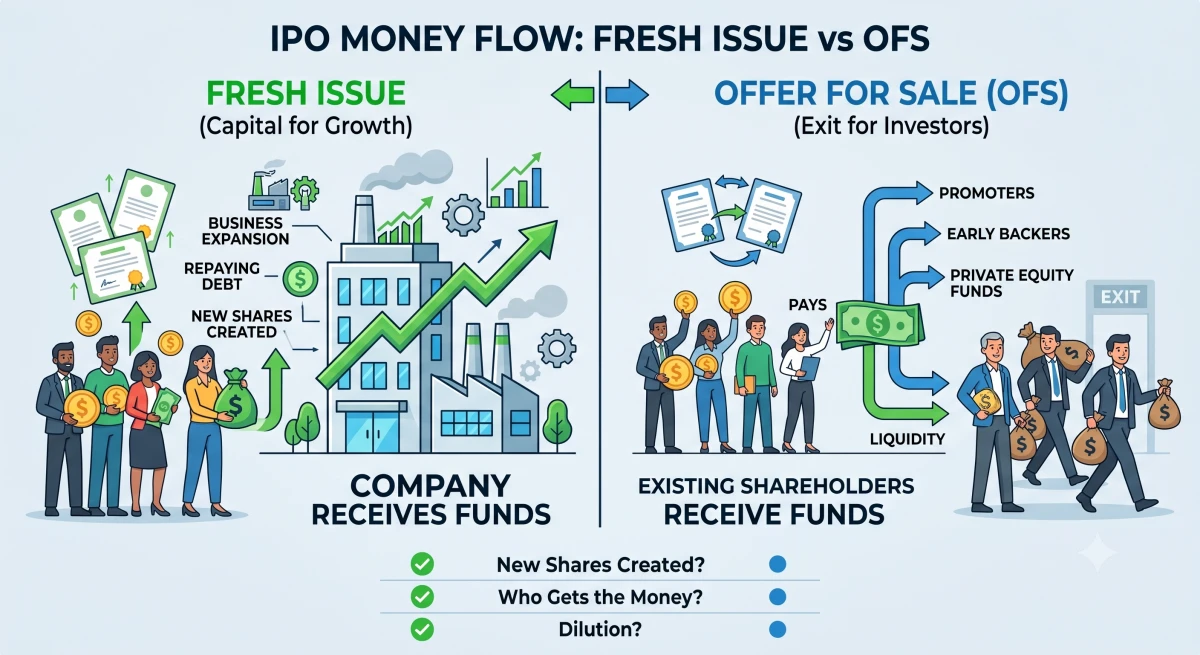
When you apply for an IPO, it's worth asking a simple question: where does your money actually go? The answer isn't always "into the company." In a fresh issue, your money flows to the company to fund growth, repay debt, or build capacity. In an offer for sale (OFS), your money goes to existing shareholders — promoters, private equity funds, or early backers — who are cashing out. The company itself receives nothing. Most large Indian IPOs are a mix of both, and the ratio between them is one of the most revealing details in any prospectus. Understanding it changes how you read every IPO.
Practical Tips
What is a Fresh Issue?
In a fresh issue, the company issues brand-new shares that never existed before. This expands the total share count and dilutes existing shareholders' percentage ownership. Critically, the money raised goes directly into the company's bank account.
The company must disclose exactly how it plans to use this money in a section of the prospectus called "Objects of the Issue." Common uses include funding expansion, setting up new plants, repaying borrowings, or general corporate purposes. Because the funds fuel the business, a fresh issue is generally viewed as growth-oriented — the company is raising capital to do something with it.
For example, when a manufacturing company launches an IPO to build a new factory, that portion is a fresh issue. Investors can track whether that money is later deployed as promised, which is why the Objects of the Issue section deserves careful reading.
What is an Offer for Sale (OFS)?
In an offer for sale, no new shares are created. Existing shareholders — typically promoters, venture capital firms, private equity investors, or early employees — sell a portion of the shares they already own to the public. Because these are existing shares changing hands, the total share count doesn't increase and there's no dilution from the OFS itself.
The key point: the company receives none of this money. It flows straight to the selling shareholders. An OFS is essentially an exit mechanism — a way for early backers to convert their holdings into cash by selling to public investors during the IPO.
This isn't inherently bad. Private equity funds have a fixed lifecycle and must eventually return money to their own investors. Early founders may want to diversify their wealth after years of building the business. But a large OFS component does mean your application money is funding someone's exit, not the company's future.
Fresh Issue vs OFS: Side-by-Side
The cleanest way to grasp the difference is to see the two side by side across the dimensions that matter to a retail investor.
| Dimension | Fresh Issue | Offer for Sale (OFS) |
|---|---|---|
| New shares created? | Yes | No |
| Who gets the money? | The company | Existing shareholders |
| Effect on share count | Increases | No change |
| Dilution of ownership | Yes | No (from OFS alone) |
| Typical purpose | Growth, debt repayment, capex | Exit for early investors |
| What it signals | Company needs capital to grow | Investors want liquidity |
| Money tracked in prospectus? | Yes — Objects of the Issue | No specific use disclosed |
Most real IPOs blend the two. A prospectus will state something like "Fresh Issue of ₹500 crore and Offer for Sale of ₹1,000 crore," giving a total issue size of ₹1,500 crore. In that example, two-thirds of what you're paying is an exit for existing holders.
Practical Tips
Why the Mix Matters When You Evaluate an IPO
The fresh-issue-to-OFS ratio is a quick lens on management's intent. A large fresh issue suggests the company genuinely needs capital and has plans to deploy it. A heavy OFS — especially one where promoters are selling a big chunk of their stake — deserves a second look. Are early investors exiting because it's simply their time, or because they see limited upside from here?
There's no rigid rule that "OFS is bad." Some of India's strongest listings have had significant OFS components. But the mix should match the story. A young, high-growth company raising almost entirely through OFS is worth questioning — if the business is so promising, why isn't it raising fresh capital to grow faster? On the other hand, a mature, cash-generating business may have little need for fresh funds, making a large OFS perfectly reasonable.
Read the OFS alongside promoter holding. If promoters are offloading a large share of their stake, note how much they retain post-listing — their remaining "skin in the game" matters.
What SEBI Rules Say About OFS
SEBI regulates OFS to protect investors and ensure promoters keep meaningful ownership after listing. Two rules matter most.
First, only shares held for at least one year before the draft offer document is filed are eligible to be offered through OFS. This prevents last-minute share creation purely to cash out during the IPO.
Second, SEBI enforces Minimum Promoters' Contribution (MPC): after the issue, promoters must collectively hold at least 20% of the post-issue capital, and this portion is locked in for three years. This ensures promoters can't fully exit through the IPO and remain committed to the company.
For SME IPOs, the rules are stricter following SEBI's 2025 framework overhaul. The OFS by selling shareholders cannot exceed 20% of the total issue size, and no selling shareholder can offload more than 50% of their holding. This was introduced specifically to stop SME promoters from using the IPO as a full cash-out route rather than a genuine capital-raising exercise.
How to Find the OFS/Fresh Issue Split for Any IPO
You don't need to dig deep to find this. Every IPO's prospectus (DRHP and RHP) states the issue structure clearly near the top — usually on the cover page. It will read something like "The Issue comprises a Fresh Issue of up to [X] equity shares and an Offer for Sale of up to [Y] equity shares."
IPO tracking platforms also summarise this breakdown for every open and upcoming issue, so you can see the split at a glance without opening a 500-page document. When reviewing any IPO on IPO360, check the issue structure alongside the price band and subscription data — it takes seconds and tells you immediately whether you're funding a company or an exit.
Once you know the split, pair it with the Objects of the Issue for the fresh-issue portion. Together, those two details answer the question we started with: where is your money actually going?