Index
Index
SME IPO Listing Requirements: What Every Company Must Meet Before Going Public
Small and Medium Enterprise IPOs operate under a separate regulatory track from mainboard listings, governed by Chapter IX of the SEBI (Issue of Capital and Disclosure Requirements) Regulations, 2018. This framework was built to let smaller companies raise public capital without the scale requirements of a mainboard IPO. But "smaller requirements" does not mean "loose requirements." Following the SEBI ICDR Amendment Regulations of March 2025, which apply to draft filings made on or after December 19, 2024, and further exchange-level operational changes effective July 1, 2025, the SME eligibility bar has moved considerably higher. Retail investors evaluating an SME IPO benefit from knowing these requirements too, since a company that barely clears the bar carries a different risk profile from one that comfortably exceeds it. This article lays out the complete checklist: financial thresholds, structural conditions, procedural obligations, and the exchange-specific differences between BSE SME and NSE Emerge.
Practical Tips
Core Financial Eligibility Criteria
The financial thresholds form the primary gatekeeping mechanism for SME listings, and they apply uniformly across both exchanges since they originate from SEBI's ICDR Regulations rather than exchange-specific rules.
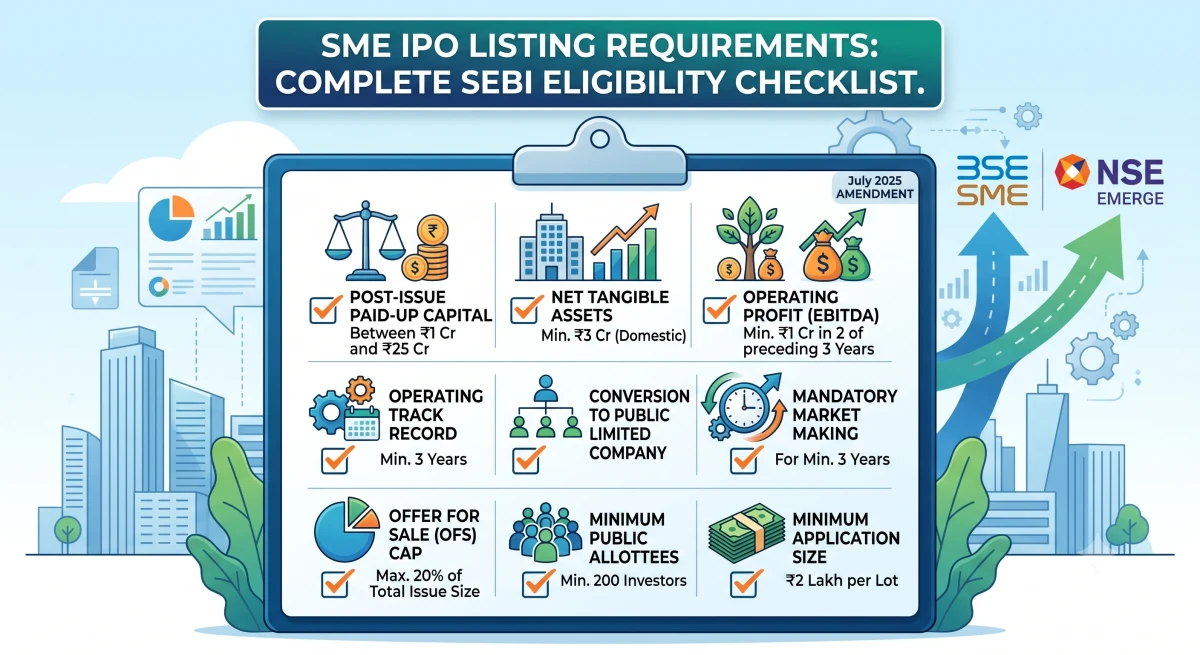
Post-issue paid-up capital face value must fall between three crore and twenty-five crore rupees. Regulation 229 mandates the issuers with post-issue paid-up capital up to ten crore rupees to list under the standard SME route, while those between ten and twenty-five crore rupees may also qualify subject to additional compliance under Chapter IX. Once post-issue capital crosses twenty-five crore rupees, the company no longer qualifies for the SME platform and must pursue a mainboard listing instead.
Net tangible assets must be at least three crore rupees in the immediately preceding financial year, with a portion required to be held domestically under exchange-level rules. Net worth must be positive, with several exchange frameworks specifying a minimum of one to one and a half crore rupees held across the preceding financial years.
The most consequential post-2025 change is the EBITDA-based profitability test. Companies must now demonstrate a minimum operating profit of one crore rupees in at least two of the three financial years preceding the IPO. This effectively closes the SME platform to loss-making companies, a segment that previously had a viable path to listing through this route. Retail investors should treat this as a baseline filter, not a quality signal. Clearing the EBITDA test confirms regulatory eligibility; it does not confirm that the business is well run or fairly priced.
Practical Tips
Structural and Corporate Governance Requirements
Beyond the financial thresholds, SEBI and the exchanges impose several structural conditions on the issuer itself.
The company must be registered as a public limited company under the Companies Act. Private limited companies, partnerships, and proprietorships cannot list directly and must first convert their corporate structure before filing.
Promoter continuity is closely scrutinized. If there has been a complete change in promoters, or if new promoters have acquired more than fifty percent of the issuer's shareholding, the company must wait at least one year from the date of that change before filing its draft offer document. Exchanges also generally disallow promoter changes in the year immediately preceding the SME listing filing.
The entire promoter shareholding must be held in dematerialized form, and the issuer must have executed depository agreements with both NSDL and CDSL. The company must not be under reference to the National Company Law Tribunal for insolvency proceedings, and there should be no pending winding-up petition admitted against it by a court.
SEBI Regulation 228 also disqualifies certain categories of issuers outright, including those debarred by SEBI from accessing capital markets, those with unresolved defaults on interest or principal payments to debenture holders, bondholders, or fixed deposit holders, and those with outstanding convertible securities that would entitle third parties to subscribe for equity shares ahead of the IPO.
Issue Structure Rules: OFS Cap and Use of Proceeds
The July 2025 amendments placed specific restrictions on how an SME IPO can be structured, primarily to prevent the platform from being used mainly as a promoter exit route rather than a genuine capital-raising mechanism.
Offer for Sale, the portion of an IPO where existing shareholders sell their shares rather than the company issuing new ones, is now capped at twenty percent of the total issue size. Within that cap, no individual selling shareholder may offer more than fifty percent of their pre-issue holding on a fully diluted basis. Prior to this amendment, SME IPOs could in some cases carry a wholly OFS-based structure, meaning the company itself raised no fresh capital at all.
Use of IPO proceeds is also restricted. Funds raised cannot be used, directly or indirectly, to repay loans or advances taken from promoters, the promoter group, or related parties. This closes a route that had previously allowed proceeds to flow back to insiders rather than into the business. A monitoring agency is now mandatory to track how proceeds are actually deployed against the stated objects of the issue.
Practical Tips
Minimum Public Participation and Application Size
SEBI has also raised the bar on how broadly an SME IPO must be distributed among the public before listing.
The minimum number of allottees required in an SME IPO has been raised to two hundred public investors, up from the previous threshold of fifty. This is intended to widen the public shareholder base and reduce the concentration risk that comes with a thinly held stock immediately after listing.
The minimum application size has also increased, from one lakh rupees to two lakh rupees per application, effective from 2025. In practical terms, this means a retail investor applying for an SME IPO now commits at least two lakh rupees per lot rather than one lakh, which raises the capital commitment threshold for retail participation in this segment and should factor into how investors size their SME allocations relative to mainboard applications.
Underwriting remains mandatory for SME IPOs, unlike mainboard issues where it is optional. The lead merchant banker must underwrite at least fifteen percent of the issue from its own account, with the balance covered through other underwriters, ensuring the issue does not go materially undersubscribed without a fallback commitment.
Compulsory Market Making
Every SME IPO requires a designated market maker to provide continuous two-way quotes for a minimum of three years from the date of listing. This requirement does not exist for mainboard IPOs and reflects the comparatively lower natural trading liquidity in SME stocks. The market maker's role is to narrow the bid-ask spread and reduce the risk of an investor being unable to exit a position at a reasonable price, though it is worth noting that market making improves liquidity rather than guaranteeing a favorable exit price. The market maker is also restricted from holding more than five percent of the issue size at any given time, which limits how much of the float it can absorb.
BSE SME versus NSE Emerge: Where the Requirements Differ
While the SEBI-level financial thresholds are common to both exchanges, BSE SME and NSE Emerge apply some distinct operational conditions.
NSE Emerge additionally evaluates Free Cash Flow to Equity for at least two of the preceding three financial years, a test that BSE SME does not currently mandate. This gives NSE Emerge a marginally more stringent cash-flow-based filter alongside the shared EBITDA test.
SME IPOs, unlike mainboard IPOs, can only be listed on one exchange at a time, so an issuer must choose between BSE SME and NSE Emerge rather than pursuing a dual listing. Both exchanges independently review the DRHP, conduct a site inspection of the company's facilities, and interview promoters before their respective Listing Advisory Committees grant in-principle approval. If a company's application is rejected or withdrawn by either exchange, a cooling-off period of six months applies before it can reapply.
Migration to the Mainboard
Companies that outgrow the SME platform have a defined migration path rather than being locked into SME status permanently. To migrate to the mainboard, a company generally needs a minimum paid-up capital of ten crore rupees, at least three years of listing history on the SME platform, and shareholder approval via a special resolution. Migration is a natural progression for SME companies that scale successfully, and it is a data point worth checking when evaluating an SME IPO's longer-term trajectory, since a company positioned for eventual migration often carries a different growth narrative than one intended to remain on the SME platform indefinitely.