Lalithaa Jewellery Mart Limited
Sector: Gems & Jewellery Retail (Organised Regional Chain)
1. Overview
Lalithaa Jewellery Mart Limited ("Lalithaa" or the "Company") is a South-India–focused organised jewellery retailer operating under the brand name "Lalithaa", offering a diverse range of gold, silver and diamond jewellery tailored to the regional preferences of the southern Indian markets. The Company was originally incorporated in 1985, opening its first store in the T. Nagar locality of Chennai, and was acquired by its present Promoter, M. Kiran Kumar Jain, in a process initiated in 1999 and concluded in 2003.
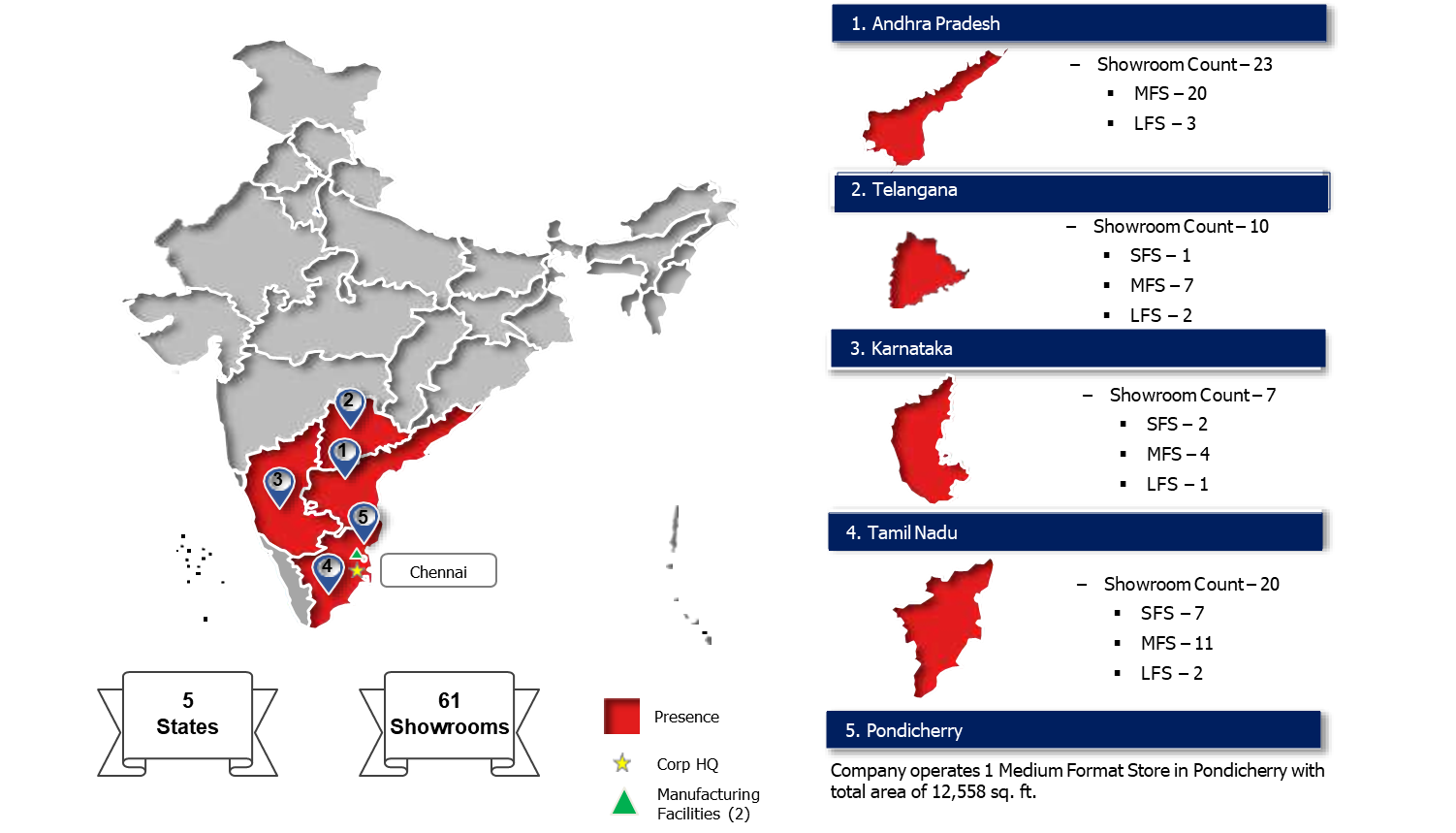
As of March 31, 2026, the Company operated 61 stores across 51 cities in Tamil Nadu, Andhra Pradesh, Telangana, Karnataka and the Union Territory of Puducherry, spread across a total operational area of 650,881 sq. ft. The store network expanded from 53 stores (FY2024) to 61 stores (FY2026). The Company positions itself as a mass-market, value-conscious brand, competing on affordable pricing enabled by in-house manufacturing, with high-purity gold (generally 18 carat or above) as its core proposition.
Lalithaa reported an operating revenue CAGR of 22.09% between FY2024 and FY2026, scaling revenue from operations from ₹16,788.05 Crore (FY2024) to ₹25,023.93 Crore (FY2026). The Company holds a distinctive competitive position: it recorded the highest operating revenue per store (₹410.23 Crore in FY2026) and the highest Operating EBITDA per store (₹27.43 Crore in FY2026) amongst key organised jewellery players in India.
Its strategy centres on Large Format Stores (>15,000 sq. ft.) and Medium Format Stores (5,000–15,000 sq. ft.), with 45 of 61 stores in Tier-II and Tier-III cities contributing ~60.25% of FY2026 revenue.
The Company operates in a structurally favourable market: the South Indian gems and jewellery retail market was valued at ₹5,026 billion in FY2026 (~40% of the total Indian market), and organised retail chains are projected to grow their market share from 37–42% (FY2026) to 45–50% by FY2030, positioning Lalithaa to capture the ongoing shift from unorganised to organised retail.
2. Business Model and Revenue Streams
Revenue Composition by Product
Lalithaa's revenue is overwhelmingly concentrated in gold jewellery, which has consistently contributed 92–95% of revenue from operations over the last three fiscals. Silverware and diamond jewellery form a small but growing complement.
| Product Type | FY2026 | % | FY2025 | % | FY2024 | % |
|---|---|---|---|---|---|---|
| Gold jewellery | 23,104.73 | 92.33% | 15,981.90 | 94.58% | 15,773.61 | 93.96% |
| Silver jewellery & articles | 1,658.85 | 6.63% | 673.71 | 3.99% | 652.60 | 3.89% |
| Others (silverware & diamond) | 260.35 | 1.04% | 241.71 | 1.43% | 361.85 | 2.16% |
| Total | 25,023.93 | 100% | 16,897.32 | 100% | 16,788.05 | 100% |
Revenue by Geography
The Company's revenue is anchored in Tamil Nadu (53.98% of FY2026 revenue), followed by Andhra Pradesh, with a well-diversified store presence across five southern states/UTs.
| State/UT | Stores (FY26) | Store Area (sq. ft.) |
|---|---|---|
| Tamil Nadu | 20 | 158,280 |
| Andhra Pradesh | 23 | 264,330 |
| Karnataka | 7 | 72,553 |
| Telangana | 10 | 143,160 |
| Puducherry | 1 | 12,558 |
| Total | 61 | 650,881 |
Pricing, Schemes and Customer Model
- Value-based mass-market pricing: Lalithaa competes primarily on affordable pricing and high gold purity, targeting price-conscious consumers in Tier-II/III markets and women (particularly working women) as its primary customer base.
- Advance-funded scheme model: The Company runs monthly instalment purchase schemes — 'Dhana Vandhanam' (₹1,000–₹10,000/month, 11-month plan with 50% bonus on one month's instalment) and 'Free-yo-Flexi' (up to ₹25,000/month, offering 100% discount on value-addition charges). As of FY2026, 473,412 customers were enrolled and active.
- Customer advances as a structural funding source: These schemes generated ₹5,042.75 Crore of customer advances in FY2026 (₹3,145.41 Crore in FY2025) — the highest amongst organised peers — providing forward visibility of sales and a low-cost working-capital funding base.
Operating Metrics and Concentration
- Store productivity leadership: Revenue per store of ₹410.23 Crore and Operating EBITDA per store of ₹27.43 Crore in FY2026 are the highest in the organised peer set.
- Supplier concentration risk: The top three suppliers of raw materials contributed 58.03% / 67.20% / 66.98% of total raw-material cost in FY2026/25/24 respectively — a meaningful dependency.
- Manufacturing dependency: In-house quality control relies on 816 Karigars (672 employed by the Company; 144 by Asita Jewellery Manufacturing on an exclusive basis) plus 296 Karigars on a non-exclusive basis.
3. Products and Service Portfolio
Core Product Lines
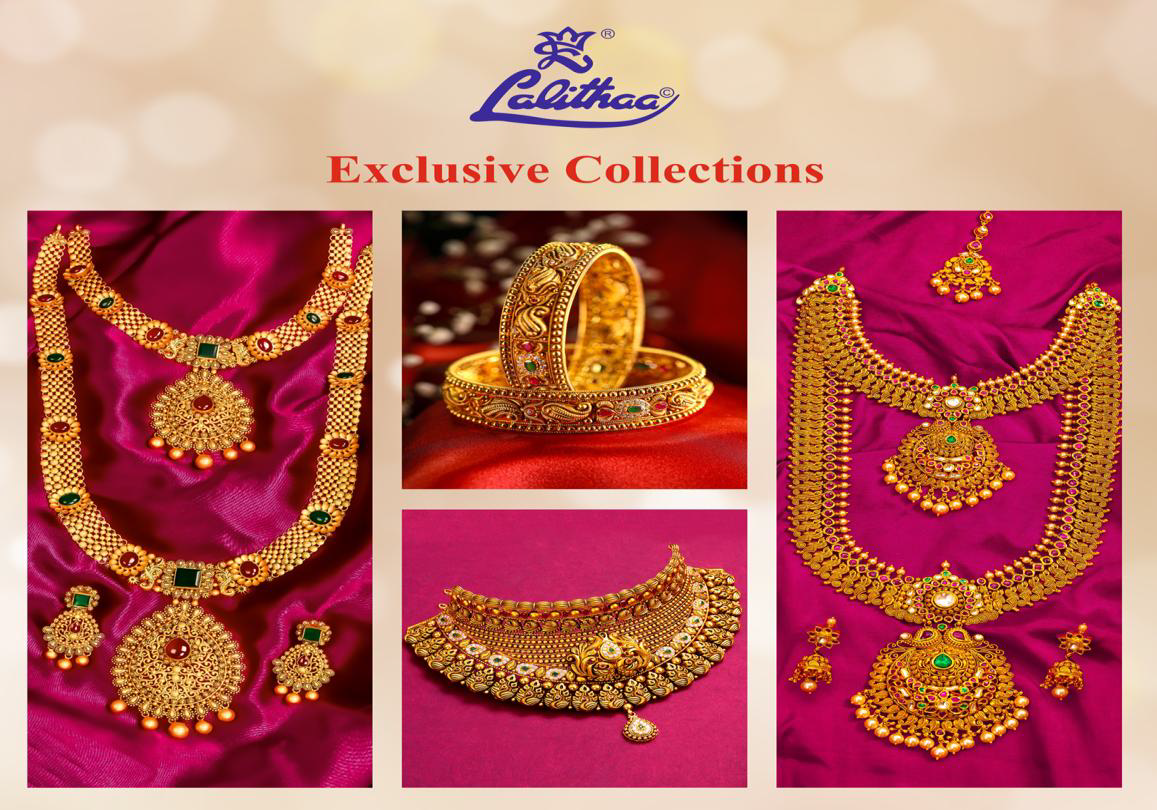
- Gold jewellery (92.33% of FY2026 revenue): The dominant, revenue-driving segment, spanning bridal, festive and daily-wear collections. Lalithaa has BIS-hallmarked all gold jewellery since 2019, ahead of the mandatory regime that began in May 2021.
- Silver jewellery and articles (6.63%): The fastest-growing segment, more than doubling from ₹673.71 Crore (FY2025) to ₹1,658.85 Crore (FY2026).
- Diamond and studded jewellery (within "Others", 1.04%): An emerging, higher-gross-margin category the Company intends to scale, widening the consumer base beyond plain gold.
Store Format Portfolio
The Company's format strategy is a core operational differentiator, enabling wide product display and scale:
| Format | Definition | Role |
|---|---|---|
| Large Format Store (LFS) | > 15,000 sq. ft. | Flagship showcase, drives footfall & scale |
| Medium Format Store (MFS) | 5,000–15,000 sq. ft. | Core network format |
| Small Format Store (SFS) | ≤ 5,000 sq. ft. | Selective presence |
Of 61 stores in FY2026, 51 stores exceed 5,000 sq. ft., of which 39 are in Tier-II and Tier-III cities. The Company operates one of India's largest jewellery stores at Vijayawada (~100,000 sq. ft. carpet area), plus large-format stores at Somajiguda (98,210 sq. ft.) and Vishakhapatnam (65,000 sq. ft.).
4. Key Business Strengths
- Regional dominance in a high-value market: Deep penetration of high-growth South Indian markets, which represent ~40% of India's total gems and jewellery demand, with revenue CAGR of 22.09% (FY2024–FY2026).
- Sector-leading store productivity: Highest operating revenue per store (₹410.23 Cr) and EBITDA per store (₹27.43 Cr) amongst organised peers in FY2026.
- Vertically integrated, cost-advantaged manufacturing: In-house design and manufacturing (816+ Karigars) enable affordable pricing and quality control, underpinning the value-brand positioning.
- Self-funding customer-advance model: Industry-highest customer advances (₹5,042.75 Cr in FY2026) from 473,412 active scheme customers provide sales visibility and low-cost working capital.
- Superior return ratios: Highest RONW (39.90%) and ROCE (42.60%) in the peer set for FY2026, reflecting efficient capital deployment.
- Tier-II / Tier-III brand pull: Strong trust and loyalty in smaller cities, with 45 of 61 stores in these markets contributing ~60.25% of FY2026 revenue.
- Trust and compliance credentials: BIS hallmarking of all gold jewellery since 2019 (ahead of the mandate) reinforces the value-and-transparency proposition.
5. Future Growth Strategy
- Store network expansion: Fund and open 10 new stores via the Fresh Issue proceeds — 5 in FY2027 and 5 in FY2028 — deepening presence in southern India and strengthening Tier-II/III coverage.
- Geographic densification: Enter new southern markets where current presence is low and develop untapped, unorganised-heavy markets for organised jewellery retail.
- Higher-margin product mix shift: Increase focus on studded and diamond gold jewellery, which carry a higher gross-margin profile and broaden the addressable consumer base.
- Sub-brand and product-line expansion: Explore new branded jewellery lines and sub-brands targeted at specific customer niches in gold and studded jewellery.
- Brand-building and marketing investment: Continue investing in brand awareness and footfall generation through occasion- and season-customised campaigns, leveraging the Promoter's on-screen brand presence.
- Customer-scheme leverage: Continue to expand 'Dhana Vandhanam' and 'Free-yo-Flexi' schemes to reinforce customer loyalty, repeat purchases and advance-funded cash flow.
- Capitalising on the organised-retail shift: Position as a reliable, affordable alternative to unorganised players to benefit from the projected rise in organised chain market share to 45–50% by FY2030.













Delete Comment?
Are you sure you want to delete this comment? This action cannot be undone.
Discussion
Join the discussion!
Log In to CommentNo comments yet. Be the first to share your thoughts!