Dhoot Transmission Limited — Business Analysis Report
Sector: Auto Ancillary — Electrical & Electronics (Wiring Harnesses)
1. Executive Overview
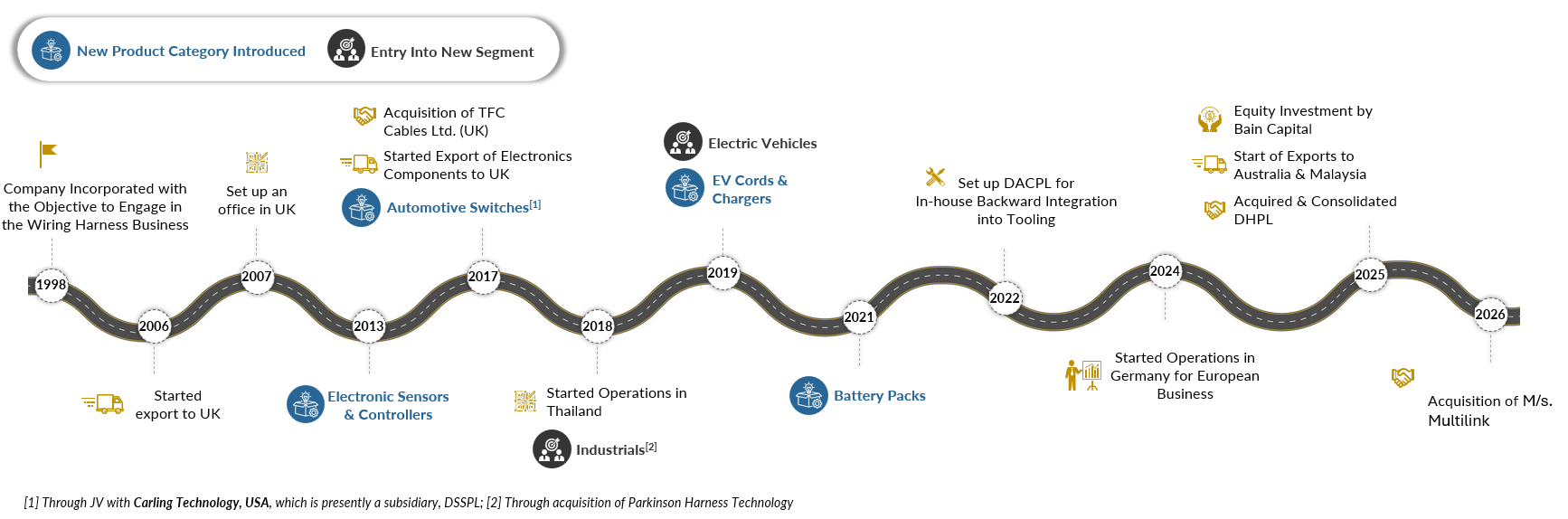
Dhoot Transmission Limited is one of India's leading electrical and electronics ("E&E") companies (Source: CRISIL Report), engaged in the design, engineering, manufacture and supply of critical wiring harnesses that integrate electronic sensors and controllers, switches, terminals, connectors, junction boxes, high-voltage interconnection systems and data cables. The Company delivers application-specific architectures across platforms, serving both automotive and non-automotive applications for original equipment manufacturers ("OEMs"). The Company traces its incorporation to 1998.
The Company holds an established leadership position in the domestic two-wheeler ("2W") and three-wheeler ("3W") wiring harness market. Its market share in Fiscal 2026 was approximately 41% by value in the combined 2W and 3W market in India, making it amongst the top two players. In the fast-growing electric 2W and 3W segments, the Company is a clear leader with a market share of close to 70% in Fiscal 2026 (Source: CRISIL Report). Beyond 2W and 3W, it has diversified into commercial vehicles ("CVs"), off-highway vehicles ("OHW"), and farming and industrial equipment.
Operationally, the Company had 22 operational manufacturing facilities, three engineering and design support centres and seven warehouses across India and key international locations as at March 31, 2026 (rising to 23 operational manufacturing units as at the date of the RHP, with two further plants under construction in India). Its footprint provides proximity to major automotive clusters in India and globally.
Competitively, the Company differentiates itself through backward integration into critical components (terminals, connectors, cables and moulded parts), architecture-agnostic products (approximately 95% of the auto product portfolio is EV-focused or powertrain-neutral), and deep integration into customers' new-product-development cycles, positioning it to benefit from long-term electrification and premiumization trends.
2. Business Model and Revenue Streams
Revenue by Product Category
The Company derives a substantial portion of its revenue from the sale of wiring harnesses, supplemented by an expanding "Others" basket (battery packs, sensors and electronic controllers, automotive switches, autocomponents, moulds and dies, scrap, and other materials). (Revenue in ₹ Cr)
| Core Product | FY2026 | % | FY2025 | % | FY2024 | % |
|---|---|---|---|---|---|---|
| Wiring harness | 3,487.72 | 77.08% | 2,687.01 | 78.00% | 2,292.04 | 81.93% |
| Others | 1,037.23 | 22.92% | 757.85 | 22.00% | 505.68 | 18.07% |
| Total | 4,524.96 | 100.00% | 3,444.86 | 100.00% | 2,797.73 | 100.00% |
Revenue by User Segment
| Segment | FY2026 | % | FY2025 | FY2024 |
|---|---|---|---|---|
| 2W sector (India) | 2,962.70 | 65.47% | 2,304.91 | 1,805.28 |
| 3W sector (India) | 581.78 | 12.86% | 430.50 | 327.57 |
| Others | 980.48 | 21.67% | 709.46 | 664.88 |
Geographic Mix
- Within India: ₹4,096.54 Cr (FY2026), the dominant revenue base.
- Outside India: ₹428.41 Cr (FY2026), giving international diversification via UK and other operations.
The Company derived 90.14% of revenue from contracts with customers within India in Fiscal 2026 — a concentration that is both a strength (domestic scale) and a risk (geographic dependence).
Contract Model and Client Concentration
The Company operates a B2B OEM supply model, engaging through a request-for-quotation ("RFQ")-to-order fulfilment process, and offers end-to-end solutions spanning design, prototyping, tooling, manufacturing and final assembly.
Client concentration is material: the top five customers contributed 71.56% and the top ten customers 80.93% of revenue from operations in Fiscal 2026.
The Company does not have firm, long-term volume commitments with its OEM customers — a structural feature of the auto-ancillary model that heightens dependence on repeat orders and program wins.
Supplier Dependency
Top five suppliers accounted for 33.32% and top ten suppliers 43.66% of raw material purchases (net) in Fiscal 2026, indicating moderate supplier concentration in a commodity-and-component-driven cost base.
3. Products and Service Portfolio
Core Product Lines
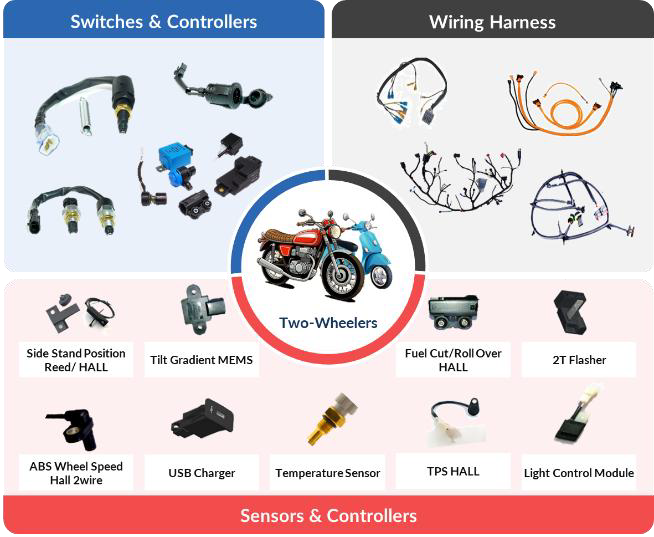
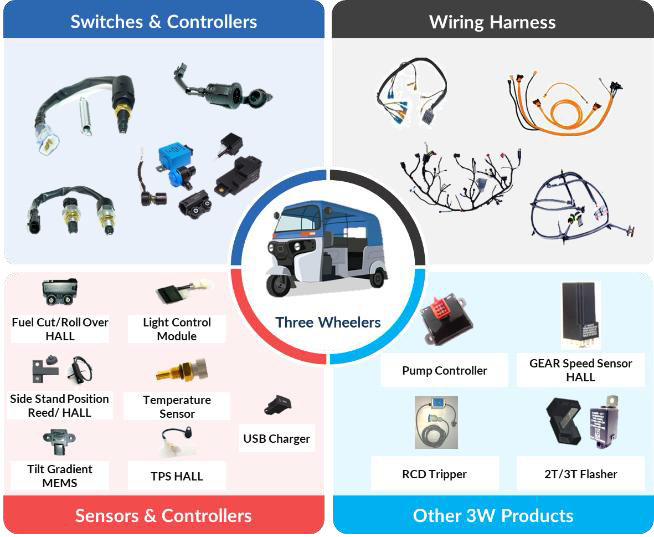
- Wiring harnesses — the flagship product, applied across 2W, 3W, CV, off-highway and non-automotive (boilers) segments, spanning both ICE and EV platforms.
- Battery packs — an EV-focused product line, primarily for the 2W segment.
- Sensors and electronic controllers — including ABS sensors, lean-angle sensors, USB chargers and light control modules; applied across ICE and EV, 2W/3W/CV.
- Automotive switches — across ICE and EV platforms in 2W, 3W and CV.
- Power supply cords, and products under development such as side-stand sensors and temperature sensors.
Approximately 95% of the auto product portfolio is EV-focused or powertrain-neutral, enabling applicability across ICE, hybrid and battery-electric architectures — a strategic hedge against powertrain transition risk. Notably, wiring harness content per 2W EV is approximately 1.5x to 2.5x that of a 2W ICE, driving structural growth in kit value per vehicle as electrification accelerates (2W EV penetration forecast to rise from 6.6% in FY2026 to 25–30% by FY2031).
Installed Capacity and Utilisation (FY2026)
| Core Product | Installed Capacity (units) | Capacity Utilisation |
|---|---|---|
| Wiring harnesses | 14,087,489* | 81.32% |
| Battery packs | 390,000 | 74.85% |
| Sensors and electronic controllers | 20,455,152 | 83.01% |
| Automotive switches | 5,475,000 | 23.98% |
*Capacity based on the generalised circuit count of a standard 2W wiring harness.
Aggregate manufacturing capacity utilisation was 74.26% in Fiscal 2026 (up from 64.22% in FY2025), signalling improving operating leverage while retaining headroom in switches. Certain facilities (Hosur, Tamil Nadu; Pithampur, Madhya Pradesh) already operate at high utilisation, underscoring the need for capacity expansion ahead of demand.
Quality and R&D Infrastructure
Facilities adhere to global standards including ISO 9001 (QMS), ISO 14001 (EMS), ISO 45001 (OHS) and IATF 16949 (automotive QMS).
The Company runs a structured new product development program (concept, design, simulation, prototyping, validation, serial launch) and has introduced products such as rollover sensors, wheel-speed sensors, dock chargers, keypad and rocker switches, and battery packs over the last five years.
Supported by in-house reliability and durability labs.
4. Key Business Strengths
- Established market leadership: Amongst the top two players in 2W and 3W wiring harnesses in India (~41% value share in FY2026), and a clear leader with ~70% share in the electric 2W and 3W segments.
- Extensive, mission-critical product portfolio: A broad, architecture-agnostic range where ~95% of auto products are EV-focused or powertrain-neutral, deeply embedded in customers' electrical systems and NPD cycles.
- Exposure to structural industry tailwinds: Positioned to capitalise on electrification, premiumization, automation/safety and connected-vehicle trends, each expanding kit value per vehicle.
- Marquee, diversified customer base: A strong business foundation with top-10 customer revenue of ₹3,662.24 Cr in FY2026, spread across a diversified end-market mix (2W, 3W, CV, off-highway, industrial).
- Backward integration and vertical control: In-house manufacture of terminals, connectors, cables and moulded parts lowers costs, secures supply, ensures quality control and shortens program launch timelines.
- Professional, experienced management, R&D team and marquee investor support (including a Bain Capital–affiliated corporate promoter, BC Asia XV).
5. Future Growth Strategy
- Capitalise on electrification and premiumization: Broaden the product portfolio across segments and technologies to drive greater content per vehicle and expand the customer base, with a strategic emphasis on the premium 2W category (150cc and above).
- Deepen design, R&D and engineering capabilities: Develop innovative systems and solutions and improve manufacturing efficiencies, reinforcing the Company's role in customers' new-product development.
- Invest ahead of demand through capacity expansion: Grow via a customer-proximate, modular and scalable manufacturing network, co-locating capacity near customer sites and backing new machinery and buildings with confirmed customer orders (part-funded by the IPO's Jhajjar and Hosur wiring-harness plants).
- Pursue selective inorganic expansion: Undertake disciplined acquisitions, joint ventures and technology partnerships to access next-generation technologies, deepen marquee-customer relationships, add new OEMs and expand across priority international markets (building on prior acquisitions to serve European and UK customers locally).
- Strengthen global footprint and business continuity: Leverage international bases to meet regional quality and regulatory standards, reduce delivery times and de-risk against changing cross-border trade policies.









































Delete Comment?
Are you sure you want to delete this comment? This action cannot be undone.
Discussion
Join the discussion!
Log In to CommentNo comments yet. Be the first to share your thoughts!