Horizon Industrial Parks Limited
Sector: Industrial & Logistics Real Estate (Warehousing / Grade A Infrastructure)
1. Overview
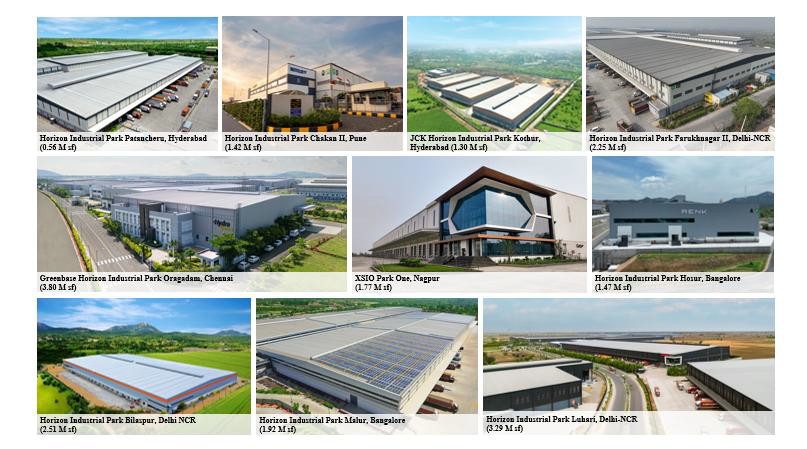
Horizon Industrial Parks Limited ("Horizon") is India's largest industrial and logistics infrastructure developer, owner and operator in terms of Total Network area (Source: JLL Report). The Company develops, owns and operates Grade A quality fulfilment centres (warehouses), industrial facilities and in-city centres across India's major industrial and consumption hubs, offering an end-to-end ecosystem designed to reduce customer time-to-market.
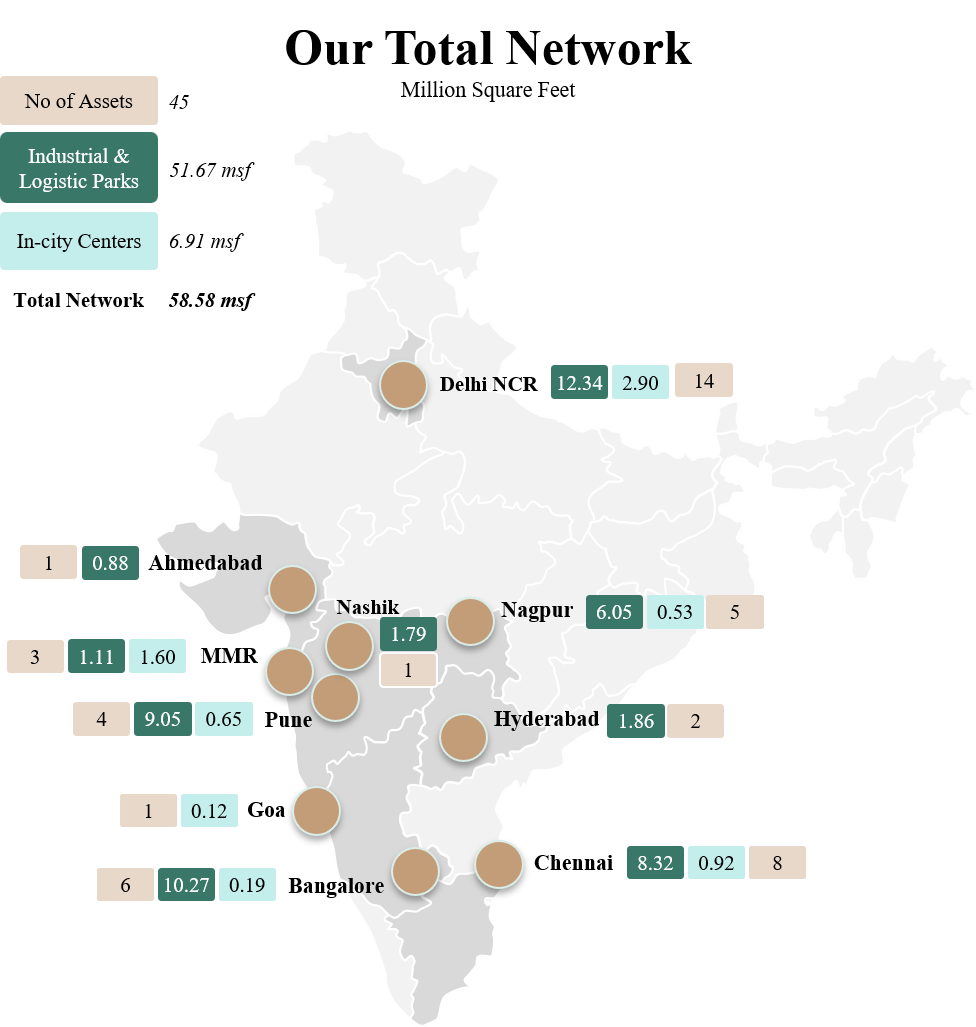
The Company's scale accelerated materially following the change in control to the Blackstone Group (its Promoters are Blackstone-affiliated BREP Asia entities). Prior to May 2021 the platform held only five assets; as of the date of the RHP, the pan-India Network comprised 45 assets across 10 cities totalling 58.58 million square feet ("msf") — subsequently rising to 46 assets and 61.13 msf including a 2.55 msf land parcel in Narsapura, Bangalore.
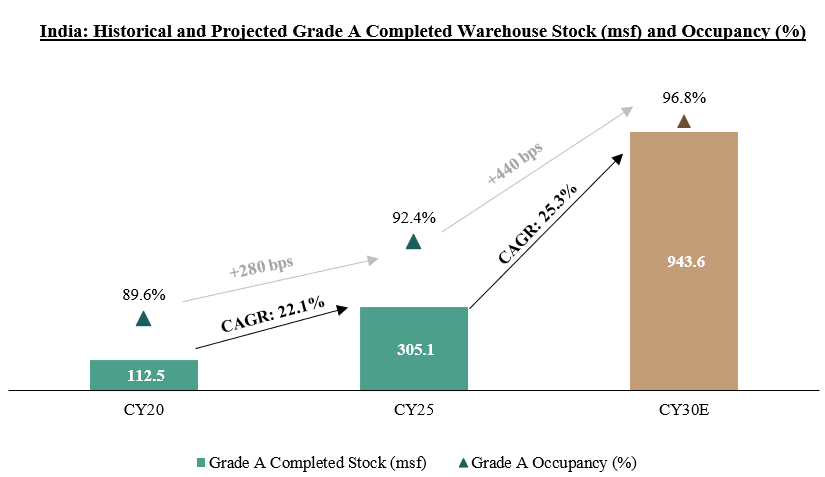
Geographically, operations are concentrated in India's principal industrial corridors — Delhi-NCR, Mumbai, Bangalore, Chennai, Pune, Hyderabad, Ahmedabad and Nagpur — with Delhi-NCR, Chennai, Bangalore and Pune together contributing 79.00% of restated revenue in Fiscal 2026. The Company is a proxy on India's manufacturing, consumption and e-commerce structural tailwinds, with the broader Grade A warehousing market projected to expand at a 25.3% CAGR from CY2025 to CY2030, potentially reaching 943.6 msf by CY2030 (Source: JLL Report).
Financially, Horizon remains in an investment-heavy, loss-making phase typical of a capital-intensive real estate developer scaling its asset base. Restated Revenue from Operations grew to ₹691.38 Crore in Fiscal 2026 (from ₹390.29 Crore in FY25 and ₹228.86 Crore in FY24), while EBITDA margins are structurally high at ~79% given the annuity-rental model. However, heavy finance costs and depreciation drove a restated loss after tax of ₹203.65 Crore in FY26. The IPO is a pure Fresh Issue deployed primarily toward debt repayment (₹2,250.00 Crore).
2. Business Model and Revenue Streams
Network Architecture
Horizon's portfolio is structured across three development stages, aggregating to its Total Network of 58.58 msf:
- Operational Network — completed, revenue-generating assets: 28.55 msf with a Committed Occupancy of 93.56% (as of May 31, 2026)
- Near Term Deliveries — projects under active development: 7.22 msf
- Planned Projects — projects with legal documentation secured: 22.81 msf
The Development Network of 30.03 msf (Near Term Deliveries + Planned Projects) is expected to be delivered over the next four to five years and represents the Company's growth pipeline. As of May 31, 2026, 2.57 msf had been pre-contracted to customers across eight locations.
Revenue Model
Horizon operates an annuity-style leasing model, deriving recurring rental income from long-term contracts with customers, supplemented by value-added services. Key characteristics:
- Contract structure: Long-term leases with Grade A and Grade A+ specification facilities, including built-to-suit and fully fitted plug-and-play configurations
- Tenant quality: As of May 31, 2026, 54.05% of the committed Operational Network was contracted to Fortune 500 companies (including end-tenants of 3PL clients), reflecting a premium, credit-worthy tenant base
- Value-added services: Turnkey solutions, energy solutions, on-site staff accommodation, skill development centres, cold storage infrastructure, racking & material handling equipment (MHEs) and on-site hospitality — these contribute directly to revenue streams and enhance tenant stickiness
Customer Base and Concentration
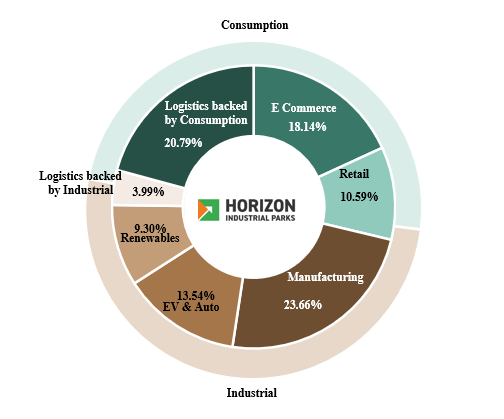
The Company serves a diversified & marquee client pool spanning consumption segments (e-commerce, quick-commerce, third-party logistics, FMCG, retail) and manufacturing segments (auto-ancillary, renewables, packaging and other manufacturing). Illustrative anchor relationships include an automotive-components manufacturer expanded across three locations (Delhi-NCR, Chennai, Hosur) and Fosroc's integrated chemical manufacturing and storage campus in Hyderabad.
Client concentration is a monitorable risk: the top 10 customers contributed 42.60% of revenue in Fiscal 2026 (largest customer 11.12%, top 3 20.96%, top 5 28.14%).
Revenue and Operating Performance
| Metric (₹ Crore unless stated) | FY2026 | FY2025 | FY2024 |
|---|---|---|---|
| Proforma Revenue from Operations | 691.38 | 609.42 | 452.85 |
| Restated Revenue from Operations | 691.38 | 390.29 | 228.86 |
| EBITDA (restated) | 607.80 | 339.12 | 151.51 |
| EBITDA Margin (restated) | 79.16% | 77.19% | 61.71% |
| Restated Loss After Tax | (203.65) | (178.78) | (162.21) |
| Total Network (msf) | 58.58 | 58.47 | 52.94 |
| Operational Network (msf) | 28.55 | 28.42 | 23.31 |
| Committed Occupancy (%) | 93.56% | 89.88% | 93.94% |
3. Products and Service Portfolio
Core Asset Categories
- Fulfilment Centres (Warehouses): Grade A / A+ warehousing forming the bulk of the Operational Network, serving e-commerce, 3PL and FMCG demand
- Industrial Facilities: Built-to-suit manufacturing and integrated industrial campuses (e.g., the Fosroc chemical manufacturing and storage campus)
- In-City Centres: A high-margin, scarcity-driven segment — the Company operates 17 in-city centres totalling 6.91 msf across seven metropolitan cities, described as the largest such network among its peers (Source: JLL Report). These provide access to a ready market of ~20 million end-consumers within a 10-to-30-minute drive and command significantly higher rents
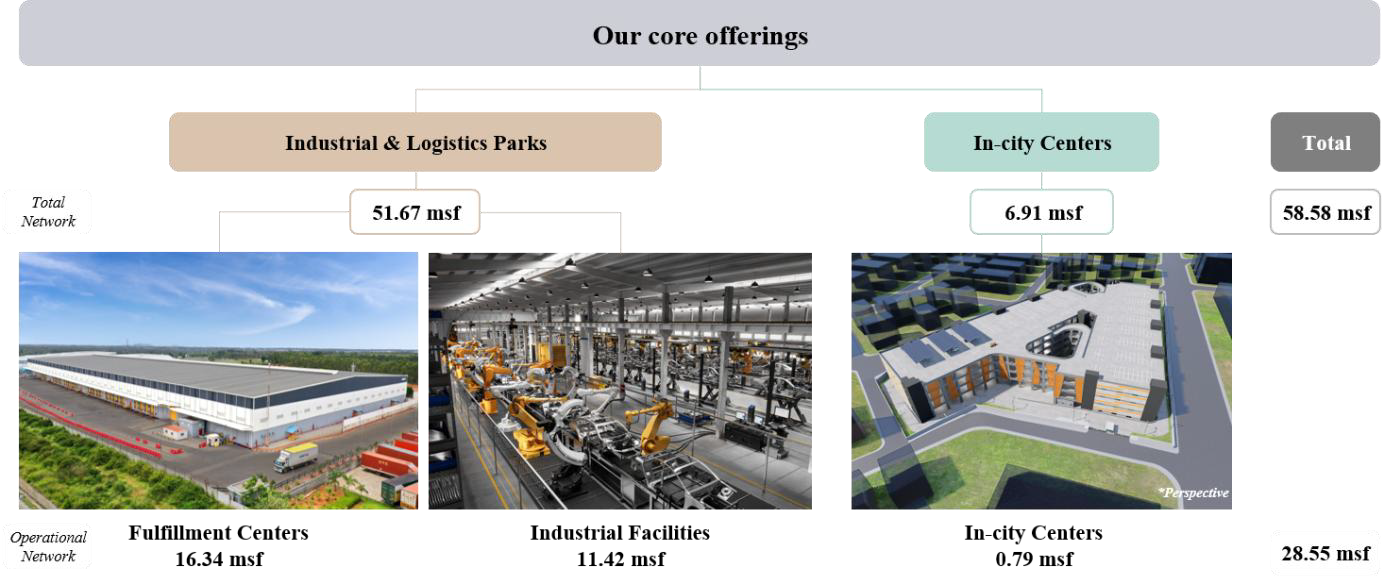
In-City Logistics — The Emerging High-Value Segment
In-city centres serve multiple use cases — last-mile delivery stations, micro-fulfilment centres, dark stores, direct-to-customer businesses, online pharma, cold storage, cloud kitchens, service centres, airline catering and large-format retail. Of the 17 in-city centres, three are operational and 14 are planned for development. The Company has secured 13 in-city sites on a long-term 45-year concession basis through a relationship with the Central Warehousing Corporation ("CWC"), creating a differentiated pipeline with high barriers to entry.
Integrated Value-Added Infrastructure
Facilities are embedded at construction stage with cold storage, compressed air systems, high-capacity electrical infrastructure, energy (including solar) solutions, on-site staff accommodation and material handling equipment, allowing tenants to operate a turnkey, plug-and-play operation.
Operating Metrics Snapshot
| Operating Metric | Value (latest disclosed) |
|---|---|
| Total Network | 58.58 msf (61.13 msf incl. Narsapura) |
| Operational Network | 28.55 msf |
| Committed Occupancy | 93.56% |
| Development Pipeline | 30.03 msf (7.22 Near Term + 22.81 Planned) |
| In-City Network | 6.91 msf across 17 centres / 7 metros |
| No. of Customers | 114 (FY2026) |
| Fortune 500 share of committed Operational Network | 54.05% |
4. Key Business Strengths
- Market Leadership & Scale: India's largest industrial and logistics developer by Total Network (58.58 msf across 45 assets in 10 cities), providing unmatched national reach and operating leverage.
- Blackstone Sponsorship: Promoter backing from the Blackstone Group provides global institutional expertise, capital access, corporate governance discipline and deal-sourcing advantage.
- Premium, Grade A+ Portfolio: High-specification assets engineered for efficiency, enabling premium rents and attracting blue-chip tenants.
- Marquee, Diversified Tenant Base: 54.05% of committed Operational Network leased to Fortune 500 companies, spread across consumption and manufacturing segments, reducing sector-specific risk.
- High-Occupancy Annuity Model: 93.56% Committed Occupancy on the Operational Network underpins visible, recurring rental cash flows.
- Structurally High Margins: ~79% EBITDA margin reflects the capital-light operating cost structure of a stabilised rental platform.
- Differentiated In-City Franchise: Largest in-city network among peers (6.91 msf / 17 centres), with a 45-year CWC concession for 13 sites creating a scarce, high-barrier growth engine.
- Embedded Industry Tailwinds: Direct leverage to India's manufacturing push, rising consumption and low (6.1%) e-commerce penetration versus ~37% in developed markets.
5. Future Growth Strategy
- Expand the In-City Logistics Network: Build out the remaining 14 planned in-city centres across major metros, capitalising on last-mile demand, scarcity-driven rental growth and the CWC concession pipeline.
- Execute the 30.03 msf Development Pipeline: Convert 7.22 msf of Near Term Deliveries and 22.81 msf of Planned Projects into operational, revenue-generating assets over the next four to five years.
- Acquisition-Led Growth on Sustainable Debt: Continue accretive asset and land acquisitions supported by strong operating cash flows and a de-levered post-IPO balance sheet (total borrowings reducing from ₹6,884.34 Crore to ₹4,634.34 Crore using Net Proceeds).
- Deepen Fortune 500 Relationships: Grow wallet share through multi-location expansions with existing marquee tenants and cross-sell value-added services.
- Broaden the Value-Added Services Suite: Scale energy solutions, cold storage, staff accommodation and turnkey offerings to lift per-asset yields and tenant retention.
- Capture Structural Market Growth: Position the Development Network to benefit from the projected 25.3% CAGR expansion of India's Grade A warehousing stock through CY2030.














Delete Comment?
Are you sure you want to delete this comment? This action cannot be undone.
Discussion
Join the discussion!
Log In to CommentNo comments yet. Be the first to share your thoughts!