1. Executive Overview
Operating under the flagship brand “AEROPLANE,” the Company is a leading integrated processor and exporter of basmati rice and FMCG products, with over four decades of industry experience. It operates across the entire value chain—from procurement and ageing to milling and distribution—focusing on premium rice and essential kitchen staples. Ranked among the top players in its segment, the Company has a strong global presence across India and 38+ countries, especially in the Middle East, supported by manufacturing facilities in Punjab, Haryana, and New Delhi.
The Company stands out due to its strong brand recognition, extensive trademark portfolio, and specialised rice ageing process, which enables premium pricing. By expanding beyond basmati rice into high-margin FMCG products, it is steadily evolving from a commodity-based business into a diversified, branded food company.
2. Business Model and Revenue Streams
- Business Model:
The Company uses a hybrid model combining:
B2C: Selling branded products to end consumers through shops and distributors
B2B/D2C: Supplying bulk quantities to businesses and exporting directly
This model helps the Company reach a wider customer base and diversify revenue sources.
2. Revenue Breakdown by Segment
This shows which products generate revenue:
Rice segment (~99.39%) is the core business and main income source
FMCG (~0.22%) is very small and still growing
The Company is currently highly dependent on rice, with limited diversification.
3. Geographic Revenue Profile
This explains where the revenue comes from:
Domestic (India): ~67.57%
Exports: ~32.43%, mainly Middle East
A balanced mix reduces risk and gives access to global demand.
4. Distribution & Channel Strategy
This explains how products reach customers:
Offline channels dominate (99.85%)
Strong distributor network (India + international)
The Company depends on traditional supply chains rather than online sales.
5. Vendor Dependency & Procurement Strategy
This shows how raw materials are sourced:
Purchases done via procurement agents (middlemen)
98.4% sourcing through agents
High dependence on top suppliers (Top 10 = ~65%)
Indicates efficiency but also risk if key suppliers are lost.
6. Industry-Specific Operating Metrics
These are important performance indicators:
Inventory Days (161): Rice is stored longer for ageing → better quality & higher price
Working Capital Days (208): Money is blocked in inventory and operations
Debt-to-Equity (1.68x): Moderate borrowing used to fund operations
Shows the business is capital-intensive but supports premium pricing strategy.
Financial Performance by Product Category (₹ in million)
| Product Category | H1 FY26 (Sep 30, 2025) | % of H1 FY26 Revenue | Fiscal 2025 | % of FY25 Revenue | Fiscal 2024 |
|---|---|---|---|---|---|
| Rice | 10,121.20 | 99.39% | 19,651.08 | 99.07% | 15,094.52 |
| FMCG | 22.46 | 0.22% | 43.15 | 0.22% | 29.12 |
| Others (By-products) | 41.16 | 0.39% | 141.45 | 0.71% | 116.37 |
| Total Revenue | 10,184.82 | 100.00% | 19,835.68 |
3. Products and Service Portfolio
The Company curates a diverse food portfolio designed to capture consumers across the entire pricing spectrum, from value-conscious buyers to premium luxury segments.
- Basmati Rice (Primary Revenue Driver): * Premium Segment: Aged for 12 to 24 months to enhance aroma and grain length. Key brands include Aeroplane La-Taste, Aeroplane Classic, and Ali Baba.
- Medium Segment: Aged for 3 to 9 months. Key brands include Aeroplane Metro and World Cup.
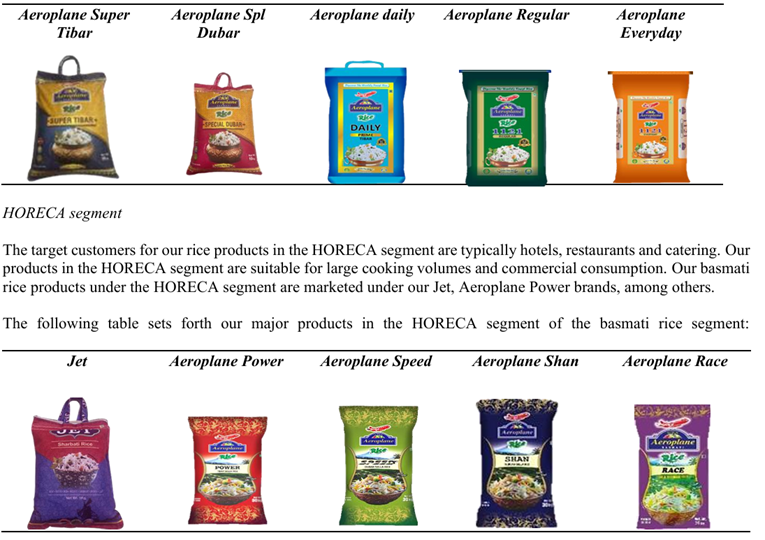
- Value Segment: Shorter grain varieties catering to economic daily consumption. Brands include Aeroplane Spl Dubar and Aeroplane Everyday.
- HORECA Segment: Bulk packaging optimized for Hotels, Restaurants, and Catering. Key brand: Jet.
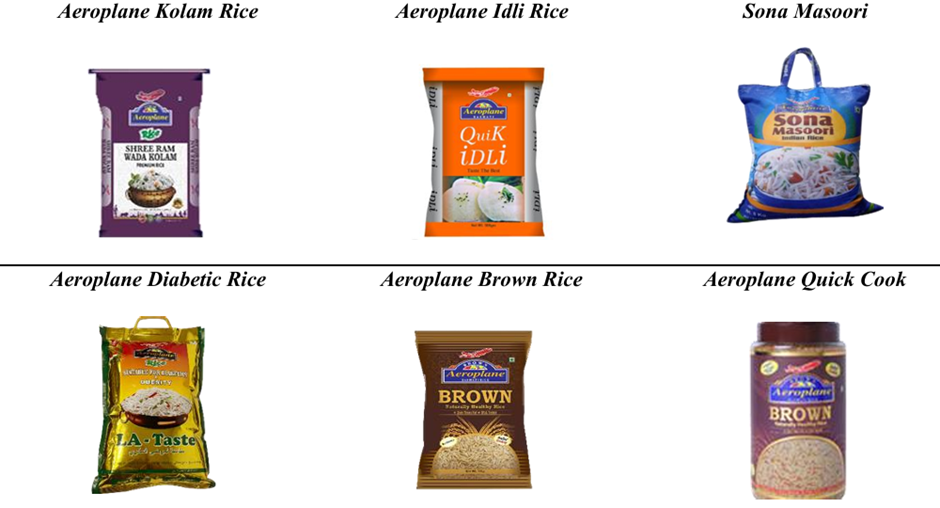
- Specialty Rice: Nutrient-focused and regional varieties including Kolam, Sona Masoori, Brown Rice, and Diabetic Rice.
- FMCG Products (Emerging Segment): A rapidly expanding portfolio of kitchen staples marketed under the "AEROPLANE" brand, including Atta, Maida, Besan, Sooji, Salt, and Sugar.
Key Operational Data: Installed Capacity & Utilization
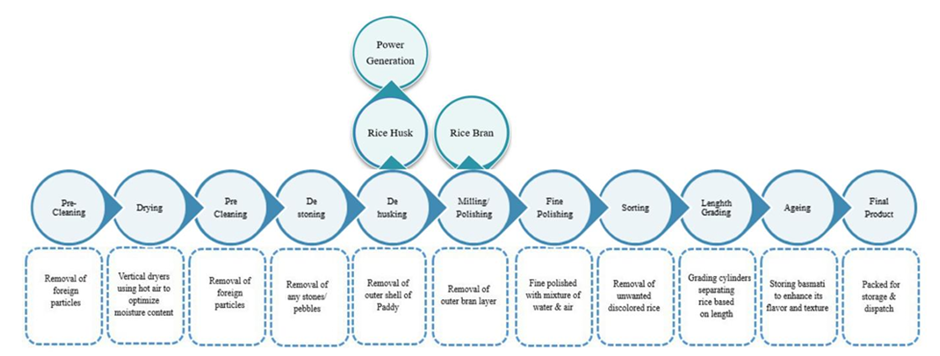
The Company operates advanced, fully automated milling machinery imported from Japan, Germany, and the United States, supporting significant headroom for growth without immediate heavy CapEx.
| Operational Metric | H1 FY26 (Sep 30, 2025)* | Fiscal 2025 | Fiscal 2024 | Fiscal 2023 |
|---|---|---|---|---|
| Installed Capacity (MT) | 550,800 | 550,800 | 550,800 | 550,800 |
| Actual Production (MT) | 134,226 | 277,908 | 196,393 | 178,690 |
| Capacity Utilization (%) | 24.37% | 50.46% | 35.66% | 32.44% |
| Paddy Storage Capacity | 140,000 MT | 140,000 MT | 140,000 MT | 140,000 MT |
| Rice Storage Capacity | 130,000 MT | 120,000 MT | 120,000 MT |
4. Key Business Strengths
1. Established Market Leadership
The Company ranks among the top three players in its segment by revenue, supported by a strong 40-year legacy. Its well-recognized “AEROPLANE” brand enhances customer trust and enables premium pricing.
2. Strategically Located Infrastructure
Manufacturing facilities in Punjab, Haryana, and Delhi are located close to key basmati paddy markets. This ensures efficient procurement and significantly reduces logistics and transportation costs.
3. Fully Integrated Value Chain
The Company manages the entire process from procurement and ageing to processing, packaging, and distribution. This end-to-end control ensures consistent quality, cost efficiency, and adherence to food safety standards.
4. Extensive Global and Domestic Reach
With a network of 431 domestic distributors and exports to over 38 countries, the Company has a diversified market presence. This reduces reliance on any single geography and supports stable revenue generation.
5. Robust Financial Profile
The Company demonstrates strong financial performance with an EBITDA margin of 10.36% and a Return on Equity (ROE) of 11.87% in H1 FY26, indicating healthy profitability and efficient capital utilization.
5. Future Growth Strategy
1. Aggressive Brand Premiumization
The Company plans to strengthen its brand through increased marketing efforts, including advertising, celebrity endorsements, and digital campaigns, aiming to improve brand positioning and margins.
2. Tier-3 and Tier-4 Expansion
It intends to expand its distributor network from 431 to over 700 by FY28, focusing on semi-urban and rural markets to capture untapped demand.
3. FMCG Portfolio Diversification
The Company aims to expand into high-margin FMCG products such as pulses, cooking oils, ghee, honey, and pasta, reducing dependency on rice and enhancing revenue streams.
4. Capacity Utilization Improvement
With current utilization at around 50%, the Company plans to increase production using existing infrastructure. This will improve operating efficiency and reduce per-unit costs.
5. E-Commerce and D2C Growth
The Company is focusing on online channels, modern trade, and quick-commerce platforms to align with changing consumer behavior and improve direct customer reach and profitability.
If you want, I can also make this into concise bullet points for quick revision.




















Delete Comment?
Are you sure you want to delete this comment? This action cannot be undone.
Discussion
Join the discussion!
Log In to CommentNo comments yet. Be the first to share your thoughts!