Manipal Health Enterprises Limited — Business Report
Sector: Healthcare Delivery / Multispecialty Hospital Networks
1. Overview
Manipal Health Enterprises Limited operates a pan-India network of multispecialty hospitals delivering a comprehensive range of care services, spanning outpatient consultations through to complex tertiary and quaternary interventions. The Company was incorporated in Bengaluru, Karnataka on February 15, 2010. Its operating legacy, however, traces back to 1991, with the launch of its flagship facility, Manipal Hospital Old Airport Road, Bengaluru, and further to the Manipal Group founded by Dr. T. M. A. Pai and advanced by Dr. Ramdas Pai and Dr. Ranjan Ramdas Pai.
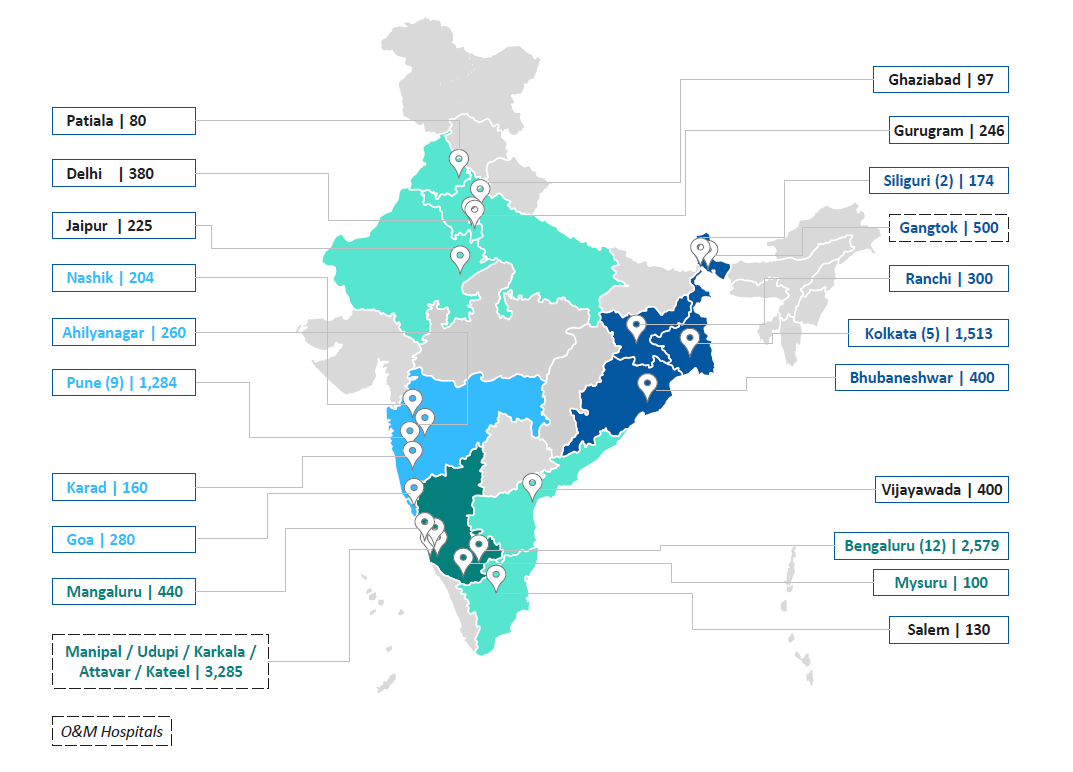
As of March 31, 2026, the Company operated 49 hospitals with 13,037 licensed beds across 14 states and union territories, making it the largest pan-India multispecialty hospital network by bed capacity and the second largest hospital chain by number of hospitals (Source: CRISIL Report). For Fiscal 2026, it reported the second-highest revenue from operations of ₹10,335.75 crores (₹10,935.62 crores on a pro forma basis) among private hospital chains in India. Of the total licensed beds, 9,252 beds across 43 hospitals are owned, while 3,785 beds across six hospitals are operated under O&M agreements. The network is supported by 2,972 ICU beds and 338 operating theatres.
Geographically, the Company is anchored in three key regions: Karnataka (6,404 licensed beds), Maharashtra and Goa (2,188 beds), and West Bengal, Odisha, Jharkhand and Sikkim (2,887 beds) — holding the leading position among private hospital chains in each. It is the only private hospital chain in India to lead in three metro markets — Bengaluru, Kolkata and Pune — by bed capacity (5,376 beds). Notably, the Company maintains a deliberate metro/non-metro balance, with 46.78% of licensed beds in metros and 53.22% in non-metros. Karnataka remains a concentration point, contributing 46.40% of Fiscal 2026 revenue from operations.
The Company served 7.63 million patients in Fiscal 2026 and had 11,064 doctors available across its hospitals, alongside an employee base of 24,240. Growth has been driven by a combination of organic expansion and a repeatable acquisition playbook — the network expanded from 33 hospitals / 9,520 beds (March 2024) to 49 hospitals / 13,037 beds (March 2026). Its shareholder base includes indirect wholly owned subsidiaries of Temasek Holdings, TPG SG Magazine Pte. Ltd. and Novo Holdings Invest Asia A/S.
2. Business Model and Revenue Streams
Revenue Composition and Scale
Revenue from operations grew at a CAGR of 29.41% from ₹6,171.63 crores in Fiscal 2024 to ₹10,335.75 crores in Fiscal 2026, while profit for the year grew at a CAGR of 31.11% from ₹533.20 crores to ₹916.52 crores. EBITDA (excluding exceptional items) increased at a CAGR of 25.45% from ₹1,776.60 crores to ₹2,795.94 crores.
| Financial Metric | Unit | FY2026 | FY2025) | FY2024) |
|---|---|---|---|---|
| Revenue from Operations | ₹ Crores | 10,335.75 | 8,242.25 | 6,171.63 |
| Revenue Growth | % | 25.40% | 33.55% | 27.52% |
| Profit for the Year | ₹ Crores | 916.52 | 1,081.67 | 533.20 |
| PAT Margin | % | 8.87% | 13.12% | 8.64% |
| EBITDA (excl. exceptional) | ₹ Crores | 2,795.94 | 2,247.07 | 1,776.60 |
| EBITDA Margin | % | 27.05% | 27.26% | 28.79% |
| Adjusted EBITDA Margin | % | 25.58% | 26.27% | 27.49% |
| ROCE | % | 21.88% | 26.98% | 27.74% |
| Net Debt / Adjusted EBITDA | times | 3.74 | 2.00 | 2.15 |
| Material Cost to Revenue | % | 20.47% | 20.38% | 20.27% |
Geographic Revenue Mix
| Region | FY2026 (₹ Cr) | % of Revenue | FY2025 (₹ Cr) | % of Revenue | FY2024 (₹ Cr) | % of Revenue |
|---|---|---|---|---|---|---|
| Karnataka | 4,795.38 | 46.40% | 4,248.58 | 51.55% | 3,701.84 | 59.98% |
| Eastern India | 2,317.16 | 22.42% | 1,826.96 | 22.17% | 687.33 | 11.14% |
| Rest of India | 2,032.08 | 19.66% | 1,701.78 | 20.65% | 1,438.93 | 23.31% |
| Maharashtra & Goa | 1,191.13 | 11.52% | 464.94 | 5.63% | 343.54 | 5.57% |
| Total | 10,335.75 | 100.00% | 8,242.25 | 100.00% | 6,171.63 | 100.00% |
Payor Mix — Concentration Risk
The revenue model carries meaningful payor concentration. Insurance and Third-Party Administrators (TPAs) accounted for 49.68% of gross inpatient revenue in Fiscal 2026 — a proportion that has remained remarkably stable (49.18% in FY2025, 49.45% in FY2024). Cash-paying patients contributed 30.33%, government schemes 13.80%, and others (corporate payors and international patients) 6.19%. This dependence on non-cash institutional payors introduces collection-cycle and contract-renewal exposure.
Operating Metrics — Core Value Drivers
| Operational Metric | Unit | FY2026 | FY2025 | FY2024 |
|---|---|---|---|---|
| Number of Hospitals | Number | 49 | 37 | 33 |
| Licensed Beds | Number | 13,037 | 10,494 | 9,520 |
| Operational Beds | Number | 6,227 | 5,179 | 4,055 |
| Occupancy | % | 64.47% | 67.09% | 65.32% |
| ARPOB | ₹ per day | 68,937.61 | 63,312.23 | 61,741.68 |
| Average Length of Stay (ALOS) | Days | 2.78 | 2.88 | 2.93 |
| Inpatient Volumes | Footfalls | 527,227 | 439,724 | 330,725 |
| Outpatient Volumes | Footfalls | 5,483,403 | 4,717,313 | 3,810,672 |
| Employee Count | Number | 24,240 | 19,707 | 15,778 |
Two operational signals deserve analytical attention. ARPOB rose 8.89% to ₹68,937.61 per day in Fiscal 2026, reflecting improved case mix and pricing. Simultaneously, ALOS compressed to 2.78 days from 2.93 in Fiscal 2024 — a throughput gain achieved despite rising CONGO-R complexity, which typically lengthens stays. Conversely, occupancy declined to 64.47% from 67.09%, largely a function of newly acquired and newly commissioned beds still in ramp-up.
Working Capital and Cost Discipline
The Company operated a negative working capital cycle of 13 days in Fiscal 2026 (negative 16 days in Fiscal 2025). Material cost to revenue was held at 20.47%, broadly flat across three fiscals — evidence of procurement discipline at scale.
Digital Channel Contribution
Digital revenue accounted for 21.58% of total revenue from operations on a consolidated basis in Fiscal 2026, sourced from appointments booked via the Company's website, mobile application, external mapping platforms, appointment aggregators and other digital channels.
3. Products and Service Portfolio
CONGO-R — The Core Clinical Franchise
The Company's clinical strategy centres on six high-acuity specialties collectively termed CONGO-R: Cardiac sciences, Oncology, Neurosciences, Gastro sciences, Orthopedics, and Renal sciences. These accounted for 64.30% of gross inpatient revenue (₹5,030.95 crores) in Fiscal 2026, up from 61.55% (₹2,839.65 crores) in Fiscal 2024 — a deliberate mix shift toward complex, higher-realisation care.
| Specialty | FY2026 | FY2025 | FY2024 |
|---|---|---|---|
| Cardiac Sciences | 16.27% | 15.74% | 15.24% |
| Orthopedics | 12.87% | 12.52% | 12.93% |
| Oncology | 11.60% | 10.24% | 8.87% |
| Neurosciences | 9.07% | 9.15% | 9.12% |
| Renal Sciences | 7.34% | 7.55% | 7.76% |
| Gastro Sciences | 7.15% | 7.36% | 7.63% |
| Others | 35.70% | 37.44% | 38.45% |
Oncology is the standout growth vector, expanding from 8.87% to 11.60% of gross inpatient revenue over three fiscals — the sharpest gain across the portfolio.
Installed Technology Base (as of March 31, 2026)
| Equipment / Platform | Installed Count |
|---|---|
| Catheterization Laboratories | 58 |
| CT Scanners | 54 |
| MRI Scanners | 44 |
| Orthopedic & Spine Robots | 23 |
| Soft-Tissue Surgical Robots | 18 |
| LINACs (Radiation Oncology) | 19 |
| PET-CT Scanners | 15 |
| EUS / EBUS Platforms | 34 |
| Brachytherapy Units | 8 |
| Ultrasound & Echocardiography Systems | 391+ |
| Tomotherapy Systems | 2 |
Adjacent Service Lines
- Diagnostics: Delivered across 18 states through subsidiary HealthMap Diagnostics Private Limited, under the brand "ManipalTRUtest", via PPP, B2B and B2C channels.
- Clinics: 21 outpatient clinics operated as of March 31, 2026, providing consultations, basic diagnostics and follow-up care.
- MARS (Manipal Ambulance Response Service): 102 ambulances deployed across 16 cities, comprising ACLS and BLS units coordinated through a 24/7 command centre, extending to air and train ambulance services.
- E-Pharmacy: Operational across 23 hospitals with over 5,000 orders processed monthly, integrated with the hospital information system and payment gateways.
- Telehealth: 36,282 virtual consultations completed between April 2025 and March 2026, plus 3,861 tele-health kiosk screenings.
- Home Healthcare: Sample collection, vaccinations, physiotherapy, nursing services and medical equipment rental across network cities.
Academic and Research Platform
The Company hosts DNB, DrNB and FNB programs with over 343 training seats across 25 hospitals and 42 specialties, supporting 785 students. Over the last five years, affiliated clinicians produced 1,163 publications in indexed journals and supported 209 research and clinical trials, overseen by 15 registered ethics committees.
Accreditation Status
41 of 49 hospitals were NABH-accredited/certified and 24 hospital labs were NABL-accredited as of March 31, 2026.
4. Key Business Strengths
- Scale Leadership: Largest pan-India multispecialty hospital network by bed capacity with 13,037 licensed beds and the second-largest by hospital count as of March 31, 2026.
- Tri-Metro Dominance: The only private hospital chain in India leading three metro markets — Bengaluru, Kolkata and Pune — with a combined 5,376 beds, an unmatched structural position.
- Regional Density: Leading private chain in Karnataka, Maharashtra & Goa, and the eastern India cluster of West Bengal, Odisha, Jharkhand and Sikkim, producing referral catchment depth beyond city limits.
- Balanced Metro/Non-Metro Footprint: 46.78% metro / 53.22% non-metro bed split, allowing quaternary-grade infrastructure to be monetised in lower-competition non-metro markets.
- High-Acuity Case Mix: CONGO-R specialties at 64.30% of gross inpatient revenue, improving realisation per bed while ALOS compressed to 2.78 days.
- Demonstrated Financial Trajectory: Revenue CAGR of 29.41% and PAT CAGR of 31.11% across Fiscals 2024–2026, with the highest revenue growth among major listed hospital players over the period.
- Working Capital Efficiency: Negative 13-day working capital cycle in Fiscal 2026, with material cost held stable at 20.47% of revenue.
- Proven Acquisition Playbook: Columbia Asia (2021), Vikram Hospitals (2021), AMRI (2023), Medica Synergie (2024) and Sahyadri Group (2025) integrated sequentially; Columbia Asia's EBITDA margin improved from 30.51% to 33.78% between Fiscals 2024 and 2026.
- Brand Equity: Manipal Hospital Old Airport Road rated the No. 1 hospital in Bengaluru for 20 consecutive years (2005–2025) by The Week–Hansa Survey.
- Clinical Technology Depth: 58 catheterization labs, 41 surgical robots, 44 MRI and 54 CT scanners, including among the highest reported volumes of robotic-assisted spine surgery in India (~1,750 surgeries).
- Institutional Shareholder Backing: Sustained decade-long support from Temasek, TPG and Novo Holdings, reinforcing governance and capital allocation discipline.
5. Future Growth Strategy
- Organic Bed Expansion to 2030: Plans to add approximately 483 licensed beds via brownfield additions at existing hospitals and approximately 1,943 licensed beds through greenfield projects — a pipeline of roughly 2,426 beds, representing ~18.6% capacity expansion.
- Occupancy Headroom Monetisation: With occupancy at 64.47%, the Company intends to drive incremental volume through existing infrastructure without material capital expenditure, adding beds only as facilities approach the ~70% occupancy trigger.
- Case Mix Escalation: Continued shift toward high-end complex procedures within CONGO-R, aligned to the WHO's projected rise in non-communicable disease incidence in India through Fiscal 2030.
- Targeted Geographic Expansion: Deepening leadership in Karnataka, Maharashtra & Goa and eastern India, while building presence in Delhi NCR, central India, Ranchi (Jharkhand) and Bhubaneswar (Odisha).
- Continued Inorganic Consolidation: India's hospital market remains fragmented, with large private hospitals accounting for only ~20% of the overall market in Fiscal 2026. A non-binding term sheet for a Karnataka hospital acquisition was signed in June 2026; further targets under evaluation across Telangana, Kerala, Andhra Pradesh and Chhattisgarh.
- Medical Tourism Capture: Focused build-out in Bengaluru, Kolkata and Delhi, with intended entry into Mumbai, targeting inbound patients from the Middle East, Africa and South Asia.
- Digital and AI Scale-Up: Extension of the "physical-plus-digital" model on a unified hospital information system — 1,809 hyperlocal SEO pages, AI-enabled nursing handovers at 24 hospitals (~2.41 million handovers July 2025–March 2026), live clinical dashboards at 14 hospitals, and the "MAI" AI health companion.
- Out-of-Hospital Care Expansion: Scaling telehealth, e-pharmacy, tele-health kiosks and home healthcare to extend the care continuum beyond physical facilities.
- Clinical Talent Pipeline: A consultant model that avoids prescribing revenue targets to doctors, combined with multi-location practice opportunities, expanded DNB residency and fellowship pathways, and nursing institute partnerships across multiple states.
- Procurement and Supply Chain Leverage: Continued vendor consolidation, batch verification and cold-chain protocols to sustain material cost at approximately 20% of revenue as the network scales.




























Delete Comment?
Are you sure you want to delete this comment? This action cannot be undone.
Discussion
Join the discussion!
Log In to CommentNo comments yet. Be the first to share your thoughts!